Body Electrical System
Description and Operation
In this manual: Body Electrical System
27steps
~162min
4/5difficulty
Done 0 of 27
Description
The SMART KEY system allows the user to access and operate the vehicle conveniently. No traditional key or remote control is required to access the vehicle. The user carries the SMART KEY FOB, which requires no deliberate action by the user (such as pressing the RKE button). The SMART KEY system is activated by pressing the button on the door handle. After activation, the vehicle sends a request within a limited area. If the SMART KEY FOB receives this request, it automatically sends a response to the vehicle. The system then decides whether to perform a specific action (unlock, lock, etc.) or remain inactive. Similarly, the electronic steering column lock (ESCL) is released. Again, communication between the vehicle and the SMART KEY FOB is required before any action. The system has the following features:- Passive Unlock via Driver and Passenger Door
- Passive Lock via Driver and Passenger Door
- Passive Start
- Passive Trunk Access via Trunk Switch at Trunk Level
- Passive Lock via Liftgate
- The system can use no more than 2 FOBs
- Driver Emergency Immobilizer Antenna, integrated into the SSB for TP authentication (for example, driving emergency mode)
- Communication with Engine Management System
- Communication with SRX
- AVG-AVD Communication
- Passive Unlock. The system allows the user to access the vehicle without performing a specific action (unlocking) using the SMART KEY FOB. This function may differ depending on the platform, as follows:
- Press the Door Handle Button
- Passive Lock. The system allows the user to lock the vehicle by pressing the button located on the door handle using the SMART KEY FOB.
- Power Button. The system allows the user to release the ESCL and change power modes (Off, Accessory, Ignition), as well as start and stop the vehicle engine without performing any specific action using the SMART KEY FOB. See the specifications for the engine start system button.
- RECOVERY DRIVING MODE. In addition, the system provides a so-called "recovery driving mode", which means that the user can operate all vehicle functions by inserting the key into the SSB.
- POWER SOURCE
- Flash Memory Microcontroller
- Single-Wire Interface to SRX
- Single-Wire Interface to EMS
- Initial Stage
- AvG Amplifier/Antenna Driver
- CAN Communication with BCM
- Passive function: receives the AvG request and automatically sends the AvD response.
- Conventional RKE function using up to 4 buttons (press).
- Transponder function in case of battery discharge or communication failure.
- AvG antennas transmit: Inductive antennas in and on the vehicle are used to convert current, controlled by the SMK ECU antenna driver, into a magnetic field at 125 (or 134.2) kHz, the SMART KEY request carrier. Three antennas cover the exterior of the vehicle: two antennas inside the door handles (DS and PS) cover the area around the doors, and an antenna in the rear bumper covers the area around the trunk or liftgate. Up to three antennas cover the vehicle interior and the trunk or liftgate: two in the cabin and one in the trunk or liftgate.
- Bidirectional immobilizer antenna (for emergency driving): The backup immobilizer antenna is used to send and receive data: it emits a magnetic field (125 - 135 kHz request) and receives changes in field length (response from the transponder).
- External receiver: The SMART KEY FOB response is received through the external AvD receiver, which is connected to the SMK ECU via a serial communication line. The SMK ECU has a connector pin for the serial communication line.
Operation
Passive Functions. The system allows the user to access the vehicle without performing any action (for example, pressing an RKE button) using the SMART KEY FOB. It is sufficient that the SMART KEY FOB is located within the restricted zone defined relative to the vehicle. Thus, the system is able to detect and authenticate the SMART KEY FOB in the areas specified below.Operating Range
The SMART KEY FOB receives and interprets the request sent by the vehicle through the exterior antennas in a free area at least 0.7 m from the antennas. The exterior antennas are integrated into the door handles, see illustration below. The access range to the trunk or liftgate is 0.7 m minimum, measured from the antenna position. The SMART KEY FOB receives and interprets the request sent by the vehicle through the exterior antennas in a free area at least 0.7 m from the exterior antennas integrated into the door handles, see illustration below. Passive Entry (Passive Access). Pressing one of the door handle buttons when all doors are closed indicates that the user wants to access the vehicle and triggers the unlock system. Passive Lock (Exit). Press one of the buttons on the door handle when one of the following conditions is met:- at least one door is unlocked and the two-stage timer is not running, or
- the two-stage timer is running and one of the buttons other than the front left side is pressed
- Preconditions: All terminals are OFF, and at least one door is open and not in the locked state. Check SMK every 100 ms while CAN/LIN is active.
- Event: The state of at least one door handle has changed from unlocked to locked.
- SMK Actions:
- IF NO ACTIVE ADM-FOB: SMK searches for FOBs inside the vehicle. Use the same AvG strategy as described above for the exit ID warning (recording only, not identification).
- IF DM-FOB IS ACTIVE: SMK searches for a valid TP.
- Preconditions: All terminals are OFF and at least one door is open (including securely) and there is no FOB-ADM and no lock status (check SMK every 100 ms while CAN/LIN is active).
- Vehicle action: Closing the fifth door or trunk while in the locked handle state or with lock in progress.
- SMK Actions: Within 500 ms after closing, if all doors are locked, then:
- IF NO ACTIVE ADM-FOB: SMK searches for FOBs inside the vehicle. Use the same AvG strategy as described above for the exit ID warning (recording only, not identification).
- IF DM-FOB IS ACTIVE: SMK searches for a valid TP.
- If the terminal state is ACC or ALL, all doors are closed, and the user starts SMK locking, a search begins outside the vehicle from the trigger side.
- If a valid FOB is not found, no action is required; but if the FOB is valid, the warning buzzer must be started.
- If "b_Tailgate Option == On" and "b_Tailgate Lock Unlock Option == On" are met, the lock warning includes the tailgate, as the lock and unlock button for the door and trunk is treated as a door open switch.
- If the terminal state is OFF and not all doors are closed, and the user starts SMK locking, a search begins outside the vehicle from the trigger side.
- If a valid FOB is not found, no action is required; but if the FOB is valid, the warning buzzer must be started.
- If "b_Tailgate Option == On" and "b_Tailgate Lock Unlock Option == On" are met, the lock warning includes the tailgate, as the lock and unlock button for the door and trunk is treated as a door open switch.
- If the terminal state is OFF, ATWS is considered disarmed, all doors are closed, and the user starts SMK locking, a search begins inside the vehicle.
- If a valid FOB is not found, the SMK locking search is started, but if a valid FOB is found, the warning buzzer must be started.
- If "b_Tailgate Option == On" and "b_Tailgate Lock Unlock Option == On" are met, the lock warning includes the tailgate, as the lock and unlock button for the door and trunk is treated as a door open switch.
- If the terminal state is ACC or ALL and vehicle speed is below 3 km/h, a periodic search (every 3 s) is performed inside the vehicle to confirm that a valid FOB is still in the vehicle.
- If a valid FOB is not found, a warning is triggered; but if a valid FOB is found, no action is started.
- Unlocking/locking doors or trunk (or liftgate), depending on vehicle equipment: using manual key
Exit ID Warning
- Preconditions:
- (ACC or ALL1) and (open door or open trunk)
- Event: The last open door is closed.
- SMK action: SMK searches inside for the SMART KEY FOB.
- If a valid SMART KEY FOB is not found, SMK activates the external warning buzzer and also sends an EXIT ID warning via CAN (external warning buzzer and interior warning chime).
- If a door is opened and then closed again while the terminals are activated, and a valid interior SMK FOB allows re-authentication, the warning is disabled. If the terminal is in the ACC position, SMK turns on the immobilizer indicator lamp.
- SMK replacement: SMK is not learned, and ESCL and SMART FOB have already been learned with the same PIN code.
- ESCL replacement: ESCL is not learned, and SMK and SMART FOB have already been learned with the same PIN code.
- Coding additional or new keys: SMK and ESCL have already been learned with the same PIN code.
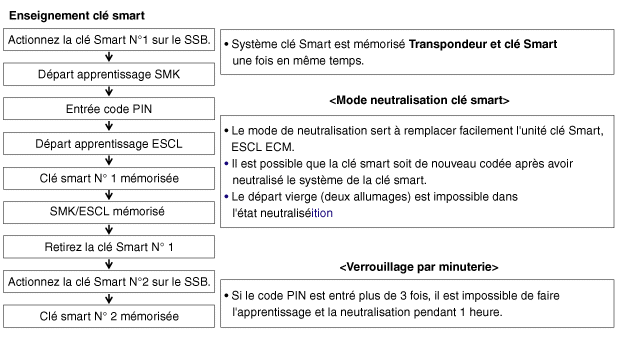
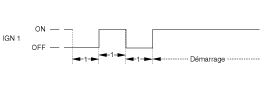
- This is for starting in the as-delivered (factory) state
- All parts related to this are in the factory-default state (Smart Key, ESCL ECM)
- ESCL is always unlocked in the initial state
- Depress the brake pedal while in P or N range.
- Press the Start/Stop button once with the dead Smart Key.
Test yourself
A quick Hyundai i20 quiz: every answer comes with an explanation and a link to the manual page.
Was this page helpful?