Engine Mechanical System
Turbocharger Repair Procedures
In this manual: Engine Mechanical System
15steps
~90min
4/5difficulty
Done 0 of 15
Removal and Installation
- Remove the turbocharger manifold. (Refer to Intake and Exhaust System - "Turbocharger and Exhaust Manifold")
Inspection on Vehicle
Turbocharger Diagnosis Chart

- Check the turbocharger fit on the connecting part (or after machining).
- Make sure the gasket is installed correctly.
- Check that the mounting bolts (or nuts) are tightened correctly.
- Check for gas leaks.
- Check for damage such as cracks or chips.
- Check the exhaust manifold and cylinder head assembly.
- Make sure the gasket is installed correctly.
- Check that the mounting bolts (or nuts) are tightened correctly.
- Check for gas leaks.
- Check the turbocharger oil supply pipe and hose, and the oil drain pipe and hose.
- Make sure the gasket is installed correctly.
- Check that the mounting bolts are tightened correctly.
- Check that the clips are in place.
- Check that the oil pipes and hoses are not damaged (kinked, crushed, torn, or cracked).
- Check for oil leaks between the center housing and the compressor housing.
- Check that the mounting bolts are tightened correctly.
- Check for oil leaks.
- Check the turbocharger actuator.
- Electronic actuator: Check the actuator rod stroke when the actuator operating force is applied by the GRS. (Refer to the Trouble Code Troubleshooting manual.)

- Electronic actuator: Check the actuator rod stroke when the actuator operating force is applied by the GRS. (Refer to the Trouble Code Troubleshooting manual.)
- Check the turbocharger compressor wheel.
- Check that the compressor wheel is not damaged (bent or deformed).
- Check that the compressor wheel rotates smoothly.
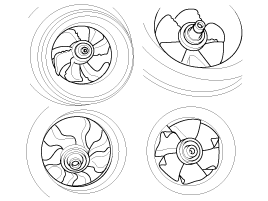
- Check the turbocharger turbine wheel.
- Check that the turbine wheel is not damaged.
- Check that the turbine wheel rotates smoothly.
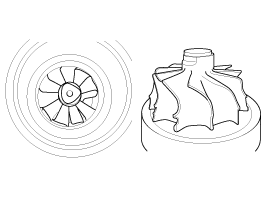
- Check the blow-by hose. (Refer to Group FL.)
- Check that the breather hose is not damaged (kinked or clogged).
- Check that the PCV (Positive Crankcase Ventilation) valve is not clogged.
- Check the intake hose connected to the turbocharger.
- Check that the intake air hose is not damaged (kinked, crushed, loose, or torn).
- Check the air filter.
- Check the air filter for contamination.
- Check the air filter for water intrusion.
- Check that the air filter cover is not dirty.
- Check that the air filter is a genuine part.
- Check the intercooler hoses and pipes.
- Make sure that the intercooler pipes and hoses are connected correctly.
- Inspect the intercooler hoses and pipes for damage (kinks, loose connections or cracks).
- Inspect the intercooler pipes for damage such as cracks.
- Check that the clamps are in place.
- Inspect the intercooler.
- Inspect the intercooler hoses and tanks for damage (oil leakage or cracks).
- Check the engine oil.
- Check the engine oil level.
- Check the engine oil for discoloration, water contamination and degradation of engine oil viscosity.
- Check the engine oil quality.
- Check the engine oil pressure.
- Engine oil pressure: Check the oil pressure with a gauge after removing the oil pressure sensor from the cylinder block.
- If the engine oil level is low, check the engine oil strainer in the oil pan. Then check for gas leakage from the injectors if foreign material has accumulated on the oil filter.
- Check the injectors, sensors, etc. (Refer to Engine Control Module / Fuel System)
- Check that the injectors operate correctly.
- Check that sensors such as the Mass Air Flow Sensor (MAFS), Intake Air Temperature Sensor (IATS) and Boost Pressure Sensor (BPS) operate correctly.
Test yourself
A quick Hyundai i20 quiz: every answer comes with an explanation and a link to the manual page.
Was this page helpful?