How Does the Airbag System Work?
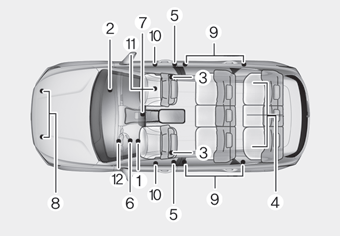
The SRS consists of the following components:
1. Driver's front airbag module
2. Passenger's front airbag module
3. Side airbag modules
4. Curtain airbag modules
5. Pretensioner retractor
6. Airbag warning light
7. SRS control module (SRSCM) / Rollover sensor
8. Frontal impact sensors
9. Side impact sensors
10. Side pressure sensors
11. Occupant classification system
12. Driver's knee airbag module
The SRSCM (Supplemental Restraint System Control Module) continuously monitors all SRS components while the ignition switch is in the ON position to determine whether the collision is severe enough to require airbag deployment or seat belt pretensioner deployment.
SRS warning light

The SRS (Supplemental Restraint System) airbag warning light on the instrument panel displays the airbag symbol shown in the illustration. The system checks the electrical portion of the airbag system for malfunctions. The light indicates a potential malfunction in the airbag system, which may include the side airbags and curtain airbags used to help protect against rollover.
WARNING
If your SRS is malfunctioning, the airbags may not inflate properly during an accident, increasing the risk of serious injury or death. If any of the following conditions occur, your SRS is malfunctioning:
- The light does not come on for approximately six seconds when the Engine Start/Stop button is turned to the ON position.
- The light remains on after illuminating for approximately six seconds.
- The light comes on while the vehicle is in motion.
- The light flashes while the engine is running.
Have an authorized HYUNDAI dealer inspect the SRS as soon as possible if any of these conditions occur.
In a frontal collision, the sensors detect the deceleration of the vehicle. If the deceleration rate is high enough, the control module will deploy the front airbags.
The front airbags help protect the driver and front passenger in frontal impacts where seat belts alone cannot provide adequate restraint. When necessary, the side airbags help provide protection in the event of a side impact or rollover.
- The airbags are active (ready to inflate if necessary) only when the ignition switch is in the ON position.
- The airbags deploy in certain frontal or side collisions to help protect occupants from serious physical injury.
- In general, airbags are designed to inflate depending on the severity and direction of the collision, among other factors. These two factors determine whether the sensors send an electronic deployment/inflation signal.
- Front airbags inflate and deflate completely in an instant. It is virtually impossible to see the airbags deploy during an accident. It is much more likely that you will only see deflated airbags hanging from their storage compartments after the collision.
- In addition to inflating in some side collisions, vehicles are equipped with a rollover sensor. The side and curtain airbags will deploy if the detection system detects a rollover. When a rollover is detected, the side and curtain airbags remain inflated longer to help provide protection against ejection, especially when used together with seat belts.
- To provide protection, the airbags must inflate rapidly. The high deployment speed is the result of the extremely short time in which the airbag must inflate between the occupant and the vehicle structure the occupant strikes. This inflation speed reduces the risk of serious or life-threatening injury and is therefore a necessary part of the airbag design. However, rapid airbag deployment can also cause injuries, which may include facial abrasions, bruises, and broken bones, because the inflation speed also causes the airbags to expand with considerable force.
- There are even circumstances in which contact with an airbag can cause fatal injuries, especially if an occupant is positioned too close to the airbag.
You can take steps to reduce the risk of injury from airbag inflation. The greatest risk is sitting too close to the airbag. The airbag needs approximately 10 inches (25 cm) of space to inflate. NHTSA recommends that drivers maintain at least 10 inches (25 cm) between the center of the steering wheel and the chest.
WARNING
To reduce the risk of serious injury or death from airbag inflation, observe the following precautions:
- NEVER install a child restraint in the front passenger seat. Always properly restrain children under 13 years of age in the rear seats of the vehicle.
- Adjust the front passenger and driver seats as far back as possible while still allowing you to maintain full control of the vehicle.
- Hold the steering wheel at the 9 o'clock and 3 o'clock positions.
- Never place anything or anyone between the airbag and the seat occupant.
- Do not allow the front passenger to place their feet or legs on the instrument panel.
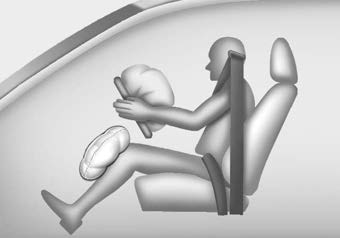
■ Driver's Front Air Bag (1)
When the SRSCM detects a sufficiently severe impact to the front of the vehicle, it will automatically deploy the front air bags.
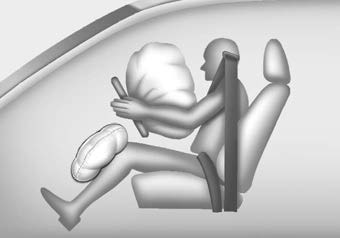
■ Driver's Front Air Bag (2)
When deployed, tear seams form directly in the covers. The covers separate under the pressure of the expanding air bags. Then the opening of the covers allows the air bags to fully inflate.
A fully inflated airbag combined with a properly worn seat belt slows the forward movement of the driver or front passenger, reducing the risk of head and chest injuries.
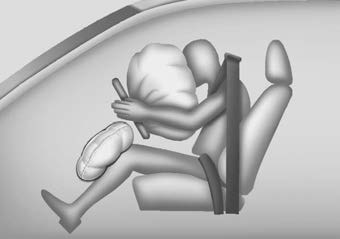
■ Driver's Front Air Bag (3)
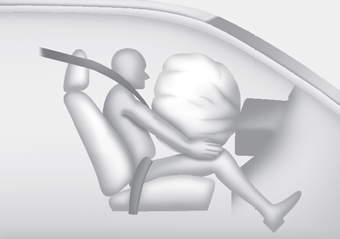
■ Passenger Front Airbag
After full deployment, the air bag begins to deflate immediately, allowing the driver to maintain forward visibility and the ability to steer or operate other controls.
WARNING
To prevent objects from becoming dangerous projectiles when the passenger airbag deploys:
- Do not install or place items (cup holder, CD holder, stickers, etc.) on the front passenger's instrument panel above the glove box, where the passenger air bag is located.
- Do not install a container of liquid air freshener near the instrument cluster or on the surface of the instrument panel.
Test yourself
A quick Hyundai Palisade quiz: every answer comes with an explanation and a link to the manual page.