Body Electrical System
Description and Operation
In this manual: Body Electrical System
22steps
~132min
4/5difficulty
Done 0 of 22
Description
System Overview: The SPAS (Smart Parking Assist System) is part of the client system that provides the driver with PAS and SPAS functions. The SPAS system is a general-purpose complex subsystem. Therefore, each SPAS application is expected to use this subsystem. Main functions: The system determines parallel parking spaces suitable for returning the vehicle by analyzing distance data provided by the SPAS sensors.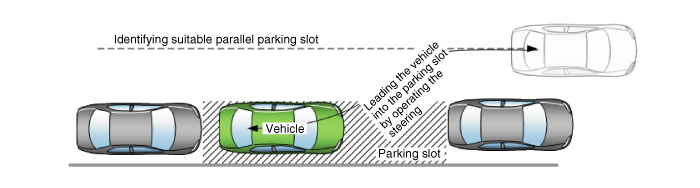
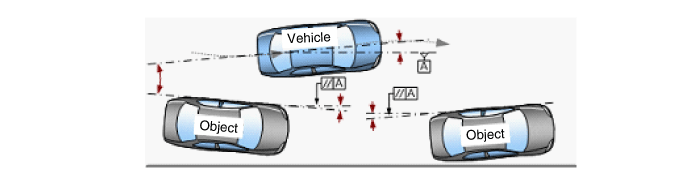
- Alignment status of other parked vehicles: Since the side sensor searches for a parking space while the vehicle is moving, the alignment of the parked vehicle may affect the parking result. It is best if the vehicle travels strictly parallel to the parking line; however, it must not exceed +/- 5 degrees for a successful parking result. Also, the position of the parked vehicle relative to the parking line may affect the result, so it must not exceed 5 degrees. Finally, the maximum angle deviation between the moving vehicle and the parked vehicle must not exceed 10 degrees.
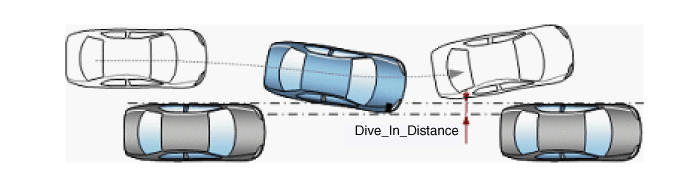
- Drive-in distance: When approaching the parking space, the drive-in distance must not exceed 0.5 m. Otherwise, the parking position may be poor or the parking process may require more steps.
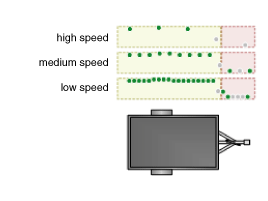
- Parking next to a trailer: As shown in the illustration, a search error occurs when a hitch attached to a trailer is present (round dotted area in the table). Even if the vehicle passes the area at very low speed, normal search results cannot be guaranteed.
- Parking next to a truck: Due to the height of the truck platform (floor), the side sensor cannot correctly detect it when searching for a parking space. Therefore, the driver must take care to avoid a collision.
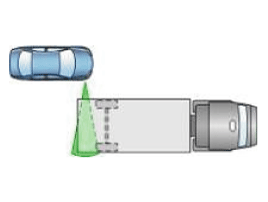
- Parking next to a 2-wheeler: If a two-wheeled vehicle such as a motorcycle or bicycle is present, the side sensor may not recognize its full shape. In addition, if it is positioned at an oblique angle, it is much more difficult to detect.
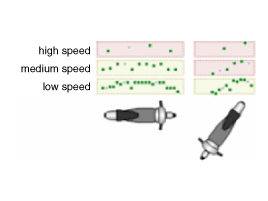
- Snow, rain, or wind: Because the sensor uses sound waves, the environment (snow, rain) may affect wave transmission. Strong wind may also distort the ultrasonic wave, which may result in abnormal parking.
- Trash can or round objects: The illustration on the right shows that the point locations are uneven in the case of a round-shaped structure.
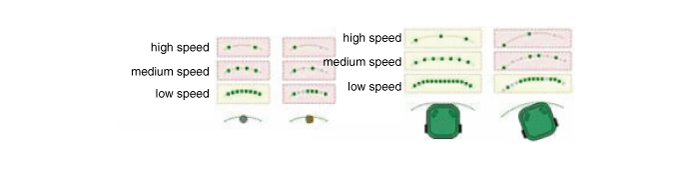
- Angled parking
- Parking on a Slope
- Parking on the roadside
- Non-standard vehicle parking
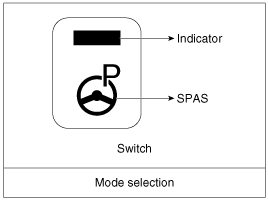
- Mode selection: To start SPAS (Smart Parking Assist System), select the parking mode; see the instrument cluster. Pressing the SPAS switch selects the parking mode (parallel right, parallel left). If the switch is pressed for more than 1.5 seconds, the system turns off. Note that the parking mode cannot be selected if the shift lever is in P or R (reverse gear for M/T). The gear position must be N or D (sport mode is also acceptable); in the case of M/T, it is possible to select while the gear is not in reverse.
- Searching for a parking space with the ultrasonic side sensor. When the vehicle passes other vehicles parked alongside the parking area, the side sensor searches for a parking space (if the parallel parking mode is selected correctly, the right side sensor operates; for the left side, the opposite sensor is used). When the vehicle has passed the parking space and the search is complete, the message "Shift to R" appears (or flashes) on the cluster and a warning sound is emitted. If you continue driving without responding to the message and sound, the system will automatically search for the next parking space. For normal parking assistance, select the parking mode in advance, approximately 2 to 3 m from the target parking space, and drive the vehicle past it by this distance.
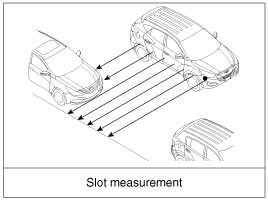
- Completing the parking space search. After the parking spaces are checked, the vehicle outputs a completion sound and a message on the cluster. If the driver shifts the transmission lever to the R position and then properly depresses/releases the brake pedal, the steering wheel will begin to move automatically.
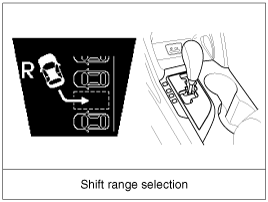
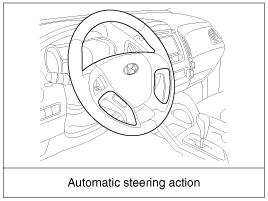
- Automatic steering. When the transmission is shifted to reverse, following the message on the instrument panel, the steering wheel begins to rotate automatically by the MDPS. You can move the vehicle by depressing the accelerator pedal, or by releasing the brake pedal, while listening to the PAS buzzer warning sound. During this time, the side sensors detect any obstacles near the vehicle. When parking is complete, SPAS ends with a completion sound and message.
- Switch
- PAS switch: The PAS switch is used to turn the PAS warning function on or off.
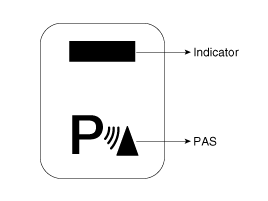
- SPAS switch: The SPAS switch selects the parking mode.
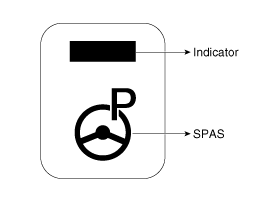
- LED indicator
Item Condition Description PAS ON PAS operating OFF PAS not operating Flashing System is under diagnosis or malfunction SPAS ON SPAS operating OFF SPAS not operating Flashing Coding error or system malfunction
- PAS switch: The PAS switch is used to turn the PAS warning function on or off.
- Cluster. It shows the current parking status and the required warning message. The HMI (Human Machine Interface) concept is applied.
- SPAS control module. After receiving the required input signals, it calculates the parking path. It outputs the required steering angle to the MDPS to automatically rotate the steering wheel. It also sounds a warning and displays the appropriate text message on the cluster during parking.
- Front/rear SPAS sensors. The function of these sensors is to detect obstacles during parking. The maximum detection range is approximately 2 m. The sensors are the same as the existing RPAS (Rear Parking Assist System) sensors.
- Side SPAS sensors. They detect parking spaces. The maximum detection range is approximately 4 m. Also, when the vehicle is moving during automatic parking, the sensors are used to detect obstacles and give a warning sound to the driver.
- MDPS. It drives the steering wheel by receiving the requested target steering angle from the SPAS control module.
- SPAS speaker. Three different warning sounds for front, rear, and malfunction, respectively.
Test yourself
A quick Hyundai Tucson LM quiz: every answer comes with an explanation and a link to the manual page.
Was this page helpful?