Vehicle Loading Limit
Tire and Loading Information Label
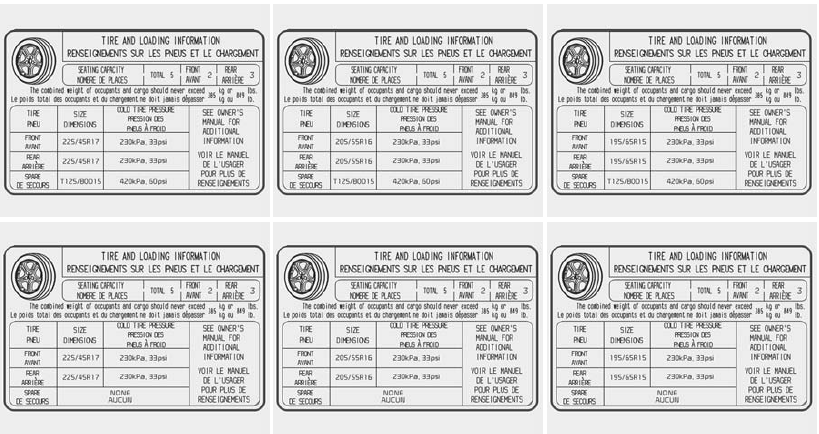
The label located on the driver's door pillar shows the original tire size, the recommended cold tire pressure for your vehicle, the number of persons that may be in your vehicle, and the vehicle's capacity weight.
Vehicle capacity weight: 410 kg (904 lb)
Vehicle capacity weight is the combined weight of occupants and cargo.
Number of seating positions:
Total: 5 persons (Front seat: 2 persons, Rear seat: 3 persons)
Number of seats is the maximum number of occupants, including the driver, that your vehicle can carry.
However, the number of seating positions may be reduced depending on the weight of all occupants and the weight of the cargo being carried.
Do not overload the vehicle. The total weight or load limit, including passengers and cargo, must not exceed the vehicle's capacity.
Towing Capacity:
We do not recommend using this vehicle to tow a trailer.
Cargo Capacity:
The cargo capacity of your vehicle will increase or decrease depending on the weight and number of occupants.
Steps to Determine Correct Load Limit -
1. Find the statement "The combined weight of occupants and cargo should never exceed XXX kg or XXX lbs." on the placard on your vehicle.
2. Determine the combined weight of the driver and passengers that will be riding in your vehicle.
3. Subtract the combined weight of the driver and passengers from XXX kg or XXX lbs.
4. The resulting figure is the available cargo and luggage load capacity. For example, if "XXX" is 635 kg (1400 lbs) and there will be five 68 kg (150 lbs) occupants in your vehicle, the available cargo and luggage load capacity is 295 kg (650 lbs).
(635 - 340 (5 x 68) = 295 kg or 1400 - 750 (5 x 150) = 650 lbs.)
5. Determine the combined weight of luggage and cargo loaded on the vehicle. This weight must not exceed the available cargo and luggage load capacity calculated in step 4.
6. If your vehicle is towing a trailer, the load from the trailer will be transferred to your vehicle. Refer to this manual to determine how this reduces the available cargo and luggage load capacity of your vehicle.
WARNING! Unsecured Cargo
Do not carry unsecured heavy objects in the passenger compartment of your vehicle (for example, suitcases or unsecured child seats). These objects can strike occupants during sudden stops or a collision.
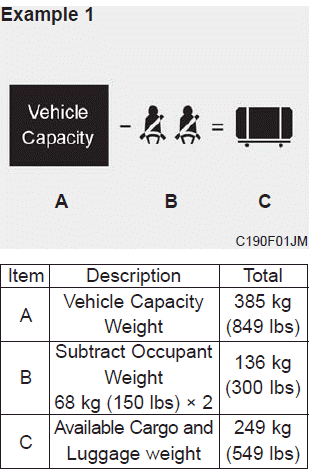
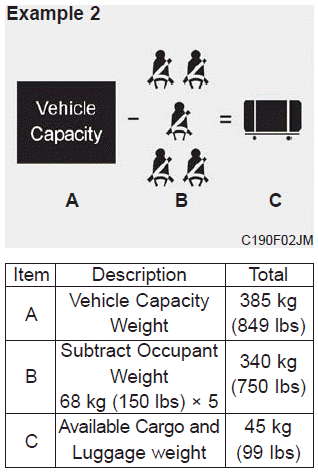
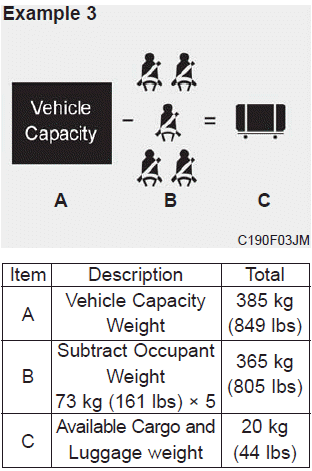
For specific information, refer to the tire and loading information label on your vehicle. The label contains information on your vehicle's load capacity and seating positions. The combined weight of the driver, passengers, and cargo should never exceed the load capacity.
Test yourself
A quick Kia Forte BD quiz: every answer comes with an explanation and a link to the manual page.