Dual Clutch Transmission (DCT)
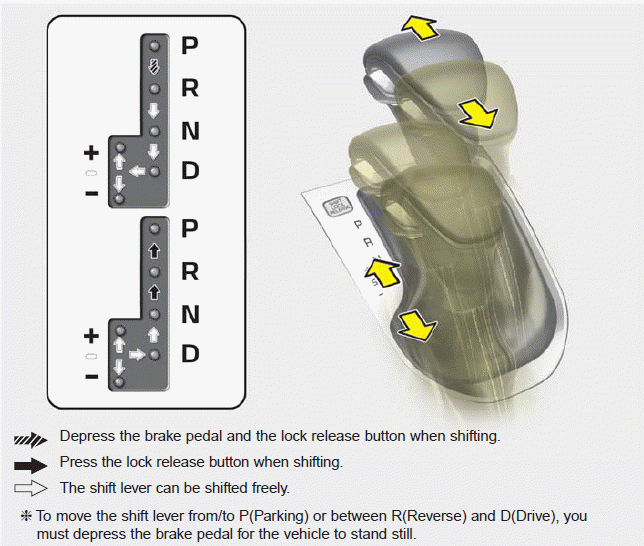
Dual Clutch Transmission Operation
The dual clutch transmission has 7 forward speeds and one reverse speed.
The individual speeds are selected automatically in the D (Drive) position.
WARNING
To reduce the risk of serious injury or death:
- ALWAYS check the area around your vehicle for people, especially children, before shifting the vehicle into D (Drive) or R (Reverse).
- Before leaving the driver's seat, always make sure the shift lever is in the P (Park) position, then apply the parking brake and turn the ignition switch to the LOCK/OFF position. Unexpected and sudden vehicle movement may occur if these precautions are not followed.
- Do not use engine braking (downshifting from a high gear to a lower gear) abruptly on slippery roads. The vehicle may skid, causing an accident.
• The dual clutch transmission provides the feel of a manual transmission, but with the convenience of a fully automatic transmission. Unlike a conventional automatic transmission, gear shifts may be felt (and heard) in the dual clutch transmission.
- Think of it as an automated manual transmission.
- Shift into D (Drive) for fully automatic shifting, similar to a conventional automatic transmission.
• The dual clutch transmission uses a dry-type dual clutch, which differs from a torque converter automatic transmission and provides better acceleration performance during driving, but initial starting may be slightly slower than with a conventional automatic transmission.
• The dry clutch transmits torque and provides a direct driving feel that may differ from a conventional torque converter automatic transmission. This may be more noticeable when starting, stopping, or driving at low speed.
• During rapid acceleration at low vehicle speed, the engine may rev higher, depending on the vehicle's drive condition.
• For a smooth start on a hill, depress the accelerator pedal gradually, depending on the current conditions.
• If you release the accelerator pedal at low vehicle speed, you may feel strong engine braking, similar to a manual transmission.
• When driving downhill, you can use Sport mode to shift to a lower gear. Downshift to control speed without applying the brake pedal excessively.
• When you start the engine or turn the ignition on, you may hear clicking sounds as the system performs a self-test. This is a normal sound for the dual clutch transmission.
WARNING
If a transmission malfunction occurs, the vehicle may not move and the position indicator (D, R) will flash on the cluster. In this situation, have the system inspected by a professional workshop. Kia recommends visiting an authorized Kia dealer/service partner.
Test yourself
A quick Kia Forte BD quiz: every answer comes with an explanation and a link to the manual page.