Airbag system functions
- The airbags will deploy only when the ignition switch is in the ON or START position.
- In the event of a severe accident, the frontal or side airbags will deploy immediately (on vehicles equipped with side or head airbags) to provide maximum protection for occupants against serious bodily injury.
- Under normal conditions, an airbag deploys when the vehicle experiences an impact of a specific angle and a specific intensity. These two factors are important elements in deciding whether the airbag deployment signal is sent or whether the electrical system function should be triggered.
- Airbag deployment depends on the angle and force of the impact. It will not occur in every accident or in every impact situation.
- Front airbags inflate and deflate within a very short time. The human eye cannot detect airbag deployment during an accident. You may only see a deflated airbag hanging out of its storage compartment after an accident.
- To provide protection in the event of a severe collision, airbags must inflate extremely quickly. Airbag deployment takes place in an extremely short time during a collision, and the airbag must be positioned between the occupant and the vehicle structure or components the occupant would otherwise strike. The short deployment time reduces the risk of serious or life-threatening injuries in severe collisions, and it is therefore a necessary part of airbag development. However, airbag deployment at very high speed can cause injuries such as facial abrasions, bruises and bone fractures.
- If the driver is unusually close to the airbag, fatal injuries are possible.
WARNING
- To avoid serious or fatal injuries from airbag deployment in an accident, the driver should sit as far away from the airbag as possible, at least 250 mm (10 in) from the steering wheel. The front passenger should always sit as far back as possible, slide the seat back and lean against the seatback.
- Airbags deploy extremely quickly in an accident, so occupants may be injured by the force of airbag deployment if they are not sitting in the correct position.
- If an airbag deploys, injuries may include facial and body abrasions, injuries caused by broken glass, or burns.
Noise and smoke
When airbags deploy, they release with a loud bang, and smoke and powder are released into the air from the vehicle. This is normal and is caused by the gas generator operating during airbag deployment. After airbag deployment, you may feel discomfort from contact with the seat belt and airbag, and breathing in smoke and powder can be uncomfortable. Open the doors or windows as soon as possible after the accident to reduce discomfort, prolonged inhalation of smoke, and contact with the powder.
Although the smoke and powder are not poisonous, they may irritate the skin, eyes, nose and throat. In this case, wash and rinse the affected area immediately with cold water and see a doctor if symptoms persist.
WARNING
When airbags have deployed, components related to the airbag system in the steering wheel, instrument cluster and roof side rail areas above the doors become hot. To avoid injury, do not touch components in the airbag storage compartments immediately after airbag deployment. Do not install or place accessories near the airbag trigger areas, such as the instrument panel, windows, pillars and roof line.
Warning label for a child restraint system on the front passenger airbag
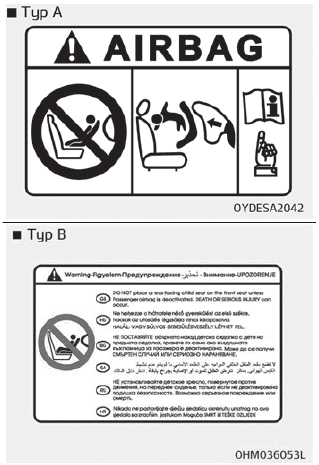
Never place a rear-facing child restraint system on the front passenger seat. If the airbag deploys, it will strike the rear-facing child restraint with force and may cause serious or fatal injuries.
In addition, do not place a forward-facing child restraint system on the front passenger seat. If the front passenger airbag deploys, it may cause serious or fatal injury to the child. If your vehicle is equipped with a "Passenger Airbag ON/OFF" switch, you can turn the passenger airbag on or off as necessary.
WARNING
- Extreme danger! NEVER use a rear-facing child restraint on a seat protected by a front airbag.
- NEVER use a rear-facing child restraint on a seat protected by an ACTIVE AIRBAG, as this may result in DEATH or SERIOUS INJURY TO THE CHILD.
- Never install a child restraint system on the front passenger seat. If the front passenger airbag deploys, it may cause serious injury or death.
- When children are in child restraint systems, make sure that the child restraint is installed as far from the door as possible and secured in its proper position, if the vehicle is equipped with side airbags or head airbags, and that the child is facing away from the direction of travel. Side airbag or head airbag deployment may cause serious injury or death to the child or small child.
Test yourself
A quick Kia Stonic quiz: every answer comes with an explanation and a link to the manual page.