Driver and Passenger Front Airbag
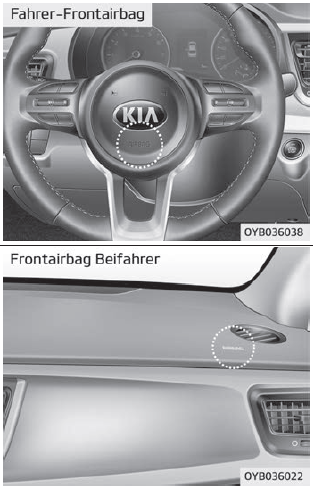
Your vehicle is equipped with a supplemental restraint system (airbag system) and three-point seat belts for the driver and front passenger seats.
Airbag system components are identified by the word "AIRBAG" on the airbag cover in the steering wheel and on the instrument panel above the glove box on the passenger side.
The SRS system consists of airbags located under the cover in the center of the steering wheel and on the passenger side of the instrument panel above the glove box.
The purpose of the SRS system is to provide the driver and/or front passenger with additional protection in the event of a frontal collision, in addition to the protection provided by the seat belts.
WARNING
The driver's hands should be on the steering wheel. The passenger's hands should be on their lap.
WARNING
Always use seat belts and child restraint systems on every trip, for all occupants! Airbags deploy with considerable force and within fractions of a second. Seat belts keep occupants in the correct seating position so they receive maximum support from the airbags. If occupants are not properly seated or belted, they may be seriously injured when the airbags deploy. Always follow the safety instructions in this manual regarding seat belts, airbags and occupant safety.
To reduce the risk of serious or fatal injury and to obtain maximum safety benefit from your restraint system:
- Never place a child seat on the front passenger seat.
- Always place children in the rear seat and always keep them secured with the seat belt. The rear seat is the safest place in the vehicle for children of all ages.
- Front and side airbags can injure improperly seated front passengers.
- Move your seat as far back as practical from the front airbag so that you can still control the vehicle.
- You and your passengers should never sit unnecessarily close to the airbags or lean too close to them. Drivers and passengers who are seated improperly may be seriously injured when the airbags inflate.
- Never lean against the door or center console. Always keep yourself in an upright seated position.
- If the SRS airbag warning light stays on while driving, have the system inspected by a qualified workshop. Kia recommends visiting a Kia dealer/service partner.
- Airbags can only be used once. After deployment, have the system replaced at a qualified workshop. Kia recommends visiting a Kia dealer/service partner.
- The SRS system is designed so that the front airbags deploy only when a certain force is present and when the angle of impact relative to the longitudinal axis of the vehicle is less than 30°. Airbags can only deploy once. Always wear your seat belt.
- Front airbags are not designed to deploy in side collisions, rear impacts, or rollovers. Front airbags will also not deploy in a frontal collision when the impact force is below the threshold.
- A child restraint system must never be installed on the front seat. An infant or child may be seriously injured or killed if the airbag deploys in an accident.
- Children under 12 years old should always be properly secured in the rear seat. Never let children ride in the front seat. When a child over 12 years old must sit in the front seat, the child must be properly belted and the seat must be moved as far back as possible.
- For maximum protection in any type of accident, all occupants, including the driver, should always wear seat belts, whether or not their seating position has an airbag. Sitting upright and not leaning unnecessarily close to an airbag while driving minimizes the risk of serious or fatal injury.
- An improper seating posture can result in serious or fatal injury in an accident. All occupants should sit upright, centered, and buckled, with the seatback in an upright position, legs comfortably extended, and feet on the floor until the vehicle is parked and the ignition key is removed.
- The airbag must deploy extremely quickly to provide protection in a collision. If the passenger is in an incorrect position on the seat, or the seat belt is not fastened, the airbag strikes the passenger with great force. Passengers may be thrown about and seriously injured or killed.
Front Passenger Airbag ON/OFF Switch (if equipped)
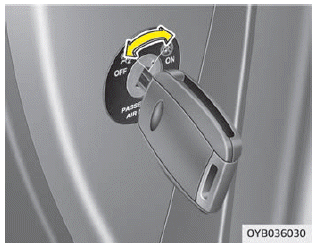
When a child restraint system is installed on the passenger seat, or the seat is unoccupied, the passenger airbag is deactivated by the "Passenger Front Airbag ON/OFF" switch.
To ensure your child's safety, the front passenger airbag must be deactivated if a child restraint system must be installed on the passenger seat under special circumstances.
Deactivating or Reactivating the Passenger Airbag:
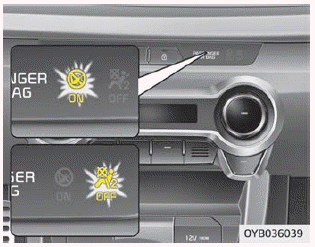
To deactivate the front passenger airbag, insert the main key into the "Passenger Front Airbag ON/OFF" switch and turn it to the OFF position. The front passenger airbag OFF indicator light ( ) illuminates and remains on until the front passenger airbag is reactivated. To reactivate the front passenger airbag, insert the key into the "Passenger Front Airbag ON/OFF" switch and turn it to the ON position.
The "Passenger Front Airbag OFF" indicator light goes out, and the "Passenger Front Airbag ON" indicator light ( ) illuminates for approximately 60 seconds.
WARNING
The front airbag ON/OFF switch can also be turned with a narrow, stable object. Always check the status of the front airbag ON/OFF switch and the passenger front airbag indicator light.
NOTICE
- If the "Passenger Front Airbag ON/OFF" switch is in the ON position, the passenger front airbag is active, and a child restraint system must not be installed or children must not be seated on the passenger seat.
- If the "Passenger Front Airbag ON/OFF" switch is in the OFF position, the passenger front airbag is deactivated.
DANGER
- If the passenger front airbag ON/OFF switch does not function properly, the SRS warning lamp (
 ) on the instrument cluster illuminates. When the passenger front airbag OFF indicator () does not illuminate (the passenger front airbag ON indicator illuminates and goes out after approximately 60 seconds), the SRS control module reactivates the passenger front airbag, and the passenger front airbag deploys in a frontal collision, even if the passenger front airbag ON/OFF switch is in the OFF position. Do not leave the vehicle in this condition. Have the system inspected at a qualified workshop. Kia recommends visiting a Kia dealer or authorized service partner.
- If the SRS airbag warning lamp flashes or does not illuminate when the ignition switch is turned ON, or remains illuminated while driving, have the system inspected at a qualified workshop. Kia recommends visiting a Kia dealer or authorized service partner.
WARNING
- The driver is responsible for correctly setting the "Passenger Front Airbag ON/OFF" switch.
- Deactivate the passenger front airbag module only with the ignition switched OFF; otherwise the SRS control module may be damaged. There is also a risk that the driver and/or passenger front airbag, side airbag, and curtain airbag may deploy or be triggered simultaneously without a proper collision.
- Never install a rear-facing child seat on the passenger seat unless the passenger front airbag has been deactivated. An infant or child may be seriously injured or killed if the airbag deploys in a collision.
- Even if your vehicle is equipped with a passenger front airbag deactivation switch, never install a child seat on the front passenger seat. A child restraint system must never be installed in the front seat. Children who are too large for child restraint systems must always sit in the rear seat and wear the seat belt. Children are safest in the rear seat when properly secured in an appropriate restraint system.
- As soon as the child seat is no longer installed on the passenger seat, reactivate the passenger front airbag.
- Do not place any objects in or near the small openings on the seatbacks marked for the side airbags, or the airbag may deploy and cause unexpected accidents or injuries.
WARNING
Do not attach objects
Do not place or attach objects (such as dashboard covers, mobile phone holders, cup holders, air freshener dispensers, or stickers) on or near the steering wheel airbag module, instrument panel, windshield, or above the glove box on the passenger side. Such objects may cause injury when the airbags deploy in a collision. Do not place objects over or between yourself and the airbag.
Test yourself
A quick Kia Stonic quiz: every answer comes with an explanation and a link to the manual page.