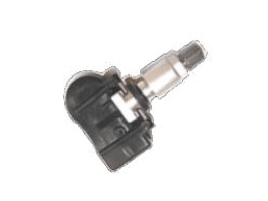
The sensor measures pressure, temperature, acceleration and battery status, and transmits the information to the ECU by wireless radio frequency.
Wheel location is identified by comparing the wheel pulse from the ECS (ABS) and the sensor acceleration value (high line).
Structure and Features
It consists of four units, one for each wheel of the vehicle.
The frequency modulation method is FSK, and the High Line is normally used.
Mode
It consists of the initial factory mode (EOL test mode), stop and drive mode, and automatic learning mode.
Functions
Function
Valve Type
Clamp Type
Thread Length Valve Cam
8.4 mm
Nut Material
AI6061 [Baolong]
Seal
CR Seal
Battery Type
CR2450 Type
TPMS Automatic Location Identification
The angular speed of each wheel differs for the following two reasons:
Slip on each axle will occur differently.
The turning radius (curve radius) for each wheel is different.
Tire wear, internal pressure, tire characteristics, etc. differ.
The TPMS sensor transmits the RF signal only at a specific phase (tire angle) in learning mode.
The TPMS receiver checks the information of each tire phase (tire angle) when it receives the RF signal from the sensor.
The RF signal of sensor ID 1, 2, 3, 4 is received each time and transmitted to the ID with the highest correlation between the phases of each collected wheel. (The RF signal is received each time, and the tire phase is transmitted to the fixed wheel.)
The TPMS sensor transmits an RF signal at 16-second intervals in learning mode.
After stopping or parking for more than 19 minutes, automatic learning is performed for each driving position.
The sensor switches to parking mode when stopped or parked for more than 15 minutes, and parking mode changes to the first block mode when acceleration of more than 4g is detected (15~20 km/h).
Indicator Lamp
Normal Mode Function
Each time the ignition is turned on, the cluster checks whether the TPMS unit is available for communication on the CAN line.
[Normal Operation]
The cluster flashes for 3 seconds, then turns off.
[Incorrect Operation]
The cluster flashes for 1 minute, then remains on.
Virgin Mode Function
TPMS does not store sensor IDs
[Normal Operation]
The cluster flashes for 3 seconds, then turns off for 3 seconds (repeats).
Low Tire Pressure Warning Lamp Function
TPMS unit detects low pressure.
[Normal Operation]
No low-pressure tires.
[Low Tire Pressure Warning Lamp On]
Low tire pressure present
Tire pressure is below the lamp illumination condition.
Malfunction Indicator Lamp Function
TPMS unit detection system malfunction.
[Normal Operation]
No system malfunctions
Cluster TPMS lamp is off
[Malfunction Indicator Lamp On]
System malfunctions present
The cluster flashes for 1 minute, then stays on
TPMS Sensor Replacement
The replaced sensor must be stored in the receiver ID, so after the ignition is turned OFF, wait 19 minutes after leaving observation mode when entering parking before location identification and learning can take place. After 25 km/h and more than 10 minutes of driving at vehicle speed, the sensor and location IDs are stored automatically. If storage is difficult, when necessary, the TPMS sensor ID can be entered directly using the transmitter ID. (Follow the high line procedure in the diagnostic equipment instructions when locating the tire.)
Tire Rotation Position
The position of the sensor on the receiver must be recognized after the change. The pressure sensors are also located as they were before the exchange. Wait more than 19 minutes after KEY OFF 25 km/h or more, driving more than 10 minutes automatically saves the position change. In practice, however, it is difficult to drive at a fast pace. The TPMS ID is saved; if necessary, the sensor ID is entered directly using the sensor ID. (Refer to the high-line instructions. In case of diagnosis, the equipment must match the tire position.)
Receiver Position Exchange: The diagnostic equipment (including the TPMS trigger tool) will perform the following tasks.
The vehicle must be entered with the code.
Enter the VIN.
Allows entry of the sensor ID.
IG ON, IG OFF after 10 seconds. (Check whether the "TPMS" warning lamp is illuminated)
TPMS Sensor Replacement Precautions
?
Test yourself
A quick Kia Cee'd quiz: every answer comes with an explanation and a link to the manual page.