Jump Starting
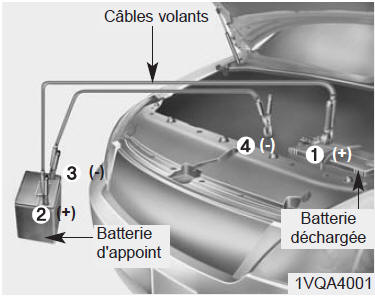
Connect the cables in numerical order and disconnect them in the reverse order.
Jump Starting
Jump starting can be dangerous if not performed correctly.
Also, to avoid personal injury or damage to the vehicle or battery, follow the jump starting procedure. If you are not sure, we strongly recommend that you have a qualified technician or a roadside assistance service perform the procedure.
CAUTIONUse only a 12-volt jump starting system. You may damage the starter motor, ignition system, and other 12-volt electrical parts if you use a 24-volt power source (two 12-volt batteries in series or a 24-volt generator).
WARNING - BatteryNever attempt to check the battery electrolyte level, as the battery could rupture or explode, causing serious injury.
WARNING - Battery- Keep flames and sparks away from the battery. The battery gives off hydrogen gas, which can explode if exposed to flames or sparks.
Jump Starting Procedure
- Make sure the booster battery is 12 volts and that its negative terminal is connected to ground.
- If the booster battery is installed in another vehicle, do not let the two vehicles touch each other.
- Turn off any unnecessary electrical loads.
- Connect the jumper cables exactly in the sequence shown in the illustration. First connect one end of a cable to the positive (+) terminal of the discharged battery (1), then connect the other end to the positive (+) terminal of the booster battery (2).
Connect one end of the other cable to the negative (-) terminal of the booster battery (3), then connect the other end to a secure, solid metal part of the engine block or body (for example, the engine mounting bracket) away from the battery (4). Do not connect it near or to a moving part.
Do not let the jumper cables touch anything except the proper terminals or ground. Do not lean over the battery when making these connections. CAUTION - Battery CablesDo not connect the jumper cable from the negative (-) terminal of the booster battery to the negative (-) terminal of the discharged battery. This may overheat the discharged battery, which may then crack and leak battery acid.
- Start the vehicle with the booster battery and let it run at 2000 rpm. Then start the vehicle with the discharged battery.
Push-starting
Do not start a vehicle with a manual transmission by pushing it, as this may damage the emission control system.
A vehicle with an automatic transmission cannot be started by pushing it.
Follow the instructions given for jump starting.
WARNINGNever tow a vehicle to start it, as the sudden forward jolt when the engine starts could cause a collision with the towing vehicle.
Test yourself
A quick Kia Optima DL3 quiz: every answer comes with an explanation and a link to the manual page.