Emission Control System
Catalytic Converter
In this manual: Emission Control System
11steps
~66min
3/5difficulty
Done 0 of 11
Description and Operation
Description
The gasoline engine catalytic converter is a three-way catalyst. It oxidizes carbon monoxide and hydrocarbons (HC) and separates oxygen from nitrogen oxides (NOx).
Repair Procedures
Removal
[Catalytic Converter]- Remove the engine room cover. (Refer to Engine Mechanical System - "Engine Room Cover")
- Drain the engine coolant. (Refer to Engine Mechanical System - "Engine Coolant")
- Remove the air cleaner assembly. (Refer to Engine Mechanical System - "Air Cleaner")
- Remove the front muffler. (Refer to Engine Mechanical System - "Muffler")
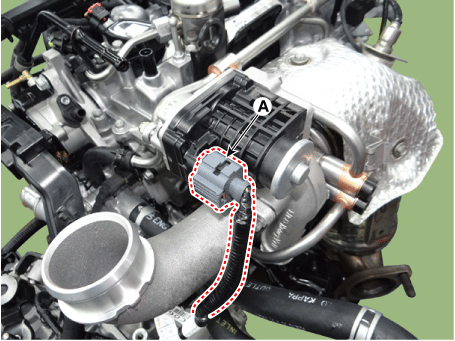
- Disconnect the extension connector (A) of the Electric Wastegate Actuator (EWGA).
- Remove the front oxygen sensor. (Refer to Engine Control/Fuel System - "Heated Oxygen Sensor (HO2S)").
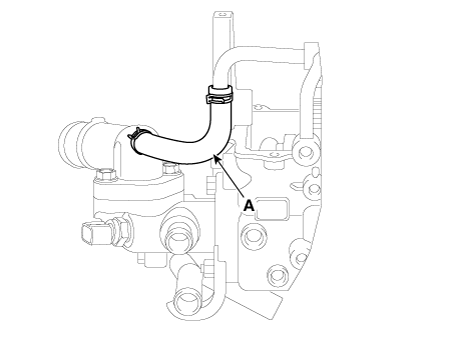
- Disconnect the water hose (A).
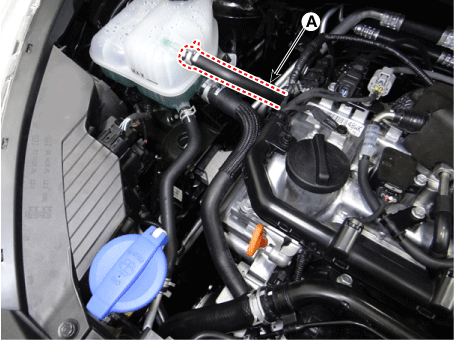
- Disconnect the turbocharger drain pipe hose (A).
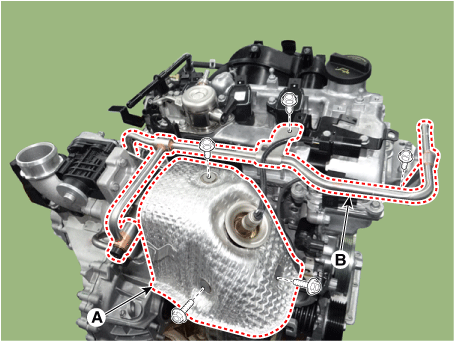
- Remove the heat shield of the coupling (A) and the water drain pipe (B). Tightening Torque Heat Shield Mounting Bolt: 9.8–11.8 N·m (If equipped with a cap, tighten until the cap is removed.) Eye Bolt: 26.4–32 N·m Pipe Mounting Bolt: 9.8–11.8 N·m
- Remove the exhaust manifold support (A).
Torque: 39.2 – 44 N·m
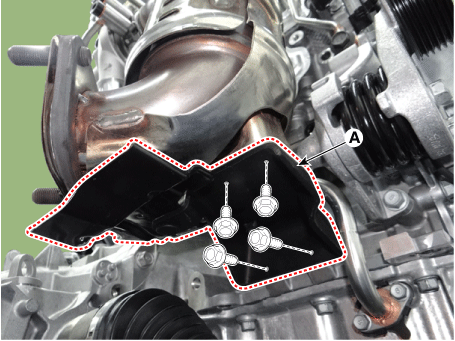
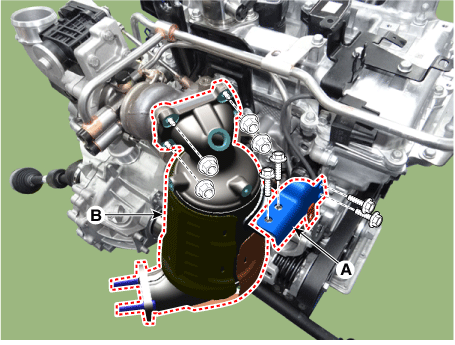
- Remove the warm-up catalytic converter (WCC) upper support (A), then remove the warm-up catalytic converter (WCC) (B). Tightening Torque Warm-Up Catalytic Converter (WCC): 49.0–54 N·m WCC Upper Support: 18.6–24 N·m
Installation
- Install in the reverse order of removal.
Test yourself
A quick Kia Picanto JA quiz: every answer comes with an explanation and a link to the manual page.
Was this page helpful?