How the Airbag System Works
- The airbags are activated (ready to inflate if necessary) only when the ignition switch is turned to the ON or START position.
- The airbags deploy instantly in the event of a severe frontal or side collision (if equipped with side airbags or curtain airbags) to help protect occupants from serious bodily injury.
NOTICE
If equipped with a rollover sensor
In addition, the airbags deploy instantly in the event of a rollover (if equipped with side airbags or curtain airbags) to help protect occupants from serious bodily injury.
- Under normal conditions, the airbag is designed to deploy based on a specific angle and severity of collision. These two factors are the key elements in deciding whether to send the airbag deployment signal or trigger the electrical operation or not.
- The airbag will deploy depending on the angle and severity of the collision. It will not deploy in every accident or collision situation.
- The front airbags deploy fully and inflate in an instant. It is virtually impossible to see the airbags inflate during an accident. It is much more likely that you will simply see deflated airbags hanging out of their storage compartments after a collision.
- To provide protection in a severe collision, airbags must inflate rapidly. The speed of airbag inflation is a consequence of the extremely short time in which the collision occurs and the need to inflate the airbag between the occupant and the vehicle structures before the occupant contacts these structures. This inflation speed reduces the risk of serious or life-threatening injuries in a severe collision and is therefore a necessary part of the airbag design. However, airbag deployment can also cause injuries, which may include facial abrasions, bruises and bone fractures, because the inflation speed also causes the airbags to expand with great force.
- There are even circumstances in which contact with the steering wheel airbag may cause fatal injuries, especially if the occupant is positioned too close to the steering wheel.
WARNING
- To avoid serious injury or death from airbag deployment in a collision, the driver must sit as far back from the steering wheel airbag as possible (at least 250 mm (10 in)). Front passengers should always move their seats as far back as possible and sit upright in their seat.
- Airbags deploy instantly in a collision and occupants can be injured by the expansion force of the airbag if they are not in the correct position.
- Airbag deployment may cause injuries including abrasions to the face or body, injuries from broken glasses or burns.
Noise and Smoke
When the airbags deploy, they create a loud noise and leave smoke and powder in the air inside the vehicle. This is normal and is the result of the combustion of the airbag inflator. After the airbag inflates, you may feel significant discomfort in breathing due to chest contact with both the seat belt and the airbag, as well as from inhaling smoke and powder.
Open the doors and/or windows as soon as possible after the impact to reduce discomfort and prevent prolonged exposure to smoke and powder.
Although smoke and powder are non-toxic, they may cause skin irritation (eyes, nose and throat, etc.). If this occurs, wash and rinse with cold water, and consult a doctor if symptoms persist.
WARNING
When the airbags deploy, air comes out of the bags, the components related to the bag in the steering wheel, and/or the instrument panel, and/or on both sides of the roof rails above the front and rear doors. It is very hot. To avoid injury, do not touch the inside of the airbag storage compartment. Components immediately after the airbag has inflated. Do not install or place accessories near airbag deployment locations, such as the instrument panel, windows, pillars, and roof rails.
Front Passenger Airbag Warning Label for Child Restraint System
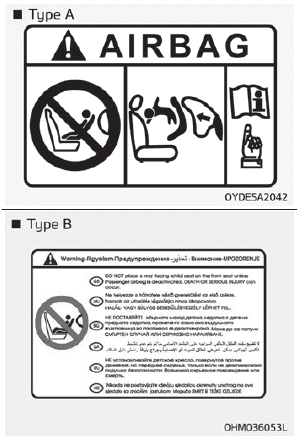
Never install a rear-facing child restraint on the front passenger seat. If the airbag deploys, it may strike the rear-facing child restraint, resulting in serious or fatal injury.
In addition, do not install a forward-facing child restraint on the front passenger seat. If the front passenger airbag deploys, it may result in serious or fatal injury to the child.
If your vehicle is equipped with a passenger front airbag ON/OFF switch, you can activate or deactivate the front passenger airbag as necessary.
WARNING
- NEVER use a rear-facing child restraint on a seat protected by an ACTIVE AIRBAG in front of it. DEATH or SERIOUS INJURY TO THE CHILD may occur.
- Never place a child restraint on the front passenger seat. If the front passenger airbag inflates, it may result in serious or fatal injury.
- When children are seated in the rear side seats of a vehicle equipped with side and/or curtain airbags, be sure to install the child restraint system as far from the door side as possible and securely lock the child restraint system in position. Inflation of the side and/or curtain airbags may result in serious injury or death to an infant or child.
Test yourself
A quick Kia Picanto JA quiz: every answer comes with an explanation and a link to the manual page.