Child Safety Seat
To reduce the risk of injury in an accident or sudden braking or maneuvers, children must sit in the rear seat and must always be properly restrained. Statistics confirm that children are safest when properly restrained in the rear seats. Children too large for a child seat must use the vehicle's seat belts.
You must comply with the laws in force in your country. Child seats and/or infant seats must be correctly installed on the rear seat. Child seats may be purchased commercially but must comply with the laws in force in the country.
Child safety seats are designed to be secured to the vehicle seats using the lap portion of a seat belt, the dedicated anchorage and/or ISOFIX anchorages (if equipped).
If child safety seats are not properly secured, children risk injury or even death in an accident. For small children and infants, use the appropriate child seats. Before buying a child safety seat, make sure it is compatible with both the seats and the seat belts, as well as the child's size.
When installing the child safety seat, follow the instructions provided by the manufacturer.
WARNING
- Child safety seats must be installed on the rear seat. Never install child or infant seats on the front passenger seat. In a collision, the front passenger airbag will deploy and can cause serious or fatal injuries to a child or infant in a child seat. Always install child safety seats on the rear seat only.
- If the vehicle is parked with the windows closed and exposed to sunlight, seat belts and child safety seats can become very hot, even when the outside temperature is not particularly high. Always check that the seats and buckles are not hot before seating a child.
- When the child safety seat is not in use, place it in the luggage compartment or secure it with the seat belt so that it cannot be thrown forward in case of sudden braking or a collision.
- A child seated in the front seat risks being killed if struck by the airbag.
WARNING To reduce the risk of serious or even fatal injury:
- Children, regardless of age, are safer when seated in the rear seats and properly secured. A child seated in the front passenger seat could be violently struck by the airbag, which could cause serious injury or death.
- Always follow the manufacturer's instructions for installing and using the child seat.
- Always make sure the child seat is correctly secured to the seat and the child is correctly secured in the child seat.
- Never hold children on your knees or in your arms while the vehicle is moving. In a collision, the force of impact would tear the child from your arms and throw them against the interior of the vehicle.
- Never wear a seat belt while holding a child in your arms. In a collision, the belt could apply tremendous pressure to the child's body and injure internal organs.
- Never leave children unattended in the vehicle, not even for a moment. The temperature inside the vehicle can rise rapidly and cause serious harm to children left inside. Also, young children may accidentally set the vehicle in motion, get trapped in the windows, or lock themselves or others inside the vehicle.
- Never allow two occupants, whether adults or children, to use the same seat belt.
- Children tend to fidget and may adopt incorrect positions. Never allow a child to position the shoulder belt under their arm or behind their back.Always position and secure children properly in the rear seat.
- Never allow children to stand or kneel on the seat or floor while the vehicle is moving. In a collision or sudden braking, the child could be thrown against the interior of the vehicle, with the risk of serious injury.
- Never use infant seats or child seats that "hook" over the seatback; they may not provide adequate protection in a collision.
- Seat belts can become very hot, especially if the vehicle is left parked in the sun.
Always check that the seat belt buckles are not hot before fastening them on a child.
Using the Child Safety Seat
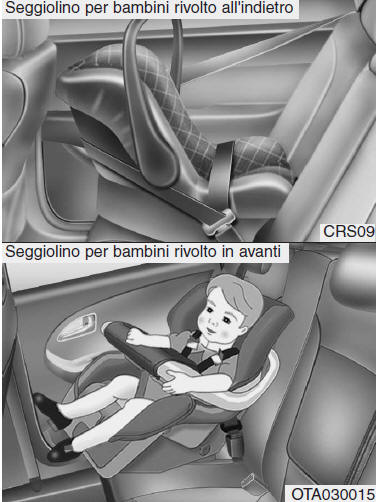
Young children and infants must use appropriate child safety seats.
These child safety seats must be the correct size for the child and must be installed according to the manufacturer's instructions.
For safety reasons, it is recommended to place the child safety seat on the rear seats.
WARNING Never install a rear-facing child seat on the front passenger seat. If the passenger airbag deploys, the impact could be fatal to the child.WARNING - Child Safety Seat Installation
- If the child safety seat is not properly secured to the seat, or if the child is not properly secured in the seat, the child's safety or even life is at serious risk in a collision. Before installing the child safety seat, read the instructions provided by the child seat manufacturer.
- If the seat belt does not work as described in this manual, have the system checked immediately by an authorized Kia dealer.
- Failure to follow the instructions in this manual regarding child safety seats and the instructions provided with the seat may increase the risk and/or severity of injury in a collision.
- If the head restraint prevents correct installation of the child seat (as described in the child seat manual), adjust the head restraint position or remove it completely.
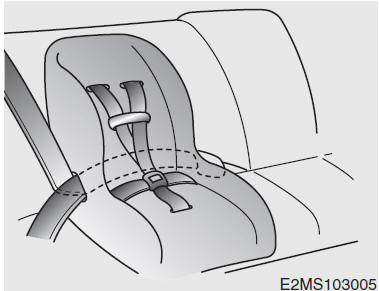
Securing a Child Seat with the Three-Point Seat Belt To install the child safety seat on the outboard or center rear seat:
1. Place the seat on the seat and route the two- or three-point belt around or along it according to the child seat manufacturer's instructions. Make sure the seat belt webbing is not twisted.
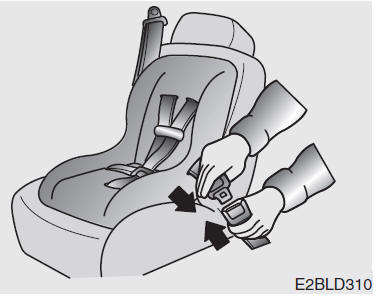
2. Insert the tongue of the lap/diagonal belt into its buckle.
Make sure you hear a "click".
Position the release button so that it is easily accessible in an emergency.
WARNING If the child seat is not securely attached to the seat, or if the child is not properly restrained in the child seat, the child's safety or even life is seriously at risk in an accident. Always follow the manufacturer's instructions when installing and using the child seat.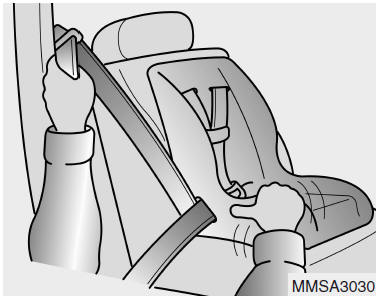
3. Engage the seat belt in the buckle and let the webbing retract. After installation, try to move the child seat in all directions to make sure it is securely fastened.
If the belt needs to be tightened further, pull it toward the retractor.
When the seat belt is released and allowed to retract, the retractor automatically returns to the normal emergency locking mode for the passenger.
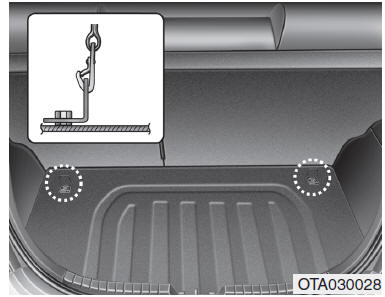
Securing a child seat with the "flexible anchorage" system (if fitted)
The anchor points for the child seat are located on the floor behind the rear seats.
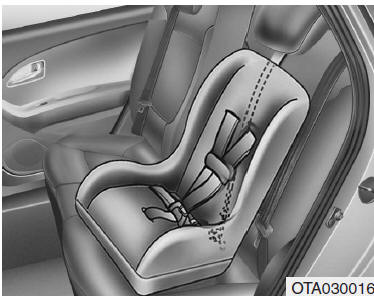
- Route the child seat strap over the backrest.
WARNING - Child seat strap
- If the child seat is not properly secured to the seat, or if the child is not properly restrained in the seat, the child's safety or even life is seriously at risk in the event of an accident. Always follow the manufacturer's instructions for installing and using the child seat.
- Do not secure more than one child seat to the same strap or the same lower anchor point. Excessive load could cause the strap or anchor points to fail, resulting in serious or even fatal injury.
WARNING - Child seat anchorage
- The child seat anchorages are designed to bear the load only if the child seat is installed correctly. Never use them to attach adult seat belts, wiring or anything else.
- The strap may not work properly if it is hooked to anywhere other than its specific anchor point.
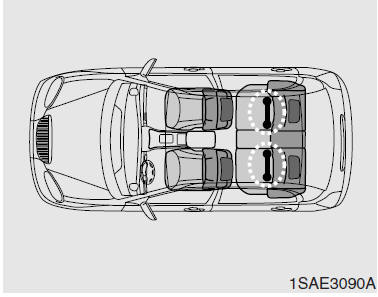
Securing a child seat with the "ISOFIX" system and the "flexible anchorage" system (if fitted) ISOFIX is a standardised method for installing child seats without using the seat belts. As well as making installation simpler and quicker, this system provides a more secure fastening.
ISOFIX child seats may only be installed if they are approved for the specific vehicle or if they are universal, in accordance with regulation ECE-R 44.
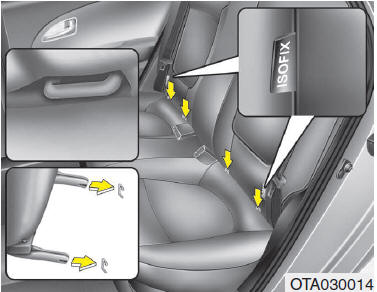
On the lower part of each side of the rear seatbacks there is a child seat symbol. These symbols indicate the position of the lower anchorages on models equipped for fitting child seats.
Both outer rear seats are equipped with a pair of ISOFIX anchorages, as well as a corresponding top tether anchorage located on the rear of the seatback. The ISOFIX anchorages are located between the seat cushion and the seatback and are marked with the ISOFIX icon. To install, the ISOFIX connectors of the child seat must engage the vehicle's ISOFIX anchorages (listen for a CLICK, check any visual indicators on the child seat, and verify by pulling on it).
Universal child seats approved to ECE-R 44 must be further secured with a strap connected to the corresponding anchor point located on the backrest.
Child seats must be installed and used in compliance with the installation manual supplied with the ISOFIX child seat.
WARNING Install the child seat as far back as possible with the seatback in an upright, not reclined, position.WARNING
- When using the "ISOFIX" attachment system to install a child seat on the rear seat of the vehicle, the metal tongues of all unused rear seat belts must be firmly engaged in their buckles and the webbing must be routed behind the child seat, to prevent the child from reaching the seat belt.
To secure the child seat:
1. To attach the child seat to the ISOFIX anchorages, insert the child seat's connecting device into the anchorage. Make sure you hear a "click".
CAUTION During installation, make sure the rear seat belt webbing is not damaged and does not get caught between the ISOFIX attachments and anchors of the child seat.2. Hook the strap onto its anchor point and tighten it to secure the child seat. (See the previous page.)
WARNING
- Do not install child seats on the centre rear seat using the ISOFIX anchorages. The ISOFIX anchorages are intended only for the outer rear seating positions, right and left. Do not misuse the ISOFIX anchorages by attempting to attach a child seat in the centre rear seating position.
In the event of an accident, the ISOFIX anchorages may not be strong enough to hold a child seat installed in the centre rear seating position, and they could break, resulting in serious or even fatal injury.
Suitability of child restraint systems Use child seats that are officially approved and suitable for transporting your children. When using child seats, refer to the following table.
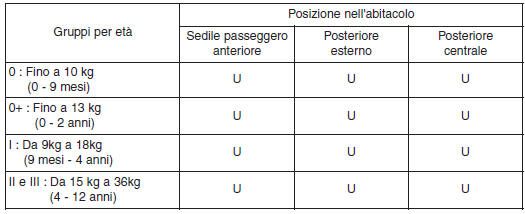
U: Suitable for "universal" child seats approved for this weight
WARNING It is recommended to install the child seat on the rear seat even when the front passenger airbag ON/OFF switch is in the OFF position. To ensure the child's safety, the front passenger airbag must be deactivated when, in exceptional cases, the child seat must be installed on the front seat.Installation positions suitable for child safety seats in vehicles with ISOFIX anchorage points
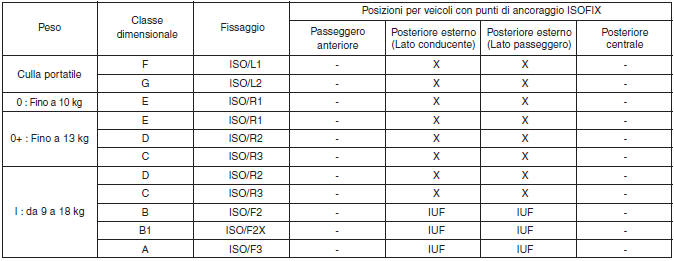
IUF = Suitable for "universal" forward-facing ISOFIX child safety seats approved for this weight.
IL = Suitable for specific ISOFIX child safety seats listed in the attached list.
These seats belong to the categories "vehicle-specific", "restricted" or "semi-universal".
X = Position not suitable for ISOFIX child safety seats for this weight/size class.
* ISO/R2 and ISO/R3 seats can only be installed with the front passenger seat in its most forward position.
* Size classes and fixings of ISOFIX child safety seats.
A - ISO/F3: Forward-facing large child seat (height 720 mm)
B - ISO/F2: Forward-facing reduced-height child seat (height 650 mm)
B1 - ISO/F2X: Forward-facing child seat, second version shaped backrest, reduced height (height 650 mm)
C - ISO/R3: Rear-facing large child seat
D - ISO/R2: Rear-facing reduced-size child seat
E - ISO/R1: Rear-facing infant seat
F - ISO/L1: Seat (portable cradle) positioned longitudinally facing left
G - ISO/L2: Seat (portable cradle) positioned longitudinally facing right
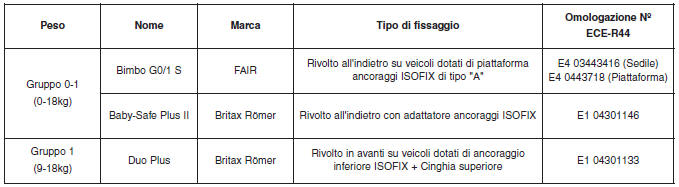
Recommended child safety seats
Test yourself
A quick Kia Picanto JA quiz: every answer comes with an explanation and a link to the manual page.