BCW (Blind-Spot Collision Warning) (if equipped)
Operating Conditions
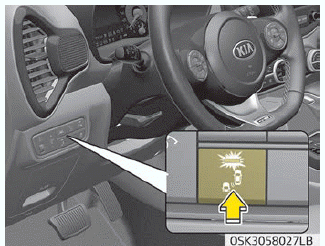
The indicator on the switch illuminates when the BCW button is pressed with the engine start/stop button ON. If the vehicle speed exceeds 30 km/h, the system is activated. Press the button again to turn off the switch indicator and deactivate the system.
If the engine start/stop button is turned OFF and then ON, the system returns to its previous state.
When the system is not in use, turn the system off by pressing the switch. When the system is on, the warning light illuminates for 3 seconds on the outside rearview mirror.
- The driver can activate the system by placing the engine start/stop button in the ON position and selecting "User Settings > Driver Assistance > Blind-Spot Safety".
- BCW is turned on and ready for activation when "Warning Only" is selected. Then, if the vehicle approaches the driver's blind spot zone, a warning sounds.
- The system is deactivated and the BCW button indicator turns off when "Off" is selected. - If you press the BCW button when "Warning Only" is selected, the button indicator turns off and the system is deactivated.
- If you press the BCW button when the system is off, the button indicator illuminates and the system is activated. In this case, the system returns to the state it was in before the vehicle was turned off.
Warning Type
The system is activated when:
1. System is on
2. Vehicle speed is above 30 km/h.
3. Other vehicles are detected behind
WARNING
- Always check road conditions for unexpected situations while driving, even when the Blind-Spot Collision Warning system is operating.
- The Blind-Spot Collision Warning system is a supplemental system that helps you. Do not rely entirely on the system. Always pay attention while driving for your safety.
- The Blind-Spot Collision Warning system does not replace proper and safe driving. Always drive safely and exercise caution when changing lanes or backing up the vehicle. The Blind-Spot Collision Warning system may not detect every object near the vehicle.

If a vehicle is detected within the system's detection zone, the warning light on the outside rearview mirror illuminates.
If the detected vehicle leaves the detection zone, the warning turns off.

The second-stage warning is activated when:
1. Stage 1 warning is activated.
2. The turn signal is activated to change lanes.
When the Stage 2 warning is activated, the warning light on the outside rearview mirror illuminates and the alarm sounds.
If the turn signal switch is returned to its original position, the Stage 2 warning is deactivated.
CAUTION
The alarm function helps alert the driver. Turn this function off only when necessary.
WARNING
- The warning indicator on the outside rearview mirror illuminates whenever the system detects a vehicle behind. To avoid accidents, do not focus only on the warning indicator and neglect what is around the vehicle.
- Drive safely even if the vehicle is equipped with the Blind-Spot Collision Warning system. Do not rely solely on the system; check your surroundings before changing lanes or reversing the vehicle.
- The system may not warn the driver under some conditions, so always check your surroundings while driving.
CAUTION
- The driver must always exercise extreme caution when driving the vehicle, whether or not the indicator light on the outside rearview mirror is illuminated or a warning alarm sounds.
- Playing the vehicle audio system at high volume may mask the Blind-Spot Collision Warning alert sound.
- The Blind-Spot Collision Warning alert may not sound while another system's warning is sounding.
Detection Sensor

The sensors are located inside the rear bumper.
Always keep the rear bumper clean for the system to function properly.
CAUTION
- The system may not operate correctly if the bumper is damaged, or if the rear bumper has been replaced or repaired.
- The detection range varies somewhat depending on road width. When the road is narrow, the system may detect other vehicles in the adjacent lane.
- The system may be deactivated due to strong electromagnetic waves.
- Always keep the sensors clean.
- NEVER disassemble the sensor component on your own or subject it to impact.
- Be careful not to apply unnecessary force to the radar sensor or sensor cover. If the sensor is forcibly moved out of proper alignment, the system may not operate correctly. In this case, a warning message may not be displayed. Have your vehicle inspected by a professional workshop. Kia recommends visiting an authorized Kia dealer/service partner.
- Do not attach foreign objects, such as bumper stickers or bumper guards, near the radar sensor or paint the sensor area. This may adversely affect sensor operation.
Warning Message

A message will appear to notify the driver if there is a foreign substance on or inside the rear bumper, or near the rear bumper is hot. The warning light on the switch illuminates, and the system turns off automatically.
Remove the foreign substance from the rear bumper.
After removing the foreign material, drive for approximately 10 minutes; the system will then operate normally. If the system does not operate normally even after the foreign material, trailer, vehicle, or other equipment has been removed, take the vehicle to a professional workshop and have the system inspected. Kia recommends visiting an authorized Kia dealer/service partner.
The message may appear even when there is no foreign matter on the rear bumper, for example when driving in rural or open areas such as deserts where there is insufficient data for operation.
This message may also be activated during heavy rain or due to road spray. In this case, the vehicle does not require service.
When a cargo compartment or other equipment is used, turn all system functions to [OFF].

If the system does not operate properly, a warning message will appear and the indicator on the switch will turn off. The system will turn off automatically.
In this case, have the system inspected at a professional workshop. Kia recommends visiting an authorized Kia dealer/service partner.
System Limitations
The driver should be careful in the following situations, as the system may not detect other vehicles or objects under certain circumstances.
- When a trailer or carrier is installed.
- The vehicle is driven in bad weather, such as heavy rain or snow.
- The sensor is contaminated with rain, snow, dirt, etc.
- The rear bumper where the sensor is located is covered with foreign objects such as a bumper sticker, bumper guard, bicycle carrier, etc.
- The rear bumper is damaged, or the sensor is not in its original default position.
- The vehicle height becomes lower or higher due to a heavy load in the cargo area, abnormal tire pressure, etc.
- When the temperature of the rear bumper is high.
- When the sensors are blocked by other vehicles, walls, or parking posts.
- The vehicle is driving on a curved road.
- The vehicle passes through a toll gate.
- The road surface (or surrounding ground) contains abnormal metallic components (for example, due to subway construction).
- A stationary object, such as a guardrail, is next to the vehicle.
- When driving down or up a steep road with different lane heights.
- Driving on a narrow road where there are trees, grass, or bushes.
- Driving in rural areas where the sensor does not detect another vehicle or structures for a long period of time.
- Driving on a wet road.
- Driving on a road where the guardrail or wall has a double structure.
- A large vehicle, such as a bus or truck, is nearby.
- When another vehicle approaches very closely.
- When another vehicle passes at very high speed.
- When changing lanes.
- If your vehicle starts moving at the same time as a vehicle next to you and accelerates.
- When a vehicle in the adjacent lane moves two lanes away from you OR when a vehicle two lanes away moves into the lane next to you.
- A motorcycle or bicycle is nearby.
- A flat trailer is nearby.
- If small objects, such as a shopping cart or baby stroller, are in the detection zone.
- If there is a low-profile vehicle, such as a sports car.
- The brake pedal is depressed.
- ESC (Electronic Stability Control) is activated.
- ESC (Electronic Stability Control) is malfunctioning.
- Tire pressure is low or a tire is damaged.
- The brakes are worn.
- The vehicle changes direction abruptly.
- The vehicle changes lanes abruptly.
- The vehicle stops abruptly.
- The temperature around the vehicle is very low.
- The vehicle vibrates strongly when driving on a bumpy road, uneven road surfaces, or concrete sections.
- The vehicle is driving on a slippery surface due to snow, puddles, or ice.
- The Lane Keeping Assist (LKA) or Lane Departure Warning (LDW) system is not operating normally. (if equipped) For more information, refer to "Lane Keeping Assist (LKA) System" on page 6-99.

• Driving on curves
BCW systems may not operate properly when driving on curved roads. In some cases, the system may not detect a vehicle in the adjacent lane.
While driving, always pay attention to the road and driving conditions.

BCW systems may not operate properly when driving on curved roads. In some cases, the system may detect a vehicle in the same lane. Always pay attention to road and traffic conditions while driving.

• Driving where the road merges or diverges
BCW systems may not operate properly when driving on merging/diverging roads. In some cases, the system may not detect a vehicle in the adjacent lane.
While driving, always pay attention to the road and driving conditions.

• Driving on slopes
BCW systems may not operate properly when driving on slopes. In some cases, the system may not detect a vehicle in the adjacent lane. Also, in some cases, the system may misidentify the ground or structures.
While driving, always pay attention to the road and driving conditions.

• Driving on roads with different lane elevations
BCW systems may not operate properly when driving in conditions where the heights of the lanes are different.
In some cases, the system may not detect a vehicle on roads with different lane heights (underpass connection sections, grade-separated intersections, etc.).
Always pay attention to the road and driving conditions while driving. [Noise barrier], [B]: Guardrail

• Driving where there are structures along the road
BCW systems may not operate properly when driving near structures beside the road.
In some cases, the system may misidentify structures (noise barriers, guardrails, double guardrails, median strips, posts, street lights, road signs, tunnel walls, etc.) located along the road as vehicles.
While driving, always pay attention to the road and driving conditions.
Test yourself
A quick Kia Soul Owner's Manual quiz: every answer comes with an explanation and a link to the manual page.