Winter Driving
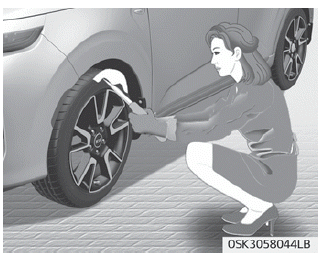
Severe winter weather conditions cause more wear and other problems. To minimize winter driving problems, you should follow these tips:
❈ For winter tires and anti-skid devices for national languages (Icelandic, Bulgarian), see Chapter 10, Appendix.
Snow or Icy Conditions
Driving in deep snow may require the use of winter tires or the installation of snow chains on the tires. If winter tires are needed, be sure to select tires equivalent in size and type to the original equipment tires. Failure to do so may adversely affect the safety and handling of your vehicle. Furthermore, exceeding the speed limit, rapid acceleration, sudden braking, and sharp turns are potentially very dangerous practices.
When braking, use engine braking as much as possible. Sudden braking on snowy or icy roads may cause skidding. Keep a sufficient distance between the vehicle ahead and your vehicle. Also, apply the brake gently. Note that snow chains on the tire will provide greater driving force, but will not prevent lateral skidding.
NOTICE
Snow chains are not permitted in all countries. Check the laws of your country before installing snow chains.
Winter Tires
If you install winter tires on your vehicle, make sure they are radial tires of the same size and load range as the original tires. Install winter tires on all four wheels to balance the handling of your vehicle in any weather conditions. Keep in mind that the traction provided by winter tires on dry roads may not be as high as that of your original tires. You must drive carefully, even when roads are clear. Consult your tire dealer for maximum speed recommendations.
WARNING
Winter Tire Size
Winter tires must be the same size and type as the standard tires. Otherwise, vehicle safety and handling may be adversely affected.
Do not install studded tires without first checking local, state, and municipal regulations regarding possible restrictions on their use.
Tire Chains
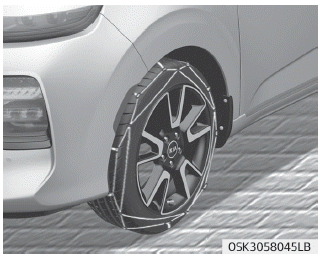
Since the sidewalls of radial tires are thinner, they can be damaged when mounting some types of snow chains on them. Therefore, it is recommended to use winter tires instead of snow chains. Do not install snow chains on vehicles with aluminum wheels; snow chains may damage the wheels. If it is necessary to use snow chains, use wire-type chains less than 12 mm (0.47 in.) thick. Damage to your vehicle caused by improper use of snow chains is not covered by your vehicle manufacturer's warranty. Install snow chains on the front wheels only.
CAUTION
- Make sure the snow chains are the correct size and type for your tires. Using incorrect snow chains may cause damage to the vehicle body and suspension and may not be covered by your vehicle manufacturer's warranty. Also, the snow chain connecting hooks may be damaged by contact with vehicle components, causing the snow chains to come off the tire. Make sure the snow chains meet SAE Class "S" certification.
- Always check the chain installation after driving approximately 0.5 to 1 km (0.3 to 0.6 mile) to ensure safe mounting. Tighten or reinstall the chains if they have loosened.
- Even with the appropriate chains installed, do not make a full turn (fully turn the steering wheel in one direction) while the vehicle is moving. (If you make a full turn, drive at a speed below 10 km/h.)
Chain Installation
When installing chains, follow the manufacturer's instructions and mount them as tightly as possible. Drive slowly with chains installed. If you hear the chains contacting the body or chassis, stop and tighten them. If they still make contact, decelerate until you stop. Remove the chains as soon as you start driving on a cleared road.
WARNING
Installing Chains
When installing snow chains, park the vehicle on a level surface away from traffic. Turn on the hazard warning flashers and place a warning triangle behind the vehicle, if equipped. Always move the shift lever to P (Park), apply the parking brake, and turn off the engine before installing snow chains.
WARNING
Snow Chains
- Using chains may adversely affect vehicle handling.
- Do not exceed 30 km/h or the chain manufacturer's recommended speed limit, whichever is lower.
- Drive carefully and avoid bumps, potholes, sharp turns, and other road hazards that may cause the vehicle to bounce.
- Avoid sharp turns or braking that locks the wheels.
CAUTION
- Chains of incorrect size or improperly installed may damage the brake lines, suspension, body, and wheels of the vehicle.
- Stop and retighten the chains each time you hear them striking the vehicle.
Use high-quality ethylene glycol-based engine coolant.
Your vehicle is factory filled with high-quality ethylene glycol-based engine coolant. This is the only type of coolant that should be used, as it helps prevent corrosion in the cooling system, lubricates the water pump, and prevents freezing. Be sure to replace or add coolant according to the "Maintenance Schedule" on page 8-29. Before winter, check the coolant to make sure its freezing point is sufficient for the temperatures expected during the winter.
Check the Battery and Cables
Winter places additional demands on the battery system. Visually inspect the battery and cables as described on page 8-45. Have the battery charge level checked by a professional workshop. Kia recommends visiting an authorized Kia dealer/service partner.
Change to "winter" engine oil if necessary.
In some climates, it is recommended to use a lower viscosity "winter weight" oil during cold weather. See "Recommendations" on page 9-11. If you are not sure which oil weight you should use, Kia recommends consulting an authorized Kia dealer/service partner.
Inspect Spark Plugs and Ignition System
Inspect the spark plugs as described on page 8-29 and replace them if necessary. Also check all ignition wiring and components to make sure they are not cracked, worn, or otherwise damaged.
To Prevent Door Locks from Freezing
To prevent the locks from freezing, spray an approved anti-freeze lock lubricant or glycerin into the keyhole. If the lock is covered with ice, spray it with an approved de-icer fluid. If the lock is frozen internally, you may thaw it using a heated key. Handle the heated key carefully to avoid injury.
Use Approved Windshield Washer Antifreeze in the System
To keep the washer fluid in the washer system from freezing, add an approved windshield washer antifreeze solution according to the instructions on the container. Windshield washer antifreeze is available from an authorized Kia dealer/service partner and most auto parts stores. Do not use engine coolant or other types of antifreeze, as they may damage the paint finish.
Do Not Let the Parking Brake Freeze
Under certain conditions, your parking brake may freeze in the applied position. This most often occurs when snow or ice accumulates around or near the rear brakes, or if the brakes are wet. If there is a risk that the parking brake may freeze, apply it only temporarily while you first place the shift lever in Park (automatic transmission) or in reverse gear (manual transmission) and block the rear wheels so the vehicle cannot roll. Then release the parking brake.
Do not allow ice and snow to accumulate under
Under certain conditions, snow and ice may accumulate under the fenders and interfere with the steering. When driving in severe winter conditions where this may occur, periodically check the underside of the vehicle to make sure the front wheels and steering components are not blocked.
Carry Emergency Equipment
Depending on the severity of the weather, you should carry appropriate emergency equipment. Some items you may take with you include snow chains, tow straps or chains, a flashlight, emergency flares, sand, a shovel, jumper cables, an ice scraper, gloves, a ground cloth, coveralls, a blanket, etc.
Test yourself
A quick Kia Soul Owner's Manual quiz: every answer comes with an explanation and a link to the manual page.