Tire pressure. Wheels. Air conditioning filter
Tire pressure has a major influence on the handling and efficiency of the Lexus GS L10. This chapter explains the importance of correct tire pressure, inspection methods, and the effects of incorrect values. Tips on load distribution and on measuring correctly with cold tires are also provided. In addition, this section contains important safety information and shows how incorrect tire pressure can negatively affect comfort, control, and safety. A must-read for responsible drivers.
Tire pressure
Always make sure the tire pressure is set correctly. Tire pressure should be checked at least once a month. However, Lexus recommends checking tire pressure every two weeks.
■ Effects of incorrect tire pressure
Driving with incorrect tire pressure can cause the following:
- Increased fuel consumption
- Reduced ride comfort and vehicle control
- Shortened tire life due to wear
- Reduced safety
- Damage to the drivetrain
If a tire keeps losing air, have it inspected by a Lexus dealer or service center, or another qualified repair shop with the proper equipment.
■ Instructions for checking tire pressure
Observe the following when checking tire pressure:
- Tire pressure should only be measured when the tires are cold.
If the vehicle has been parked for at least 3 hours and has not been driven more than 1.5 km (1 mile) afterward, you will get accurate cold tire pressure readings.
- Always use a tire pressure gauge.
It is difficult to judge by eye whether tire pressure matches the specified value.
- It is normal for tire pressure to be higher after driving, because heat builds up in the tire. Do not reduce tire pressure after driving.
Do not reduce tire pressure after driving.
- The weight of occupants and cargo must be distributed so that the vehicle is loaded evenly.
WARNING
■ Correct tire pressure is essential for safe tire performance. Maintain the specified tire pressure.
If the tire pressure of individual tires does not match the specified values, the following may occur, and accidents resulting in death or serious injury may happen:
- Excessive wear
- Uneven wear
- Poor vehicle handling
- Risk of tire blowout due to overheating
- Air may leak between the tire and the wheel
- Wheel deformation and/or tire damage
- Increased risk of tire damage while driving (caused by hazardous road conditions, expansion joints, sharp edges on the road surface, etc.)
■ When checking and adjusting tire pressure
Do not forget to screw the valve caps back on.
Without the valve cap, dirt and moisture can enter the valve and cause air leakage, which reduces tire pressure.
Wheels
If a wheel is bent, cracked, or severely corroded, it must be replaced. Otherwise, the tire may separate from the wheel or the driver may lose control of the vehicle.
Selecting wheels
When replacing wheels, make sure the new wheels match the original wheels in load capacity, diameter, rim width, and positive offset*.
New wheels are available from any Lexus dealer or service center, or another qualified repair shop with the proper equipment.
*: Commonly referred to as "offset."
Lexus recommends that you do not use the following wheels:
- Wheels of different sizes or types
- Used wheels
- Bent wheels that have been straightened
- Steel wheels (except for a GS200t with a steel spare wheel)
Precautions for aluminum alloy wheels
- Use only Lexus wheel nuts and a Lexus wheel nut wrench for aluminum alloy wheels.
- After rotating, repairing, or changing tires, check that the wheel nuts are still tight after 1,600 km (1,000 miles).
- When installing snow chains, take care not to damage the aluminum alloy wheels.
- To balance the wheels, use only genuine Lexus balance weights or equivalent, and a plastic or rubber mallet.
■ When replacing wheels (vehicles with Tire Pressure Warning System)
The wheels of your vehicle are equipped with valves and transmitters that allow the Tire Pressure Warning System to issue a timely warning when tire pressure drops.
When replacing wheels, the Tire Pressure Warning System valves and transmitters must also be installed.
WARNING
■ Replacing wheels
- Do not use wheels with a size different from the size specified in the owner's manual, as this may cause loss of vehicle control.
- A tire that has lost air and is tubeless must never be repaired by inserting a tire tube. This may cause an accident resulting in fatal or serious injury.
- Do not use steel wheels. The wheel mounting surface could be damaged, and the wheel could come off while driving, which may cause an accident resulting in serious or fatal injury. (Except for a GS200t with a spare wheel with a steel rim)
■ Do not use damaged wheels.
Do not use wheels that have cracks or deformation.
Otherwise, air may escape from the tire while driving, which may cause an accident.
NOTICE■ Replacing the tire pressure warning system valves and transmitters (vehicles with tire pressure warning system)
- Tire repair or tire replacement may affect the tire pressure warning system valves and transmitters. Have the tires serviced by a Lexus dealer or authorized service center, or another qualified repair shop with suitable equipment. Also make sure that you purchase tire pressure warning system valves and transmitters only from a Lexus dealer or authorized service center, or another qualified repair shop with suitable equipment.
- Make sure that only genuine Lexus wheels are fitted to your vehicle.
With non-genuine wheels, the tire pressure warning system valves and transmitters may not function properly.
Air Conditioning Filter
The air conditioning filter must be replaced regularly to maintain air conditioning performance.
Removal Procedure
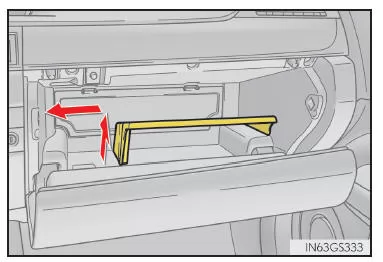
- Turn the engine switch off.
- Open the glove box.
Lift up the side with the stopper, release the claws of the stopper, and pull out the partition horizontally.
- Press the claws and remove the filter cover.
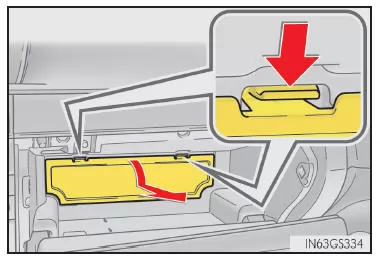
- Press the claws and remove the filter case.
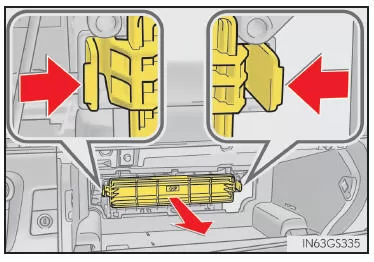
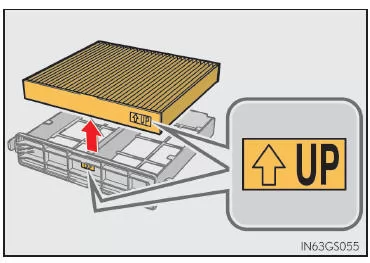
- Remove the air conditioning filter from the filter case and replace it with a new one.
The "↑UP" markings on the filter and the filter case must point upward.
■Replacement Interval
Inspect and replace the air conditioning filter according to the maintenance schedule. In dusty areas or areas with heavy traffic, earlier replacement may be necessary. (For scheduled maintenance information, refer to the "Lexus Maintenance Log" or the "Lexus Warranty Information" booklet.)
■ When the airflow from the vents noticeably decreases
The filter may be clogged. Check the filter and replace it if necessary.
■ Air Conditioning Filter with Odor Neutralizing Function
If you place air fresheners in your vehicle, the odor neutralizing effect may decrease significantly after a short time.
Replace the air conditioning filter if odors continue to come from the air conditioning system.
NOTICE■ Using the Air Conditioning System
Always make sure a filter is installed.
Operating the air conditioning system without a filter may damage it.
Correct tire pressure is essential for the driving safety of the Lexus GS GRL1 (2016–2020). Optimal pressure improves ride comfort, enhances driving stability, and extends tire service life. The clear instructions for checking and adjusting tire pressure help minimize risks.
The high-quality wheel design and recommended genuine parts emphasize the premium character of the Lexus GS 4th generation sports sedan.
FAQHow often should tire pressure be checked?
At least once a month, preferably every two weeks, especially before long trips.
Why should only genuine wheels be used?
Only genuine wheels guarantee the correct function of the tire pressure warning system and driving safety.
Test yourself
A quick Lexus GS quiz: every answer comes with an explanation and a link to the manual page.