Engine compartment
The engine compartment of the Lexus GS L10 is designed for functionality and provides easy access to all maintenance points. This chapter describes the location of the battery, coolant reservoir, oil dipstick and fuse boxes and gives clear instructions for checking and topping up oil and coolant. Safety notes on working on a hot engine and on the proper disposal of used oil are particularly emphasized. This ensures that maintenance of the Lexus GS is carried out safely and in an environmentally friendly manner.
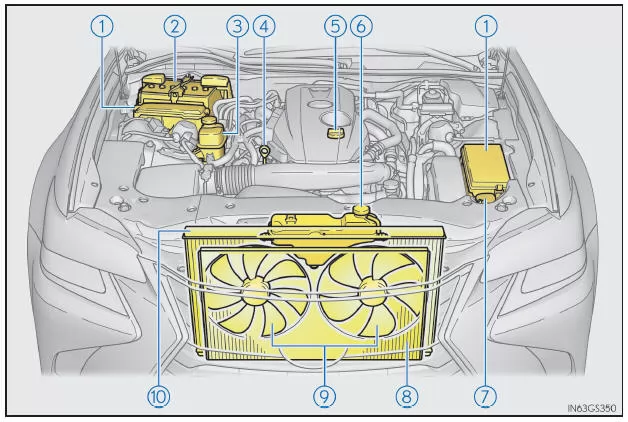
GS350

- Fuse boxes
- Battery
- Oil dipstick
- Engine coolant reservoir
- Oil filler cap
- Windshield washer fluid reservoir
- Electric cooling fans
- Condenser
- Radiator
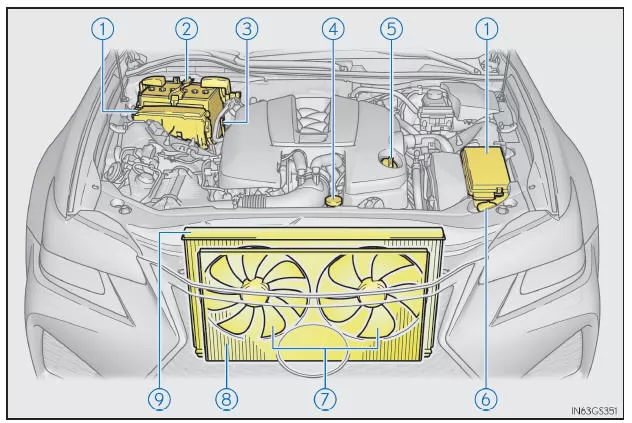
GS200t
- Fuse boxes
- Battery
- Intercooler coolant reservoir
- Oil dipstick
- Oil filler cap
- Engine coolant reservoir
- Windshield washer fluid reservoir
- Condenser
- Electric cooling fans
- Radiator
GS F
- Fuse boxes
- Battery
- Oil dipstick
- Engine coolant reservoir
- Oil filler cap
- Windshield washer fluid reservoir
- Electric cooling fans
- Condenser
- Radiator
Right-hand drive vehicles: The battery and the fuse box in front of the battery are located on the opposite side of the engine compartment.
Engine compartment cover
■ Removing the engine room cover
GS350/GS200t (Right Side)
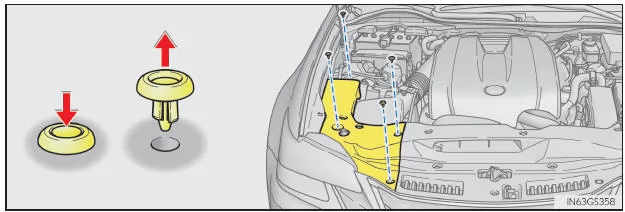
GS350/GS200t (Center)
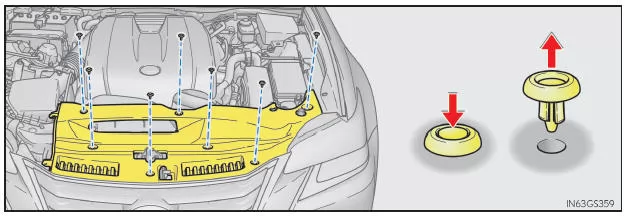
GS F
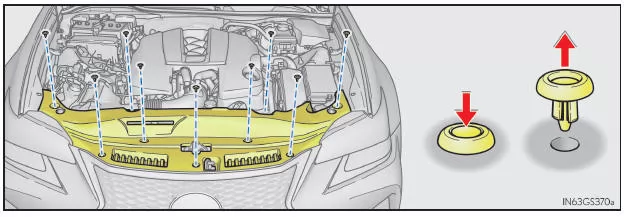
■ Installing the clips
- Press the center section upward
- Insert
- Press
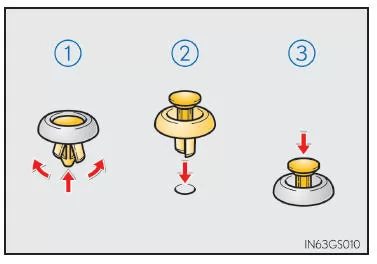
■ Checking the engine room cover after installation
Make sure the cover is securely installed in its original position.
Engine oil
Check the engine oil level with the dipstick while the engine is at operating temperature and stopped.
■ Checking the engine oil level
- Park the vehicle on level ground. After warming up the engine and turning it off, wait more than 5 minutes so the oil can drain back into the oil pan.
- Hold a rag under the end and pull out the dipstick.
GS350
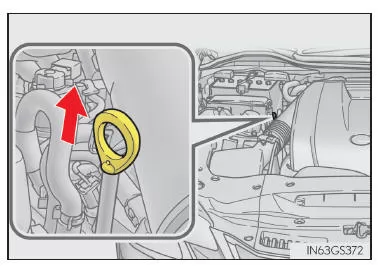
GS200t
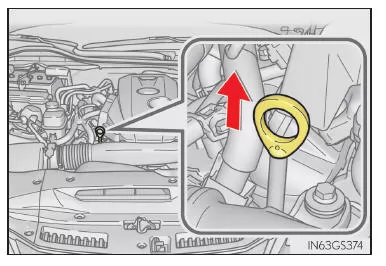
GS F

- Wipe the dipstick clean.
- Reinsert the dipstick fully.
- Hold a rag under the end, pull out the dipstick and check the oil level.
Smooth dipstick
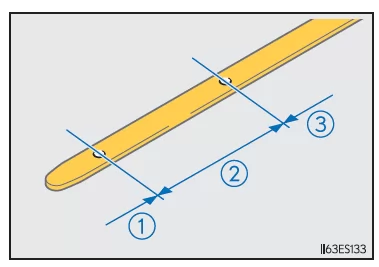
Non-smooth dipstick

Depending on the vehicle or engine type, the shape of the dipstick may differ.
- Wipe the dipstick clean and reinsert it fully.
■ Adding engine oil
Add engine oil of the same type if the oil level is at or near the MIN mark.
GS350

GS200t

GS F

Make sure you use the correct oil type and have the tools needed for adding oil ready.
| Selecting the correct engine oil | |
| Oil capacity (MIN → MAX) | 1,5 L |
| Supplies | Clean funnel |
- Turn the oil filler cap counterclockwise to remove it.
- Add the engine oil slowly while checking the dipstick.
- Turn the oil filler cap clockwise to reinstall it.
■ Engine oil consumption
Some engine oil is consumed during driving. Oil consumption may increase in the following cases, and engine oil may need to be topped up between regular oil change intervals.
- When the engine is new, for example right after purchasing the vehicle or replacing the engine
- When low-quality oil or oil with the wrong viscosity is used
- When driving at high engine speeds or under heavy load, when towing a trailer, or when frequently accelerating and braking
- When the engine idles for long periods or when driving frequently in heavy traffic
■ After changing the engine oil (GS350/GS200t)
The engine oil maintenance data must be reset. Proceed as follows:
- Press
 or
 on the instrument switch and select
 .
- Press
 or
 on the instrument switch and select "Vehicle Settings". Then press
 .
- Press or on the instrument switch and select "Oil Maintenance".
Then press
. - Select "Yes" and press.
- A message is displayed on the multi-information display.

WARNING
■ Used oil
- Used oil contains harmful substances that may cause skin inflammation and skin cancer. Avoid prolonged or repeated skin contact with used oil. Wash used oil off the skin thoroughly with soap and water.
- Dispose of used engine oil and used oil filters only in a safe manner and in accordance with local regulations. Do not dispose of used oil or used filters in household waste, down drains, or on the ground.For information on recycling or disposal, contact a Lexus dealer or authorized repair shop, another qualified and properly equipped specialist workshop, or a gas station or auto parts store.
- Keep used oil out of the reach of children.
■ To prevent serious engine damage
Check the engine oil level regularly.
■ When changing engine oil
- Be careful not to spill engine oil on vehicle components.
- Do not overfill, as this could damage the engine.
- Check the oil level with the dipstick each time you add oil.
- Make sure the oil filler cap is securely tightened.
Coolant
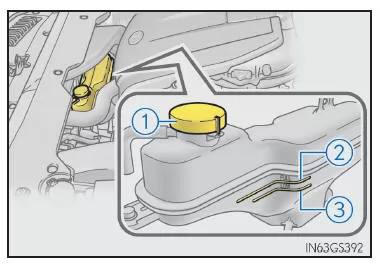
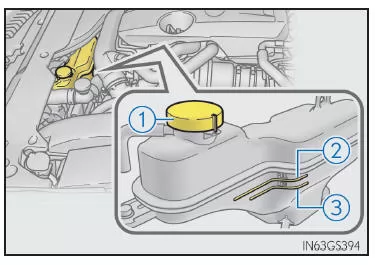
With the engine cold, the coolant level should be between the "FULL"/"F" and "LOW"/"L" marks on the reservoir.
■ Engine coolant reservoir
- Coolant reservoir cap
- "FULL" mark
- "LOW" mark
GS350
GS200t
GS F
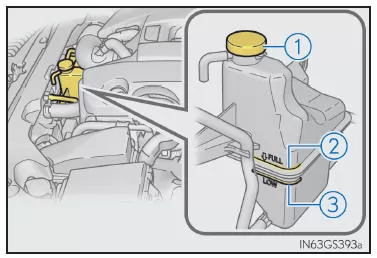
If the level is at or below the "LOW" mark, add coolant up to the "FULL" mark.
■ Intercooler coolant reservoir (GS200t only)

- Coolant reservoir cap
- "F" mark
- "L" mark
If the level is at or below the "L" mark, add coolant up to the "F" mark.
■ Selecting the correct coolant
Use only "Toyota Super Long Life Coolant" or an equivalent high-quality ethylene glycol-based coolant without silicate, amine, nitrite, and borate compounds, based on long-life hybrid organic acid technology.
"Toyota Super Long Life Coolant" is a mixture of 50% coolant and 50% distilled water. (Suitable for temperatures down to: -35 C) For more details about coolant, contact any Lexus dealer or authorized repair shop, or another qualified and properly equipped specialist workshop.
■ If the coolant level drops again shortly after adding coolant
Visually inspect the radiator, hoses, engine coolant reservoir cap, drain cock, and water pump.
If you cannot find the leak, have the cap and cooling system checked for leaks by a Lexus dealer or authorized repair shop, or another qualified and properly equipped specialist workshop.
WARNING
■ If the engine has overheated
Do not remove the cap from the engine coolant reservoir, the intercooler coolant reservoir, or the coolant inlet. (→ P. 630) The cooling system may be under pressure, and if the cap or lid is removed, hot coolant may spray out and cause serious injury, such as burns.
NOTICE■ When adding coolant
Neither plain water nor pure antifreeze is suitable as coolant. Only the correct mixture of water and antifreeze ensures proper lubrication, corrosion protection, and cooling. Always read the label on the antifreeze or coolant.
■ If coolant is spilled
Rinse it off with water to prevent damage to components or paint.
Radiator and Condenser
Check the radiator and condenser and remove any foreign objects.
If any of the above parts are heavily soiled or you are unsure of their condition, have your vehicle checked by a Lexus dealer or authorized repair shop, or another qualified and properly equipped specialist workshop.
WARNING
■ If the engine has overheated
Do not touch the radiator or condenser, as they may be hot and cause serious injury, such as burns.
Battery
Check the battery as follows.
■ Warning symbols
The warning symbols on top of the battery have the following meanings:

■ Battery exterior
Make sure the battery terminals are not corroded and that there are no loose connections, cracks, or loose clamps.
- Terminal clamps
- Hold-down bracket

■ Checking the battery fluid level
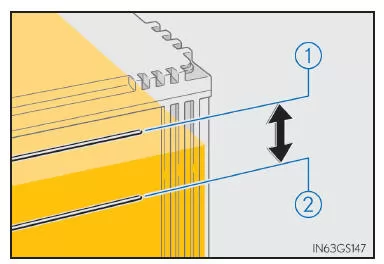
Make sure the level is between the "UPPER LEVEL" and "LOWER LEVEL" lines.
- "UPPER LEVEL" line
- "LOWER LEVEL" line
If the fluid level is at or below the "LOWER LEVEL" line, add distilled water.
■ Adding distilled water
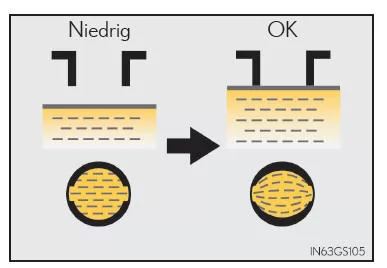
- Unscrew the cap.
- Add distilled water.
- Reinstall the cap and tighten it securely.
■ Before charging
When charging, the battery produces flammable and explosive hydrogen gas.
Therefore, observe the following before charging:
- If the battery is charged while installed in the vehicle, disconnect the negative cable first.
- Make sure the charger is switched off when connecting or disconnecting the charging cables to the battery.
■ After charging/reconnecting the battery
The engine may not start. To initialize the system, follow these steps.
- Shift the shift lever to "P".
- Open and close one of the doors.
- Start the engine again.
- Immediately after reconnecting the battery, it may not be possible to unlock the doors with the smart access and start system. If this is the case, use the remote control or the mechanical key to lock/unlock the doors.
- Start the engine with the engine switch in ACCESSORY mode. The engine may not start if the engine switch is off. However, the engine will work normally on the second attempt.
- The engine switch mode is stored by the vehicle. When the battery is reconnected, the vehicle returns the engine switch mode to the state it was in before the battery was disconnected. Always turn the engine off before disconnecting the battery. Be especially careful when reconnecting the battery if the engine switch mode was not known before the battery discharged.
If the engine still does not start with either method after several attempts, contact a Lexus dealer or authorized service center, or another qualified repair shop with suitable equipment.
WARNING
■ Chemicals in the battery
The battery contains toxic and corrosive sulfuric acid and can produce flammable and explosive hydrogen gas. When working on or near the battery, follow these precautions to minimize the risk of death or serious injury:
- To prevent sparks, do not touch the battery terminals with tools.
- Do not smoke or light a match near the battery.
- Avoid contact with eyes, skin, or clothing.
- Never inhale or swallow electrolyte.
- Wear protective eye wear when working near the battery.
- Keep children away from the battery.
■ Safe places to charge the battery Always charge the battery in an open area. Do not charge the battery in a garage or poorly ventilated room.
■ First aid for electrolyte contact
- If electrolyte gets in the eyes. Flush eyes with clean water for at least 15 minutes and seek medical attention immediately. If possible, continue to apply water with a sponge or cloth on the way to the nearest doctor.
- If electrolyte gets on the skin. Rinse the affected area thoroughly with water. If pain or burning persists, seek medical attention immediately.
- If electrolyte gets on clothing. Electrolyte can soak through clothing to the skin. Remove the clothing immediately and, if necessary, follow the steps above.
- If electrolyte is accidentally swallowed. Drink plenty of water or milk. Seek medical attention immediately.
■ When recharging the battery
Never charge the battery with the engine running. Also make sure all accessories are turned off.
■ When adding distilled water
Avoid overfilling. Water that overflows during battery charging can cause corrosion.
Washer fluid
If a windshield washer does not work or the corresponding warning message appears on the multi-information display, the washer fluid reservoir may be empty. Add washer fluid.
GS350/GS200t
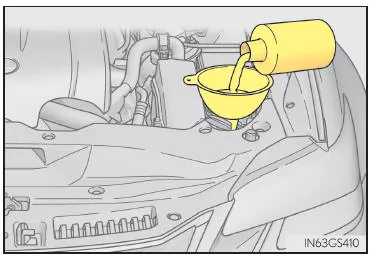
GS F

WARNING
■ Adding washer fluid
Never add washer fluid when the engine is hot or running, as the washer fluid contains alcohol and could ignite if it contacts the engine or other hot components.
NOTICE■ Do not use any fluids other than washer fluid
Do not use soapy water or engine antifreeze as washer fluid.
This may cause streaking on the painted surfaces of the vehicle.
■ Diluting washer fluid
Dilute the washer fluid with water as needed.
Observe the freezing temperatures shown on the label of the washer fluid bottle.
The engine compartment of the Lexus GS GRL1 (4th generation) is well laid out and allows easy maintenance of the main components such as the battery, fuses, and fluid reservoirs. All components are clearly labeled, which makes handling easier even for less experienced drivers.
The precise instructions for checking oil and coolant and for adding fluids safely reflect the premium character of this sport sedan. This keeps the Lexus GS 2016–2020 a reliable everyday companion.
FAQHow often should the engine oil level be checked?
Lexus recommends checking it regularly before long trips and at least once a month.
Why is the correct coolant important?
Only the correct coolant optimally protects the engine from overheating and corrosion.
Test yourself
A quick Lexus GS quiz: every answer comes with an explanation and a link to the manual page.