Solenoid Valve Inspection [FS5 A EL]
Water or foreign objects entering the connector can cause a poor connection or corrosion. Be sure not to drop water or foreign objects on the connector when disconnecting it.
1. Perform the following procedures.
a. Remove the battery cover..
b. Disconnect the negative battery cable.
c. Remove the air cleaner component..
d. Disconnect the coupler component connector.
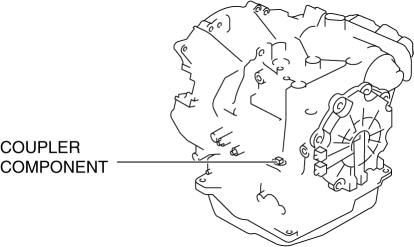
2. Measure the resistance between the coupler component terminals.
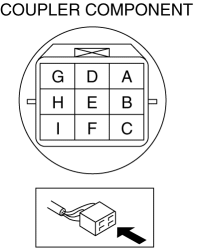
If there is any malfunction, inspect the coupler component for continuity.
If coupler component has no malfunction, perform the “Off-vehicle inspection“..
Solenoid valve |
Terminal |
Resistance (ohm) |
Pressure control solenoid A |
D↔I |
2.4—7.3 |
Shift solenoid A |
A↔GND |
1.0—4.2 |
Shift solenoid B |
C↔GND |
1.0—4.2 |
Shift solenoid C |
G↔GND |
1.0—4.2 |
Shift solenoid D |
B↔GND |
10.9—26.2 |
Shift solenoid E |
F↔GND |
10.9—26.2 |
Operating inspection CAUTION:
Do not apply battery positive voltage to terminals for more than 3 s.
Because the operation sound of the solenoid valve is small, perform inspection in a quiet place.
1. Perform the following procedures.
a. Remove the battery cover..
b. Disconnect the negative battery cable.
c. Remove the air cleaner component..
d. Disconnect the coupler component connector.
2. Apply battery positive voltage to the coupler component terminals A, B, C, F or G and battery negative voltage to GND, and verify that operating sound is heard from solenoid valve.
If the operation sound is not heard, inspect the coupler component for continuity.
If coupler component has no malfunction, perform the “Off-vehicle inspection“..
3. Apply battery positive voltage to the coupler component terminal D and battery negative voltage to terminal I, and verify that operating sound is heard from solenoid valve.
If the operation sound is not heard, inspect the coupler component for continuity.
If coupler component has no malfunction, perform the “Off-vehicle inspection“..
1. Measure the resistance between the solenoid valve terminals.
If there is any malfunction, replace the solenoid valve..
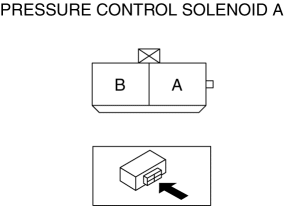
- Pressure control solenoid A specification
2.4—7.3 ohms
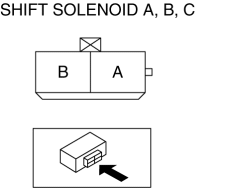
- Shift solenoid A, B, C specification
1.0—4.2 ohms
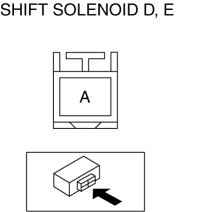
- Shift solenoid D, E specification
10.9—26.2 ohms
1. Perform the following procedures.
a. Remove the battery cover..
b. Disconnect the negative battery cable.
c. Remove the battery component (ex: battery, battery tray and PCM component)..
d. Disconnect the coupler component connector.
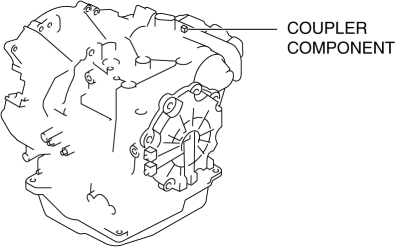
2. Measure the resistance between the coupler component terminals A and B.
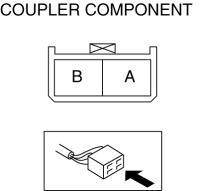
If there is any malfunction, inspect the coupler component for continuity.
If coupler component has no malfunction, perform the “Off-vehicle inspection“..
Solenoid valve |
Terminal |
Resistance (ohm) |
Pressure control solenoid B |
A↔GND |
1.0—4.2 |
Shift solenoid F |
B↔GND |
8.4—21.8 |
Operating inspection CAUTION:
Do not apply battery positive voltage to terminals for more than 3 s.
Because the operation sound of the solenoid valve is small, perform inspection in a quiet place.
1. Perform the following procedures.
a. Remove the battery cover..
b. Disconnect the negative battery cable.
c. Remove the battery component (ex: battery, battery tray and PCM component)..
d. Disconnect the coupler component connector.
2. Apply battery positive voltage to the coupler component terminals A, B and battery negative voltage to GND, and verify that operating sound is heard from solenoid valve.
If the operation sound is not heard, inspect the coupler component for continuity.
If coupler component has no malfunction, perform the “Off-vehicle inspection“..
1. Measure the resistance between the solenoid valve terminals.
If there is any malfunction, replace the solenoid valve..
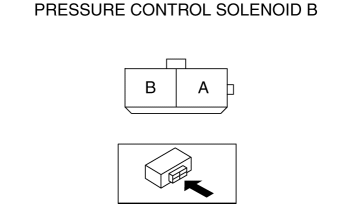
- Pressure control solenoid B specification
1.0—4.2 ohms
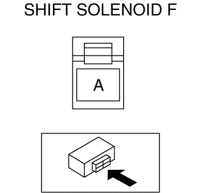
- Shift solenoid F specification
8.4—21.8 ohms
Test yourself
A quick Mazda 3 quiz: every answer comes with an explanation and a link to the manual page.