Specifications
Dual-circuit hydraulic brake system with vacuum brake booster.
The brake booster incorporates Brake Assist (BAS).
Ventilated discs at the front and solid discs at the rear.
Mechanical parking brake operated by a floor-mounted lever and cables acting on the rear wheels.
Anti-lock braking system (ABS) with electronic stability program (ESP), including traction control (ASR), fitted as standard across the range.
Front brakes
Ventilated disc brakes with single-piston floating calipers.
DISCS
New thickness:
- petrol engine: 22 mm,
- diesel engine: 25 mm.
Wear limit:
- petrol engine: 19.4 mm,
- diesel engine: 22.4 mm.
Wear limit during servicing:
- petrol engine: 20 mm,
- diesel engine: 23 mm.
PADS
New thickness (with backing plate):
- petrol engine: 18.7 mm,
- diesel engine: 19.7 mm.
Wear limit (without backing plate): 2 mm.
Wear limit (with backing plate):
- petrol engine: 11.2 mm,
- diesel engine: 11.7 mm.
Wear limit (without backing plate) during servicing:
- petrol engine: 5 mm,
- diesel engine: 5.5 mm.
Wear limit warning: 3 mm
Rear brakes
Solid disc brakes with single-piston floating calipers, with automatic wear adjustment and integrated parking brake mechanism.
DISCS
New thickness: 8 mm.
Wear limit: 7 mm.
Wear limit during servicing: 7.3 mm.
PADS
New thickness (with backing plate): 14.4 mm.
Wear limit (without backing plate): 2 mm.
Wear limit (with backing plate): 8 mm.
Wear limit (without backing plate) during servicing: 3.5 mm.
Controls
BRAKE BOOSTER
Vacuum brake booster with mechanical brake assist device across the range.
MASTER CYLINDER
Tandem master cylinder.
BRAKE FLUID RESERVOIR
The brake fluid reservoir is mounted above the master cylinder and incorporates a level sensor.
It supplies the hydraulic clutch circuit on vehicles fitted with a manual gearbox.
PARKING BRAKE
Mechanical parking brake operated by cables acting on the rear wheels.
VACUUM PUMP (DIESEL)
Pump mounted on the front housing, driven by the exhaust camshaft, supplying vacuum to the brake booster.
Brake assist management
ABS/ESP/BAS BRAKING SYSTEM
The Bosch ESP stability control is fitted as standard across the entire range. This active safety system improves vehicle stability in all situations. It works by acting individually on the brakes of one or more wheels and/or on engine management. It includes the following functions:
- anti-lock braking system (ABS),
- emergency brake assist (BAS),
- traction control (ASR),
- engine torque control on deceleration (MSR) during heavy downshifts,
- tyre pressure loss detection (RDW) by comparing wheel speeds in a straight line.
ELECTROHYDRAULIC UNIT
It is located near the front left wheel arch, under the brake fluid reservoir (Fig. 1).
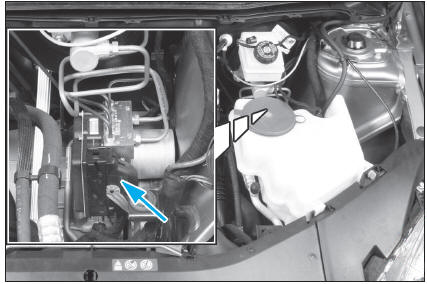
Fig. 1
CONTROL UNIT
Digital electronic control unit with 46 pins (numbered 1 to 46) (Fig. 2).
Control unit connector pin assignment (Fig. 2)
| Pins | Assignments |
| 1 | Ground |
| 2 | Power supply via fuse 9 |
| 3 | Power supply via fuse 15 |
| 4 | Ground |
| 13 | Front left wheel speed sensor signal |
| 15 | Rear left wheel speed sensor |
| 16 | Rear left wheel speed sensor signal |
| 18 | Rear right wheel speed sensor signal |
| 20 | Brake light switch |
| 21 | Front right brake pad wear switch |
| 25 | Low line of the yaw rate and lateral acceleration sensor |
| 28 | Power supply after ignition via fuse 25 |
| 29 | High line of the engine CAN bus |
| 30 | Low line of the engine CAN bus |
| 33 | Front right brake pad wear switch ground |
| 34 | Front left wheel speed sensor |
| 36 | Brake fluid level warning switch |
| 38 | Rear right wheel speed sensor |
| 39 | Front right wheel speed sensor |
| 40 | Front right wheel speed sensor signal |
| 41 | Parking brake warning switch |
| 44 | Vehicle speed output signal |
| 45 | Brake light switch |
| 46 | High line of the yaw rate and lateral acceleration sensor |
| Unused pins: 5 to 12, 14, 17, 19, 22 to 24, 26, 27, 31, 32, 35, 37, 42 and 43 | |
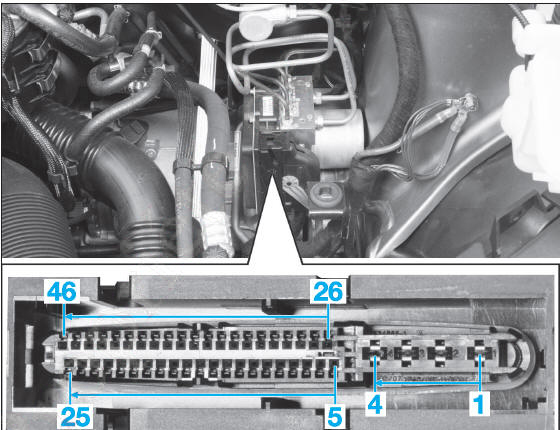
Identification of the ABS/ESP control unit connector pins.
YAW RATE AND LATERAL ACCELERATION SENSOR
This sensor is located near the handbrake lever (Fig. 3). It detects the vehicle's rotation speed around its vertical axis and the lateral acceleration.
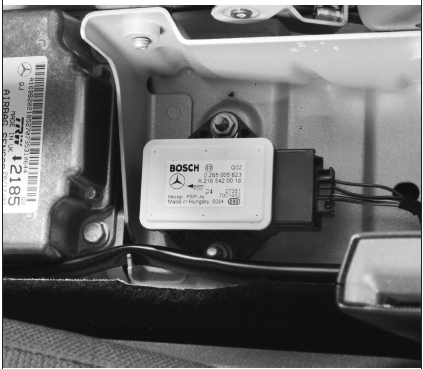
Location of the yaw rate and lateral acceleration sensor, Fig. 3
The arrow indicates the front of the vehicle
WHEEL SPEED SENSORS
The front wheel speed sensors are mounted on the steering knuckles (Fig. 4), while the rear wheel speed sensors are fixed to the wheel carrier (Fig. 5).
They are powered by the ABS control unit.
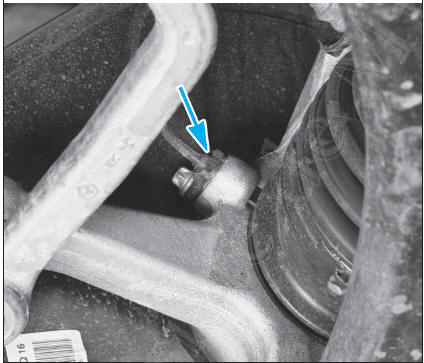
Location of the front wheel speed sensor, Fig. 4
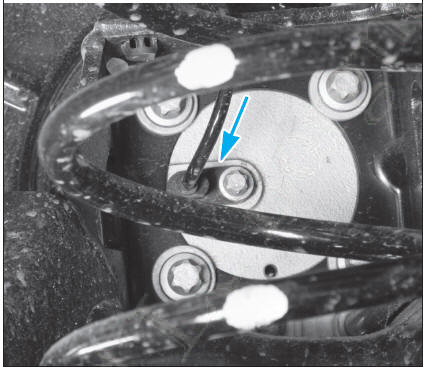
Location of the rear wheel speed sensor, Fig. 5
STEERING WHEEL ANGLE SENSOR
The steering wheel angle sensor is mounted on the steering column, behind the steering wheel (Fig. 6). It detects the steering wheel position and sends it to the multiplex network.
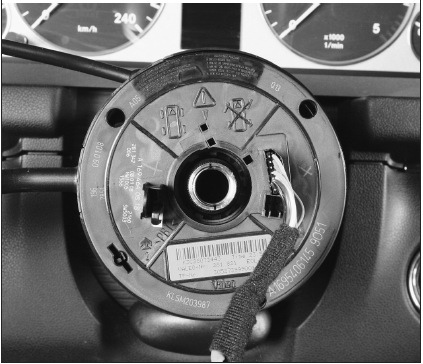
Location of the steering wheel angle sensor, Fig. 6
Specifications
BRAKE FLUID
Specification:
Synthetic fluid meeting DOT 4 Plus specifications.
Capacity:
0.6 litre.
Observe the 'MIN' and 'MAX' level marks on the reservoir.
Service interval: Replace and bleed every 2 years.
Test yourself
A quick Mercedes-Benz B-Class quiz: every answer comes with an explanation and a link to the manual page.