Brakes
Anti-lock braking system (ABS)
In this manual: Brakes
~2min read
ELECTROHYDRAULIC UNIT
REMOVAL AND REFITTING
 Before working on the brake hydraulic circuit or disconnecting a fitting, allow the fluid to drain and protect the surrounding area. Then plug all open ports with suitable caps.
- Disconnect the battery.
- Set the washer fluid reservoir aside without disconnecting the hoses.
- Using a syringe, draw out as much brake fluid as possible from the expansion reservoir.
- Disconnect the lines (1) (Fig.29) from the hydraulic unit.
- Unlock and disconnect the connector (2) from the ABS/ESP control unit.
- Unclip the hydraulic control unit bracket at (a).
- Lift the hydraulic control unit out upwards.
To refit, reverse the removal procedure and observe the following:
- observe the tightening torques,
- bleed the brake system,
- pump the brake pedal several times,
- check the brake fluid level,
- read and, if necessary, clear the fault memory,
- check braking efficiency and ABS operation.
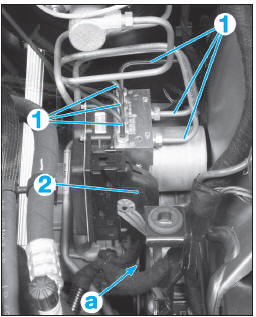
Fig. 29
CONTROL UNIT
REMOVAL AND REFITTING
- Disconnect the battery.
- Set the washer fluid reservoir aside without disconnecting the hoses.
- Unlock and disconnect the connector (1) from the ABS/ESP control unit (Fig.30).
- Remove the 4 control unit mounting bolts (arrows).
- Remove the control unit from the hydraulic unit.
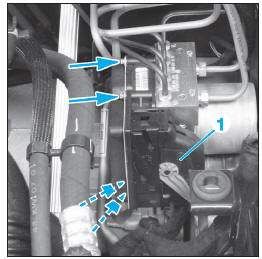
Fig. 30
To refit, reverse the removal procedure and observe the following:
- check the seal for damage and correct positioning; if the seal is not secured or is damaged, replace the control unit,
- do not rethread the hole in the hydraulic unit.
If the thread is damaged or the torque cannot be reached, replace the hydraulic unit,
- replace the control unit mounting bolts,
- check the brake fluid level,
- read and, if necessary, clear the fault memory,
- check braking efficiency and ABS operation.
Test yourself
A quick Mercedes-Benz B-Class quiz: every answer comes with an explanation and a link to the manual page.
Was this page helpful?