Garage Door Opener
The integrated HomeLink garage door opener in the Mercedes E-Class (4th generation, W212, 2009–2016) makes it easier to operate gates and barriers. This section describes programming, use and safety information so that operation is convenient and safe.
General Notes
The integrated HomeLink garage door opener in the interior mirror can operate up to three different door and gate systems.After programming, the integrated garage door opener in the interior mirror takes over the function of the garage door system's remote control. See also the operating instructions for the garage door system.
When programming a garage door opener, park the vehicle outside the garage. Do not leave the engine running during programming.The garage door opener is only available in certain countries. Observe the legal regulations in each country.
The HomeLink garage door opener is compatible with most garage and external gate drives within Europe. For more information about HomeLink and/or compatible products, contact:- at a qualified specialist workshop
- via the HomeLink hotline (0) 08000 466 354 65 or alternatively +49 (0) 6838 907-277
- on the Internet at:
Important Safety Notes
WARNINGWhen you operate or program the garage door with the integrated garage door opener, persons in the movement area of the garage door may be trapped or struck by the garage door. There is a risk of injury!
When using the integrated garage door opener, always make sure that no one is within the range of movement of the garage door.WARNING
Combustion engines emit toxic exhaust gases such as carbon monoxide. Inhaling these exhaust gases leads to poisoning. There is a risk to life! Never let the engine run in enclosed spaces without adequate ventilation.Programming
Programming the buttons
Observe the "Important Safety Notes".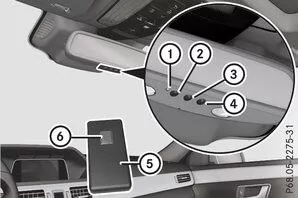
The remote control of the garage door operator is not included in the scope of supply of the integrated garage door opener.
 Turn the key in the ignition to position 2.
One button to
 to be assigned to control the garage door operator.
Start programming mode: Press and hold one of the buttonstoof the integrated garage door opener. starts to light yellow after a short time. The indicator lightlights yellow immediately when the button is stored for the first time.,
 orIf the selected button is already programmed, the indicator lightonly lights yellow after ten seconds.The button, orRelease. The indicator lightflashes yellow.
Teaching in the remote control: The remote controlat a distance of 5 to 20 cm, point it at the buttonstoon the interior mirror.
Keep pressing the button the remote controluntil the indicator lightturns green.lights green: programming is complete. If the indicator lightflashes green: programming was successful. In the next step, a rolling code synchronization must be carried out .The buttonthe remote controlRelease the button on the garage door operator.lights red: repeat the programming procedure for the corresponding button on the interior mirror. Change the distance between the remote controland the interior mirror. The required distance between the remote controland the integrated garage door opener depends on the garage door operator system. Further attempts may be necessary. Keep each tested position for at least 25 seconds before trying another position.
Rolling code synchronization
Observe the "Important Safety Notes".If the garage door system works with a rolling code, you must additionally synchronize the garage door system with the integrated garage door opener in the interior mirror. You need the programming button on the operating unit of the door operator for this. Depending on the manufacturer, the programming button may be in different locations. Usually it is on the ceiling of the garage, on the door operator unit.
Refer to the operating instructions of the garage door operator, e.g. under "Teaching in additional remote controls", before carrying out the following steps.Your vehicle must be within range of the garage or exterior door operator. Make sure that your vehicle, persons and objects are not within the movement area of the door.
Turn the key in the ignition to position 2.Exit the vehicle.
Press the programming button on the door operator unit.You normally then have 30 seconds to initiate the next step.
Re-enter the vehicle.
times in quick succession, press the previously programmed button, orof the integrated garage door opener until the door closes.
Problems during programming
If you have problems programming the integrated garage door opener in the interior mirror, observe the following notes:- Check which transmission frequency the remote controlof the garage door operator uses and whether it is supported. The transmission frequency can usually be found on the back of the garage door operator's remote control.
- Replace the batteries in the remote controlof the garage door operator. This increases the likelihood that the remote controlsends a stronger and more accurate signal to the integrated garage door opener.
- When programming, hold the remote controlat different distances and angles from the button you are programming. Try different angles at a distance of 5 to 30 cm, or the same angle at different distances.
- If another remote control is available for the same garage door operator, repeat the programming steps with this remote control. Before carrying out the steps, make sure that there are new batteries in the remote controlof the garage door operator.
- Note that some remote controls only transmit for a limited time (the indicator light on the remote control goes out). Press the button again before the transmission time expiresthe remote control.
- Align the antenna wire of the garage door opener unit. This can help to transmit and/or receive signals better.
Open or close the garage door
After programming, the integrated garage door opener takes over the function of the garage door system's remote control. See also the operating instructions for the garage door system.Turn the key in the ignition to position 2.
Press one of the buttons, orthat has been programmed to operate the garage door.
lights green.Garage door system with a rolling code: The indicator lightflashes green.
lights yellow.If necessary, press the button again, orpress.
Clearing the memory
Before selling the vehicle, clear the memory of the integrated garage door opener.Turn the key in the ignition to position 2.
Press the buttonsandand hold them down.
The buttonsandrelease.Frequencies
Europe
| Country | Radio approval number Frequency range (MHz) |
|---|---|
| AD (Andorra) | 20 Jul 2005 MHz: 27, 30, 40, 433, 868 |
| AT (Austria) | Article 6 of Directive 1999/5/EC R&TTE 18 May 05 MHz: 27, 40, 433, 868 |
| BE (Belgium) | Article 6 of Directive 1999/5/EC R&TTE 18 May 05 MHz: 27, 40, 433, 868 |
| BG (Bulgaria) | Article 6 of Directive 1999/5/EC R&TTE 12 April 07 MHz: 27, 40, 433, 868 |
| CH (Switzerland) | Article 6 of Directive 1999/5/EC R&TTE 14357 27 May 05 MHz: 27, 40, 433, 868 |
| CY (Cyprus) | Article 6 of Directive 1999/5/EC R&TTE 5 May 05 MHz: 27, 40, 433, 868 |
| CZ (Czech Republic) | General Licence GL-30/R/2000 Reg No. 844 13 May 05 MHz: 27, 40, 433 |
| DK (Denmark) | Article 6 of Directive 1999/5/EC R&TTE 20 April 05 MHz: 27, 40, 433, 868 |
| DE (Germany) | Article 6 of Directive 1999/5/EC R&TTE7519301 29 April 05 MHz: 27, 40, 433, 868 |
| EE (Estonia) | Article 6 of Directive 1999/5/EC R&TTE 11 May 05 MHz: 27, 40, 433, 868 |
| ES (Spain) | 000438/2005, 000439/2005, 000440/2005 000441/2005, 000445/2005, 000446/2005 000447/2005MHz: 27, 40, 433, 868 |
| FI (Finland) | Article 6 of Directive 1999/5/EC R&TTE10668 13 May 05 MHz: 27, 40, 433, 868 |
| FR (France) | Article 6 of Directive 1999/5/EC R&TTE10668 13 May 05 27, 30, 40, 433, 868 |
| GI (Gibraltar) | Article 6 of Directive 1999/5/EC R&TTE 13 May 05 (UK) MHz: 27, 40, 418, 433, 868 |
| GR (Greece) | Article 6 of Directive 1999/5/EC R&TTE11409/18/4/2005 18 May 05 MHz: 27, 40, 433, 868 |
| HR (Croatia) | SDR 224/06 MHz: 27, 40, 433, 868 |
| HU (Hungary) | Article 6 of Directive 1999/5/EC R&TTE 18 May 05 MHz: 27, 40, 433, 868 |
| IC (Canary Islands) | 000438/2005, 000439/2005 000440/2005, 000441/2005 000445/2005, 000446/2005000447/2005, 3 June 2005 MHz: 27, 40, 433, 868 |
| IE (Ireland) | Article 6 of Directive 1999/5/EC R&TTE 18 May 05 MHz: 27, 40, 433, 868 |
| IS (Iceland) | Article 6 of Directive 1999/5/EC R&TTE 18 May 05 MHz: 27, 40, 433, 868 |
| IT (Italy) | DGPGSR/II/347487/FOR/15347 DGPGSR/II/347487/FOR/15348 DGPGSR/II/347487/FOR/15350DGPGSR/II/347487/FOR/15357 DGPGSR/II/347487/FOR/15358DGPGSR/II/347487/FOR/15359 MHz: 27, 40, 433, 868 |
| LI (Liechtenstein) | Article 6 of Directive 1999/5/EC R&TTE 14357 27 May 05 MHz: 27, 40, 433, 868 |
| LT (Lithuania) | Article 6 of Directive 1999/5/EC R&TTE27.4-1B-1609 6 May 05 MHz: 27, 40, 433, 868 |
| LU (Luxembourg) | Article 6 of Directive 1999/5/EC R&TTE150405/9538 24 May 05 MHz: 27, 40, 433, 868 |
| LV (Latvia) | Article 6 of Directive 1999/5/EC R&TTE 27.4-1B-1609 26 April 06 MHz: 27, 40, 433, 868 |
| MC (Monaco) | Article 6 of Directive 1999/5/EC R&TTE10668 13 May 05 MHz: 27, 40, 433, 868 |
| MT (Malta) | Article 6 of Directive 1999/5/EC R&TTE 18 May 05 MHz: 27, 40, 433, 868 |
| NL (Netherlands) | Article 6 of Directive 1999/5/EC R&TTE 18 May 05 MHz: 27, 40, 433, 868 |
| NO (Norway) | Article 6 of Directive 1999/5/EC R&TTE05/02424-SA644 18 May 05 MHz: 27, 40, 433, 868 |
| PL (Poland) | Article 6 of Directive 1999/5/EC R&TTE 21 April 05 MHz: 27, 40, 433, 868 |
| PT (Portugal) | ANCOM-S08399/05 27, 40, 433, 868 |
| RO (Romania) | Article 6.4 of Directive 1999/5/EC R&TTE MHz: 27, 30, 40, 433, 868 |
| RU (Russian Federation) | POCC DE.MJ05.H00015 13 May 05 MHz: 433 |
| SE (Sweden) | Article 6 of Directive 1999/5/EC R&TTE 18 May 05 MHz: 27, 40, 433, 868 |
| SI (Slovenia) | Article 6 of Directive 1999/5/EC R&TTE 500-1/2005-437 9 May 05 MHz: 27, 40, 433, 868 |
| SK (Slovak Republic) | Article 6 of Directive 1999/5/EC R&TTE Slovak 206/11/2005 4 May 05MHz: 27, 40, 433, 868 |
| UK (Great Britain) | Article 6 of Directive 1999/5/EC R&TTE 18 May 05 MHz: 27, 40, 418, 433, 868 |
Africa
| Country | Radio approval number Frequency range (MHz) |
|---|---|
| EG (Egypt) | W-KLE-17 / 08 Mar. 06 MHz: 27, 30, 40, 418, 433, 868 |
| RE (Réunion) | Article 6 of Directive 1999/5/EC R&TTE 11 July 05 MHz: 27, 40, 433, 868 |
| ZA (South Africa) | 11 Oct. 2005 MHz: 27, 40, 433 |
Americas
| Country | Radio approval number Frequency range (MHz) |
|---|---|
| BB (Barbados) | No approval required MHz: 27, 40, 433, 868 |
| CL (Chile) | 38447/F-23 No.3.3634 MHz: 40, 433 3943/DFRS05165/F-50MHz: 280 to 433 |
| GF (French Guiana) | Article 6 of Directive 1999/5/EC R&TTE10668 13 May 05 MHz: 27, 30, 40, 433, 868 |
| GP (Guadeloupe) | Article 6 of Directive 1999/5/EC R&TTE10668 13 May 05 MHz: 27, 30, 40, 433, 868 |
| MQ (Martinique) | Article 6 of Directive 1999/5/EC R&TTE 11 July 05 MHz: 27, 30, 40, 433, 868 |
| MX (Mexico) | MHz: 280 to 390 |
Asia
| Country | Radio approval number Frequency range (MHz) |
|---|---|
| AE (United Arab Emirates) | 1623/5/10-2/26/76 MHz: 433 |
| JO (Jordan) | TRC/LPD/2005/23 MHz: 27, 30, 40, 433, 868 |
| KW (Kuwait) | 5 October 2005 MHz: 27, 30, 40, 418, 433, 868 |
| SA (Saudi Arabia) | 11_02_05/5024-5-6 MHz: 418, 433 |
| SY (Syria) | 279/4/14 / 05 Mar. 06 |
| TR (Turkey) | National Certification 23.Jul.07 MHz: 433 |
Australia
| Country | Radio approval number Frequency range (MHz) |
|---|---|
| AU (Australia) | 28 Jun 2005 MHz: 27, 30, 40, 433, 868 |
| NZ (New Zealand) | 20 Mar 06 MHz: 27, 30, 40, 433 |
The rear climate control system of the Mercedes E-Class W212 (model years 2009–2016) also provides a comfortable interior climate for passengers in the rear. Separate controls allow the rear airflow to be adjusted individually.
This feature contributes significantly to comfort on longer journeys and underlines the premium character of the vehicle.
Question: Why is separate rear climate control advantageous?
Answer: It allows rear passengers to adjust the climate to their own preferences.
Question: What maintenance information applies to the air conditioning system?
Answer: The filter should be replaced regularly, and the function should be checked by an authorized workshop.
Test yourself
A quick Mercedes-Benz E-Class quiz: every answer comes with an explanation and a link to the manual page.