System. Awd System
SYSTEM DIAGRAM
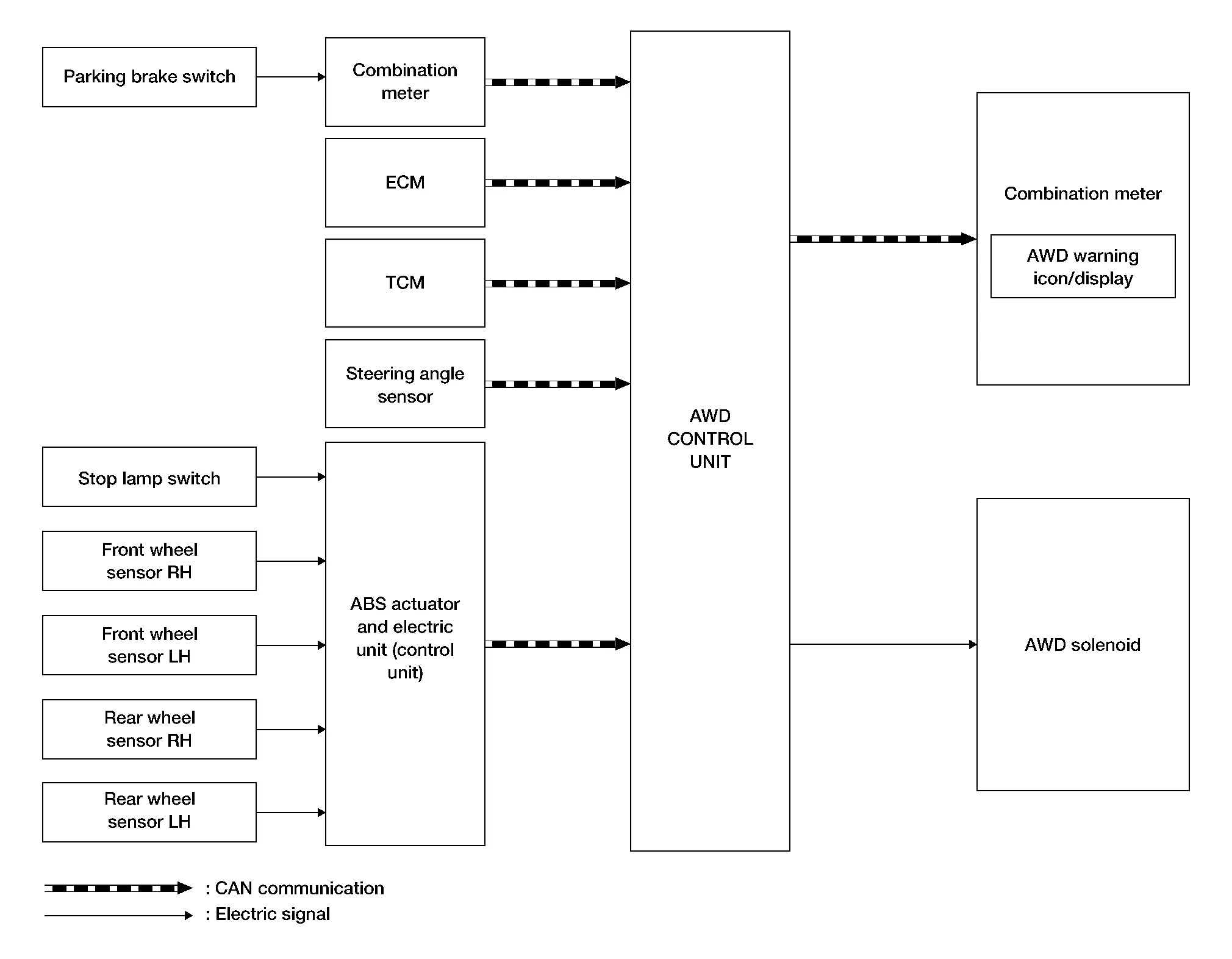
INPUT SIGNAL AND OUTPUT SIGNAL
It transmits/receives each signal from the following AWD control unit via CAN communication line:
| Component parts | Function |
|---|---|
| ABS actuator and electric unit (control unit) | Transmits the following signals via CAN communication to AWD control unit:
|
| ECM | Transmits the following signals via CAN communication to AWD control unit:
|
| TCM | Transmits the following signals via CAN communication to AWD control unit:
|
| Combination meter | Transmits conditions of parking brake switch signal via CAN communication to AWD control unit. |
Receives the following signal via CAN communication from AWD control unit:
|
|
| Steering angle sensor | Transmits conditions of steering angle sensor signal via CAN communication to AWD control unit. |
DESCRIPTION
AWD controls distribution of drive power between front-wheel drive (100:0) and 4-wheel drive (50:50) conditions according to signals from sensors.
By receiving the steering angle sensor signal, yaw rate sensor signal, side G sensor signal and decel G sensor signal, Nissan Murano vehicle with VDC corrects a torque distribution for front and rear wheels according to a driving operation and a behavior of the Nissan Murano vehicle during cornering and improves drivability and safety on a slippery road surface.
Electronic control allows optimal distribution of torque to front/rear wheels to match road conditions.
AWD mode makes possible stable driving possible with no wheel spin, on snowy roads or other slippery surfaces.
On roads which do not require 4-wheel drive, it contributes to improved fuel economy by driving in conditions close to front-wheel drive.
Sensor inputs determine the Nissan Murano vehicle's turning condition, and tight cornering/braking are controlled by distributing optimum torque to rear wheels.