Wheel change
 Switch on
the hazard warning lights.
Park the vehicle away from traffic, on level, non-slip, firm ground (if necessary, place a solid support under the jack base).
Apply the parking brake and engage a gear (first or reverse, or P for automatic gearboxes).
Have all occupants get out of the vehicle and keep them away from the traffic area.
Vehicles fitted with jack and wheel brace
If necessary, remove the wheel trim.
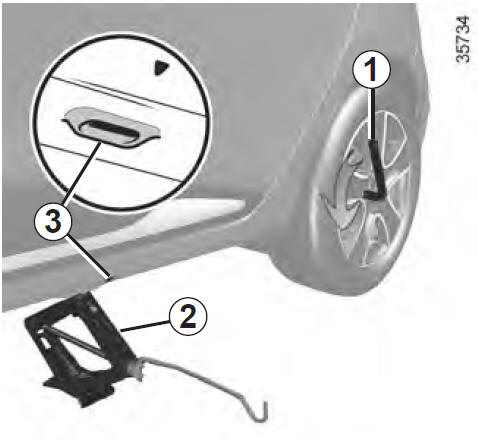
Loosen the wheel bolts using the wheel brace 1. Position it so that you can apply force to it.
Start screwing the jack 2 in by hand so that its head is correctly seated on the nearest sheet-metal jacking point to the wheel concerned, marked by an arrow 3.
Continue turning until the base is correctly positioned (it must be under the vehicle and aligned vertically with the jack head).
Turn a few more times to lift the wheel off the ground.
If the vehicle is not equipped with a jack, wheel brace, etc., you can obtain them from an authorised dealer.To avoid any risk of injury or damage to the vehicle, raise the jack until the wheel to be replaced is at most 3 cm from the ground.
Remove the bolts and take off the wheel.
Fit the spare wheel onto the central hub and turn it so that the fixing holes of the wheel and hub line up.
Tighten the bolts, making sure the wheel sits flat against its hub.
Lower the jack.
With the wheel on the ground, tighten the bolts firmly and have the tightening torque (105 N.m) and the spare wheel inflation pressure checked as soon as possible.
In the event of a puncture, replace the wheel as soon as possible.
A punctured tyre must always be inspected by a specialist and repaired if possible.
If parking on the side of the road, you must warn other road users of your vehicle's presence using a warning triangle or other devices required by the local legislation of the country where you are.Test yourself
A quick Renault Clio quiz: every answer comes with an explanation and a link to the manual page.