Tyres (tyre safety, wheels, winter use)
Tyre safety - wheels
The tyres are the only contact between the vehicle and the road, so it is essential to keep them in good condition.
You must strictly comply with the local rules set out in the highway code.
 When
tyres need to be replaced, only fit tyres of the same brand, size, type and construction as those on your vehicle. They must either be identical to the original tyres, or match those recommended by a brand Representative.
Tyre maintenance
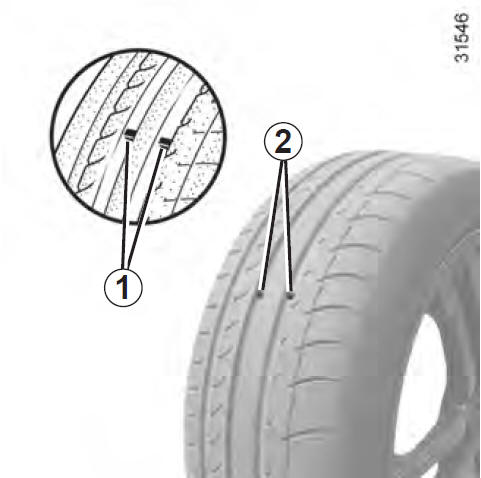
Tyres must be in good condition and their tread must have sufficient depth. Tyres approved by our technical departments have wear indicators 1, which are raised bars built into the thickness of the tread.
When the tread has worn down to the level of the wear indicators, they become visible 2: the tyres must then be replaced, as the tread depth is then 1.6 mm at most, which causes poor grip on wet roads.
An overloaded vehicle, long motorway journeys especially in hot weather, and regular driving on rough tracks all contribute to faster tyre deterioration and affect safety.
Driving incidents such as hitting kerbs may damage the tyres and wheels, and cause front or rear wheel alignment faults.
In this case, have their condition checked by a brand Representative.
Inflation pressures
Observe the inflation pressures (including the spare wheel), check them at least once a month and before every long journey (refer to the label on the driver's door edge).
Insufficient pressures cause premature wear and abnormal overheating of the tyres, with all the safety consequences this entails: – poor handling, – risk of tyre blowout or loss of tread.
The inflation pressure depends on the load and the driving speed.
Adjust the pressures according to the conditions of use (refer to the label on the driver's door edge).
Pressures must be checked when the tyres are cold. Do not take into account the higher pressures reached in hot weather or after driving at high speed.
If the pressure cannot be checked on cold tyres, increase the indicated pressures by 0.2 to 0.3 bar (or 3 PSI).
Never deflate a hot tyre.
Caution, a missing or incorrectly tightened valve cap may affect tyre sealing and cause pressure loss.
Always use valve caps identical to the original ones and screw them fully on.
Spare wheel
Refer to the sections 'Spare wheel' and 'Wheel change' in chapter 5.
Wheel rotation
This practice is not recommended.
Tyre replacement
For safety reasons, this operation must be carried out exclusively by a specialist.
Fitting a different tyre size or type may change:
- the vehicle's compliance with current regulations;
- its cornering behaviour;
- the steering weight;
- the fitting of snow chains.
Winter use
Snow chains
For safety reasons, fitting chains to the rear axle is strictly prohibited.
Fitting tyres larger than the original size makes chain fitting impossible.
Snow chains can only be fitted to tyres of the same size as those originally fitted to your vehicle.
18-inch wheels cannot take snow chains.
If you wish to use chains, it is essential to use specific equipment.
Consult a Renault dealer.Snow tyres or all-season tyres
We recommend fitting all four wheels to preserve as much as possible the grip of your vehicle.
Warning: these tyres sometimes have a direction of rotation and a maximum speed rating that may be lower than the maximum speed of your vehicle.
Studded tyres
This type of equipment may only be used for a limited period, as determined by local legislation. Observe the speed limit imposed by the regulations in force.
These tyres must be fitted to at least both wheels of the front axle.
In all cases we recommend consulting a brand Representative, who will advise you on the equipment best suited to your vehicle.Test yourself
A quick Renault Clio quiz: every answer comes with an explanation and a link to the manual page.