Tyre inflation kit
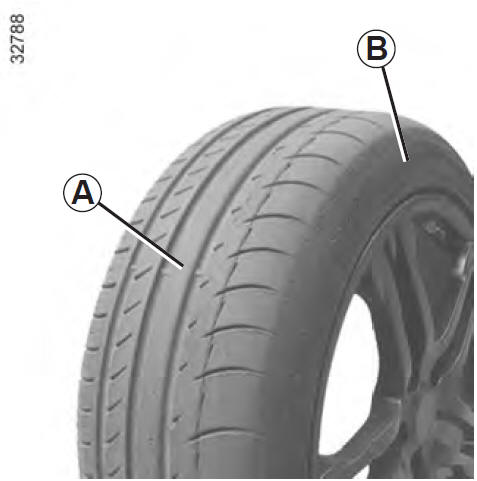
 The
kit repairs tyres damaged on the tread A by objects less than 4 millimetres in size. It does not repair all types of punctures, such as cuts longer than 4 millimetres or cuts on the sidewall B of the tyre… Also make sure your rim is in good condition.
Do not remove the foreign object causing the puncture if it is still in the tyre.
Do not use the inflation kit if the tyre has been damaged by driving on a punctured tyre.
Therefore, carefully inspect the tyre sidewalls before any intervention.
Similarly, driving on under-inflated or even flat (punctured) tyres may compromise safety and may make them unrepairable.This repair is temporary
A punctured tyre must always be inspected (and repaired if possible) by a specialist as soon as possible.
When replacing a tyre repaired with this kit, you must inform the specialist.
While driving, you may feel vibration due to the product inside the tyre.The kit is approved only for inflating the tyres of the vehicle it was originally supplied with.
It must never be used to inflate the tyres of another vehicle or any other inflatable object (ring, boat…).
Avoid splashing skin when handling the liquid repair bottle. If droplets escape, rinse thoroughly.
Keep the repair kit out of reach of children.
Do not dispose of the empty bottle in the environment. Return it to an authorised dealer or to a body responsible for its collection.
The bottle has a limited service life, indicated on its label.
Check the expiry date.
Go to an authorised dealer to replace the inflation hose and the repair sealant bottle.
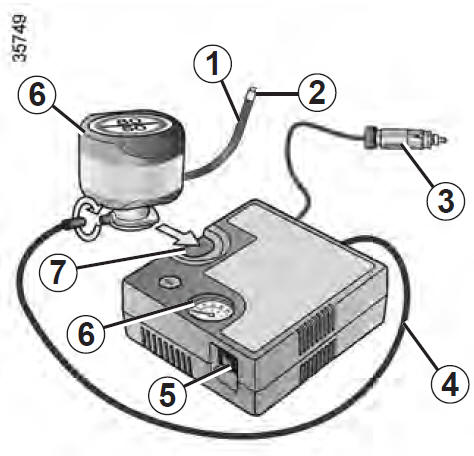
Depending on the vehicle, in the event of a puncture, use the kit located under the luggage compartment floor.
 Before
using the kit, park the vehicle well away from the traffic lane, switch on the hazard warning lights and apply the parking brake. Have all occupants get out of the vehicle and keep them away from the traffic lane.
Engine running, parking brake applied,
- Unroll the bottle hose;
- connect hose 4 of the compressor to the bottle inlet 6;
- depending on the vehicle, connect or screw bottle 6 onto the compressor at bottle recess 7;
- unscrew the valve cap of the affected wheel and screw on the inflation nozzle of bottle 2;
- connect plug 3 to the vehicle accessory socket without fail;
- press switch 5 to inflate the tyre to the recommended pressure (refer to the paragraph “Tyre inflation pressure”);
- after 15 minutes maximum, stop inflating to read the pressure (on gauge 6).
Note: while the bottle empties (approximately 30 seconds), gauge 3 briefly indicates a pressure of up to 6 bar, then the pressure drops.
- adjust the pressure: to increase it, continue inflating with the kit; to decrease it, press button 1 located on the inflation nozzle.
If a minimum pressure of 1.8 bar is not reached after 15 minutes, the repair is not possible. Do not drive the vehicle; contact an authorised dealer.
 If
parked on the side of the road, you must warn other road users of your vehicle’s presence using a warning triangle or other devices required by the local legislation of the country you are in.
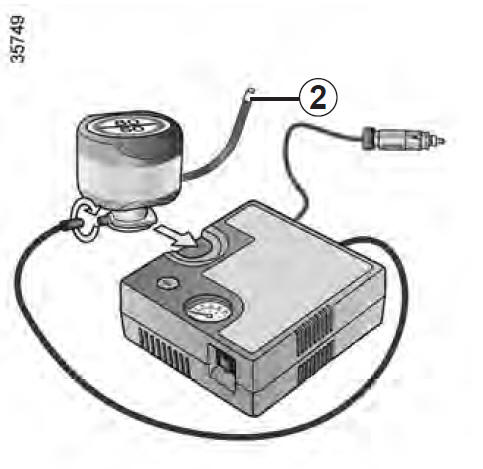
Once the tyre is correctly inflated, remove the kit: slowly unscrew inflation nozzle 2 to avoid spraying the product, and store the bottle in a plastic bag to prevent the product from leaking.
 No
objects should be placed at the driver’s feet: in the event of sudden braking, such objects may slide under the pedals and prevent their use.
- Stick the driving recommendation label in a place visible to the driver on the dashboard.
- Stow the kit.
- At the end of the first inflation operation, the tyre will still leak. It is essential to drive the vehicle to seal the hole.
- Start driving immediately and drive at between 20 km/h and 60 km/h so that the product spreads evenly inside the tyre. After 3 km of driving, stop and check the pressure.
- If the pressure is above 1.3 bar but below the recommended pressure, adjust it (refer to the label stuck on the driver's door edge). Otherwise, contact an authorised dealer: the repair is not possible.
Precautions for using the kit
The kit must not operate for more than 15 consecutive minutes.
 Caution,
a missing or incorrectly tightened valve cap may affect tyre sealing and cause pressure loss.
Always use valve caps identical to the original ones and screw them fully on.
After a repair using the kit, do not drive more than 200 km.
In addition, reduce your speed and, in all cases, do not exceed 80 km/h. The label that you must stick in a place visible on the dashboard reminds you of this.
Depending on the country or local legislation, a tyre repaired using the tyre inflation kit may need to be replaced.
Test yourself
A quick Renault Clio quiz: every answer comes with an explanation and a link to the manual page.