Choosing a child seat mounting
Rear-facing child seats
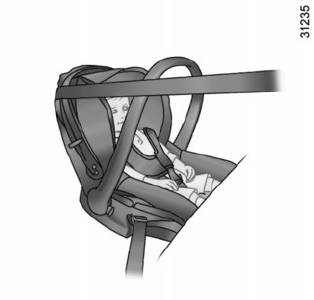
A child's head is heavier in proportion to body weight than an adult's head, and the neck is very delicate. Keep the child in this position for as long as possible (at least until the age of 2). It supports the head and neck.
Choose a shell-type child seat that provides the best side protection, and replace it with another when the child's head starts to protrude above the shell.
Forward-facing child seats
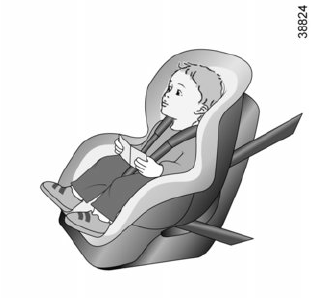
Above all, protect the child's head and abdomen. A child seat securely installed in the vehicle in a forward-facing position reduces the risk of head injury. Children should travel in a seat suited to their height, facing forward, and secured with the harness.
Choose a seat that wraps around the child for better side protection.
Booster cushions
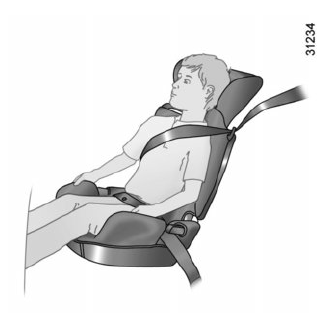
Above 15 kg or 4 years of age, the child may travel on a booster cushion, which allows the seat belt to be adjusted to fit the child's body. The booster cushion should have guides that position the belt across the child's thighs, not the abdomen. A backrest with height adjustment and a belt guide is recommended to position the belt across the middle of the shoulder. It must never be positioned across the neck or the outer part of the shoulder.
Choose a shell-type child seat that provides the best side protection.
There are two ways to secure a child seat: with the seat belt or with the ISOFIX system.
Fitting with the seat belt
The seat belt must be adjusted so that it performs its function in the event of sudden braking or a collision.
Keep the belt routing specified by the child seat manufacturer.
Always check the seat belt latch by pulling it upwards, then tension the belt fully by pressing down on the child seat.
Check that the seat is correctly secured by moving it left and right and forward and backward: the seat should remain rigidly fixed.
Check that the child seat is not installed at an angle and that it does not rest against the window.
Do not use a child seat in which the restraining belt may be unlocked: the base of the seat must not rest on the buckle and/or the seat belt lock. Before using an ISOFIX child seat bought for another vehicle, make sure it is approved for installation in this vehicle. Check the list of vehicles in which the seat may be used in the equipment manufacturer's documentation. The seat belt must never be loosened or twisted. Never pass it under the arm or behind the back. Check that the belt is not damaged by sharp edges.If the seat belt does not work normally, it cannot protect the child. Contact an authorised brand partner. Do not use that seat position until the belt has been repaired.
Fitting with the ISOFIX system
Approved ISOFIX child seats are type-approved under the ECE-R44 standard in the following three cases:
- Universal ISOFIX child seat, 3-point, for installation facing forward;
- Semi-universal ISOFIX child seat, 2-point;
- special child seat.
For the last two, check the list of compatible vehicles to confirm that the child seat can be installed.
Secure the child seat using the ISOFIX anchorages if the vehicle is equipped with them. The ISOFIX system provides easy, fast and secure installation.
The ISOFIX system consists of 2 anchorage points and, in some cases, 3 anchorage points.
No modifications may be made to the original restraint system components: this applies to the belts, the ISOFIX system, the seats, and the individual anchorage components.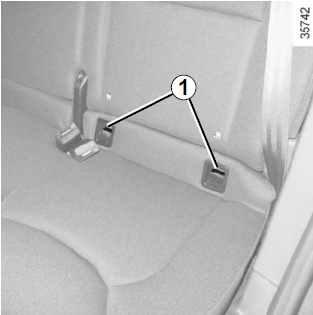
Both anchorage points 1 are located between the backrest and the seat cushion and are marked.
Top tether anchorage point 4 is used to secure the top tether of certain child seat versions.
Rear seats
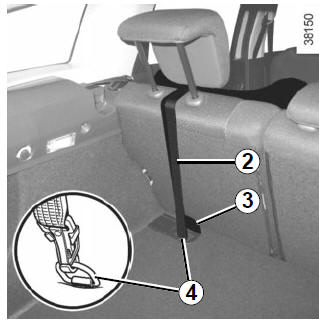
Route strap 2 between the backrest and the rear shelf. To do this, remove the rear shelf (see the "Rear shelf" section in Chapter 3).
Attach the hook to one of the anchorage points 4 marked with the symbol .
Depending on the vehicle version, unclip movable cover 3 from the floor panel to access the anchorage point.
ISOFIX anchorage points are designed specifically for child seats equipped with the ISOFIX system. Never use them to fix any other type of child seat, belts or other objects. Make sure there are no obstacles around the anchorage points that could hinder installation.If the vehicle has been involved in a road accident, have the ISOFIX anchorage points inspected and replace the child seat.
Pull strap 2 taut so that the backrest of the child seat contacts the vehicle seat backrest.
Make sure the backrest of a forward-facing child seat is in contact with the backrest of the vehicle seat.In this case, the child seat does not always rest on the vehicle seat cushion.
Test yourself
A quick Renault Clio quiz: every answer comes with an explanation and a link to the manual page.