System operation
SYSTEM COMPOSITION
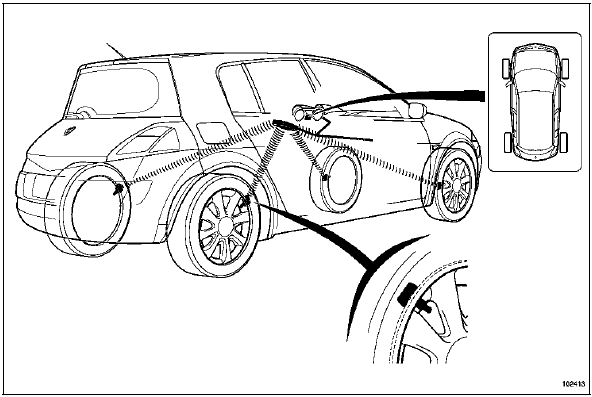
The tyre pressure monitoring system consists of the following components:
- four sensors (one on each wheel but not on the spare wheel),
- one control unit (Cabin Central Unit),
- a display on the instrument panel to inform the driver.
It is forbidden to fit PAX System tyres to a vehicle that is not fitted with PAX System tyres as standard.
On the MEGANE II range, only the 5-seat SCENIC II can take PAX System tyres.
SYSTEM OPERATION
- The valves wake up about one minute after the vehicle is driven at a speed above 20 km/h.
- While driving, the valves transmit every minute.
- The valves remain awake for 15 minutes after the vehicle stops, then switch to sleep mode.
- In sleep mode, the valves do not transmit unless they detect a pressure difference greater than 68 mbar between two successive measurements, or a pressure difference greater than 68 mbar since the last transmission (due to tyre cooling).
- Tyres are considered cold when the vehicle speed has been zero for 1 h 45 min.
- The minimum detection time for a leak is approximately 15 minutes.
- The message "Inflate tyres to motorway pressure" is displayed if the vehicle is driven at more than 170 km/h for 3 minutes and the pressure in at least one of the wheels is 400 mbar lower than the recommended low-speed pressure. This message is inactive if the wheels are inflated to motorway pressure, regardless of vehicle speed.
- Alert thresholds:
- over-inflation when cold = recommended pressure + 700 mbar
- over-inflation when hot = recommended pressure + 850 mbar
- under-inflation = recommended pressure - 400 mbar
- severe under-inflation = recommended pressure - 600 mbar
- imbalance = pressure difference between the left and right wheels of the same axle greater than 500 mbar
- Information messages given to the driver:
- "Puncture, change wheel" + STOP warning light + display of the affected wheel on the instrument panel + buzzer.
- "Tyre pressure to be readjusted" + display of the affected wheel on the instrument panel.
- "Inflate tyres to motorway pressure" + display on the instrument panel for all four wheels.
- "Tyre sensor out of service" + clearing of the affected wheel.
- "Electronic fault" + "service" warning light + display disappears from the instrument panel for the four affected wheels.
- No tyre pressure display on the instrument panel on MEGANE II.
MATCHING THE VALVE TO ITS WHEEL
For any wheel rotation, use the diagnostic tool to teach the new valve positions to the Cabin Central Unit (UCH).
Refit the coloured rings at the location shown on the label on the driver's door.
Ring colours:
- Front left: green
- Front right: yellow
- Rear left: red
- Rear right: black
WINTER WHEELS - SUMMER WHEELS
When leaving the factory, the summer set is configured in the Cabin Central Unit (UCH), but the customer may fit a winter set (winter wheels = rims + sensors + specific tyres).
The first time a winter wheel set is fitted, teach the codes of the four valves. After that, each time the wheel sets are switched, recognition is automatic with no action required at the Cabin Central Unit (UCH).
Establishing communication between the Cabin Central Unit (UCH) and the CLIP diagnostic tool:
- Connect the cable to the diagnostic socket and switch the ignition on.
- Switch on the tool.
- Select the vehicle type and run the multiplexed network test.
- Select the "Tyre" function.
- Then follow the previously defined diagnostic procedure.
REPLACING THE CABIN CENTRAL UNIT (UCH)
When replacing the Cabin Central Unit (UCH), configure the UCH "WITH TPMS" and teach the four wheel sensors to the new UCH using procedure SC002 "Teaching the codes of the four valves".
See chapter 87B "Cabin Central Unit" to configure the other equipment managed by the UCH.
Test yourself
A quick Renault Megane quiz: every answer comes with an explanation and a link to the manual page.