Preliminaries
1. APPLICABILITY OF THIS DOCUMENT
This document describes the diagnosis applicable to all control units with the following characteristics
| Vehicle(s): MEGANE II and SCENIC II Function concerned: ESP BOSCH 8.0 |
Control unit name: ESP 8.0 Program no.: 2.3 VDIAG no.: 08 |
2. ESSENTIAL ITEMS FOR DIAGNOSIS
Documentation type
Diagnostic methods (this document):
- Assisted diagnosis (built into the diagnostic tool), paper (Repair Manual or Technical Note), Dialogys.
Wiring diagrams:
- Visu-Schéma (CD-ROM), paper.
Diagnostic tool type
- CLIP
Essential tool type
ESSENTIAL SPECIALIST TOOLS |
|
3. REMINDERS
Fault diagnosis
There are declared present faults and declared stored faults (which appeared under certain conditions and have since cleared, or are still present but were not diagnosed under the current conditions).
The "current" or "stored" fault status must be checked when starting the diagnostic tool after switching on ignition (without operating any components of the system).
For a present fault, deal with the fault following the procedure given in the chapter "Fault interpretation".
For a stored fault, record the displayed faults and follow the instructions in the "Instructions" section.
If the fault is confirmed when the instruction is applied, the fault is present. In this case, repair the fault.
If the fault is not confirmed, carry out the basic checks. To do so, check:
- The electrical wiring related to the fault.
- The connectors of these circuits (corrosion, bent pins, etc.).
- The resistance of the component identified as faulty.
- The condition of the wiring (melted or cut insulation, chafing).
Conformity check
The conformity check aims to verify the states and parameters that show no fault on the diagnostic tool when they are inconsistent. This step therefore allows you to:
- To diagnose faults without a fault code displayed that may correspond to a customer complaint.
- To check correct system operation and make sure a fault will not reappear after the repair.
This chapter therefore contains a diagnosis of states and parameters, under the conditions required for their check.
If a state does not operate normally or a parameter is out of tolerance, refer to the corresponding diagnostic page.
Customer complaints - Fault locating tree
If the diagnostic tool check is correct but the customer complaint is still present, deal with the problem using "customer complaints".
A summary of the overall procedure is shown as a flowchart on the next page.4. DIAGNOSTIC PROCEDURE
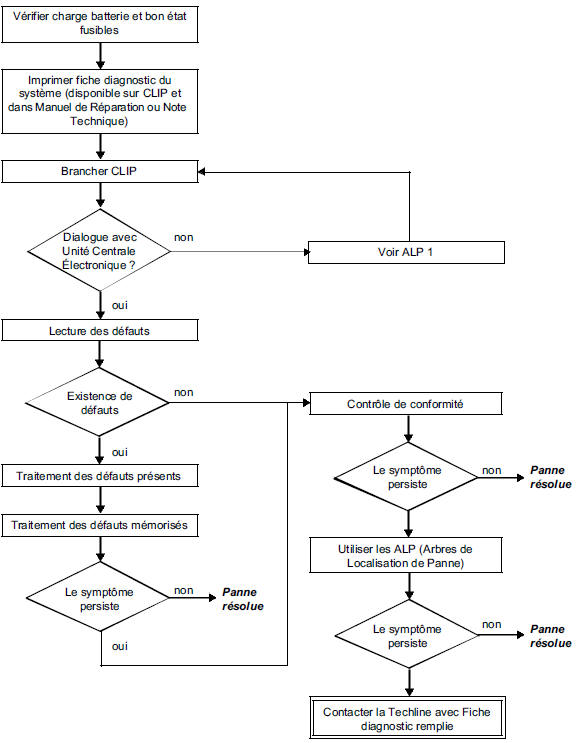
5. DIAGNOSTIC SHEET
WARNING: For any warranty claim on a "monitored" part (control unit type) or a Techline call, a correctly documented diagnostic sheet will be required.
A DIAGNOSTIC SHEET MUST BE COMPLETED EVERY TIME A DIAGNOSIS IS PERFORMED.This sheet will always be requested:
- When requesting technical assistance from the techline.
- For approval requests, when replacing parts that require mandatory approval.
- To be attached to the "monitored" parts returned. It is then required for warranty reimbursement and helps with a better analysis of the removed parts.
6. SAFETY INSTRUCTIONS
Any operation on a component requires safety rules to avoid any material damage or personal injury:
- Check that the battery is correctly charged to avoid damage to the ECUs in case of low charge.
- Road tests with the diagnostic tool communicating with the control unit are prohibited, because the ABS and electronic brake force distribution (EBD) functions are disabled. Brake pressure is identical on both axles of the vehicle (risk of spin-out under hard braking).
7. ABBREVIATIONS GLOSSARY
ABS: Anti-lock braking system.
+ APC: + after ignition.
ASR: Traction control.
+ AVC: + before ignition.
BVA: Automatic gearbox.
CLUSTER, BICAPTEUR (combined sensor): 1 single sensor combining the yaw rate sensor and the lateral acceleration sensor functions.
COSLAD: Cornering static light adjustment (xenon lamps).
CSV: Understeer control
DAE: Electric power steering.
DTC: Diagnostic trouble code.
ESP: Electronic stability program.
MSR: Engine torque control
REF: Electronic brake force distribution (EBD).
UCH: Passenger compartment central unit.
UPC: Protection and switching unit.
VIN: Vehicle identification number.
Test yourself
A quick Renault Megane quiz: every answer comes with an explanation and a link to the manual page.