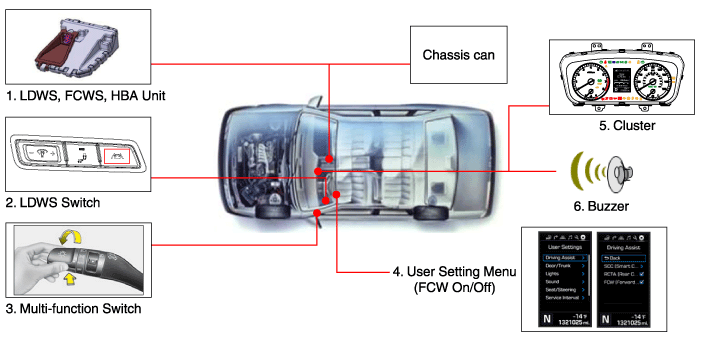
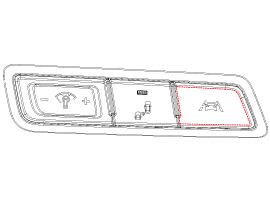
Block Diagram The LDWS consists of the following components
No
Item
Function
Position
1
LDWS UNIT
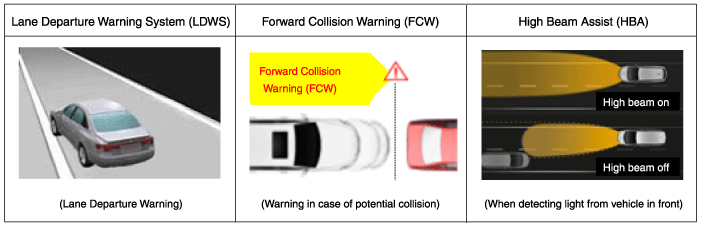
Lane Departure Warning System (LDWS): Recognizes the lane ahead and activates the warning function if the vehicle is in danger of leaving the roadway.
FCW: Monitors the area ahead of the vehicle and activates the warning function if the vehicle is in danger of a collision.
High Beam Assist (HBA): Detects headlights and taillights of vehicles ahead and turns the high beams on/off.
Windshield
2
LDWS switch
LDWS ON/OFF switch
Airbag Location (Left)
3
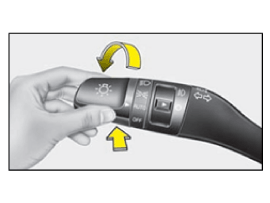
Multifunction switch
HBA On/Off Switch (MF: Automatic Mode)
Steering Wheel
4
User Settings Menu
FCW ON/OFF Menu
Cluster Menu
5
Cluster/Buzzer
FCW/LDWS Attenuation
Cluster
The LDWS camera unit processes the following function using the input video signal.
Lane detection and analysis
Detection of Light Ahead of the Vehicle
Detect and analyze the condition of vehicles ahead and, if necessary, issue warning sounds (or messages) to the driver.
The Lane Departure Warning System transmits information via the high-speed CAN bus.
Lane Departure Warning System (LDWS) UnitThe Lane Departure Warning System is a convenient device that recognizes the lanes ahead from the camera image and vehicle signals and warns of lane departure. It consists of a camera unit and recognizes the lane by calculating the input image signal from the camera. The image processing sensor module detects the lane ahead in the camera unit, identifies the lane in order to keep it, and calculates key parameters, i.e., vehicle center offset, road width, vehicle yaw angle, and road curvature. The following procedures describe the lane recognition process through on-screen image processing.
Ground Sensing in Road Image Input Procedure
Lane Filtering Calculation
Extraction of Lane Candidate Points (constituent points evaluated as lane markings)
Ground Sensing Using Candidate Points
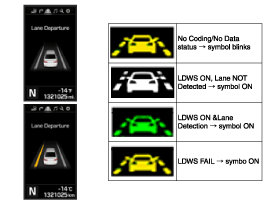
LDWS Operation Process: When the LDWS switch is pressed, the operating status of the Lane Departure Warning System is displayed in the center, and the LDWS indicator illuminates. The specific classification of displays is shown in the following table.
Category
Operation
LDWS Display and Warning
Control (Button)
On
LDWS ON
Off
LDWS OFF
Operation Status
Cluster Indicator
Operating Conditions
Activates when the vehicle speed exceeds the set speed while the LDWS system is on.
[Start: 70 km/h ^] [Stop: 66 km/h v]
? The lane departure warning does not activate if the turn signals or hazard warning lights are on.
FCWS Operation Process
Category
Operation
LDWS Display and Warning
Control (USM)
On
FCW ON
Off
FCW OFF
Operation Status
Displayed only when the alarm is turned on
Operating Conditions
Activates when the vehicle speed exceeds the set speed while the FCW function is on.
[Start: 40 km/h ^] [Stop: 35 km/h v]
FCW Display
FCWS control switch: consists of the User Settings Menu (USM)
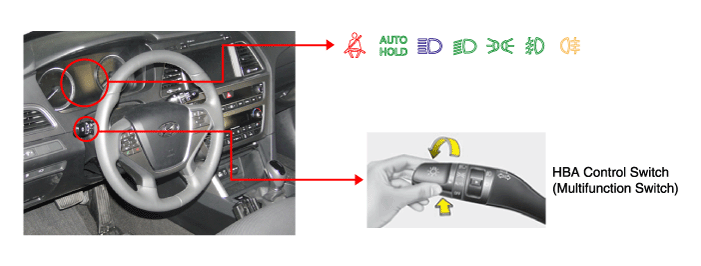
High Beam Assist (Multifunction Switch Auto/High Beam Position)
Category
Operation
LDWS Display and Warning
Control (Button)
On
When the high beam switch is activated (push-return) while the multifunction switch is set to AUTO.
HBA ON + Low Beam HBA ON + High Beam
Off
When the high beam switch is activated again while the multifunction switch is NOT set to AUTO, or when HBA is on.
Operation Status
LCD Display
Operating Conditions
Activates when the vehicle speed exceeds the set speed while HBA is on.
[Start: 45 km/h ^] [Stop: 30 km/h v]
? Activates only if the multifunction switch is set to AUTO and the low beams are on.
LDWS ON/OFF Switch: When the LDWS switch is pressed, LDWS is turned on and the LDWS indicator light illuminates. When the LDWS switch is pressed again, LDWS is turned off and the indicator light goes off. High Beam Assist Switch: The High Beam Assist system is activated when the lighting switch of the multifunction switch is set to AUTO and the headlight switch is set to high beam (pressed).
If the lighting switch is not set to AUTO or high beam, the automatic high beam control system is deactivated.
LDWS Warning Method
Visual warning: The lane in the departure direction flashes yellow.
The LDWS switch must be turned on. When the switch is on, the LDWS indicator light on the instrument cluster illuminates.
It operates when LDWS is on and the vehicle speed exceeds 70 km/h. The warning function is temporarily suspended when the vehicle speed drops below 65 to 70 km/h, and the warning is reactivated when the speed exceeds 70 km/h.
It does not issue a warning when the left or right turn signal is used to indicate a lane change. The departure warning function is reactivated 2 seconds after the left and right turn signals are turned off. The lane departure warning function is also disabled when the hazard warning lights are on.
Turn on the turn signal switch and change lanes. An arbitrary lane change without operating the turn signal in the direction of travel generates a warning.
When more than 40% of the vehicle crosses the lane marking, the warning activates, recognizing a departure for a lane change.
The lane departure warning does not activate when the vehicle is traveling in the center of the lane.
Be careful in the following conditions, as the LDWS may not operate correctly.
When the lane is not clearly visible due to rain, snow, dust, puddles, or other foreign matter.
When visibility is poor due to bad weather, such as fog, heavy rain, or heavy snow.
When sunlight, street lamps, or headlights of oncoming vehicles are reflected on a wet road surface.
When brightness changes abruptly upon exiting a tunnel.
When a taillight shines strongly against the vehicle's direction of travel.
When the headlights are not used or the light beam is too weak at night or inside a tunnel.
When the lane is not distinguishable and the road is damaged
When the shadow of the median covers the lane
When the lane and road cannot be distinguished due to dust on the lane.
When there are more than 2 lanes to the left or right, such as an exclusive bus lane.
On winding roads or steep roads.
When there are signs other than lane markings, or similar markings (such as arrows) next to the lane.
When there is a boundary structure such as a curb block.
When the windshield or LDWS camera lens is contaminated with moisture or foreign material.
When the distance to the vehicle ahead is very short, or the vehicle ahead is driving across the lane
When the vehicle is severely shaken
On a diverging or merging lane section, or a complex lane intersection (example: interchange and toll gate)
When an object is placed on the instrument panel.
Arrow marking on the road surface
When the lane is too narrow or too wide
When the color of the lane and the road is not clear
When the temperature around the rearview mirror is very high due to direct sunlight
When the LDWS cannot identify the lane marking color from the surrounding light (example: inside a tunnel, a section with sodium lamps at night, and in rain)
When visibility is too poor to detect other lanes
This system does not operate when the vehicle speed is below 70 km/h or when lane markings are not recognized.
Do not tint the windshield or attach stickers or accessories around the rearview mirror.
Take care that water does not get onto the LDWS.
Do not disassemble or strike LDWS components randomly.
Do not place reflective material (white paper or a mirror) on the instrument panel. A malfunction may be caused by sunlight reflection.
Excessive noise may prevent you from hearing the LDWS warning signal.
LDWS Operating Conditions: The LDWS operating conditions are as follows.
?
Test yourself
A quick Hyundai Sonata LF quiz: every answer comes with an explanation and a link to the manual page.