Listening to a USB memory
Connecting a USB memory allows you to listen to music directly through the vehicle speakers. Press the "MODE" button until "USB" is displayed.
Connecting a USB memory
Control panel
Type A
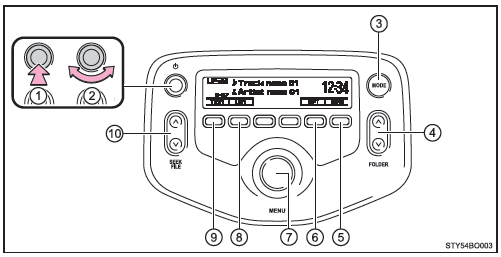
- Power
- Volume
- Changing the audio source/playback
- Selecting a folder
- Random or back button
- Repeat
- Selecting a file or items
- Displaying the folder list
- Displaying a text message
- Selecting a file, fast-forwarding or reversing
Type B
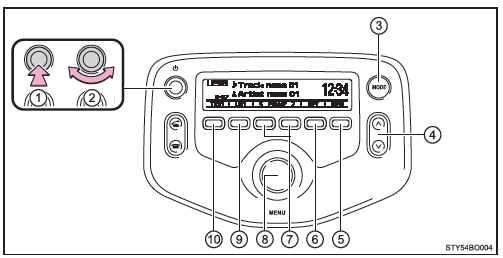
- Power
- Volume
- Changing the audio source/playback
- Selecting a song, fast-forwarding or rewinding
- Random or back button
- Repeat
- Selecting a folder
- Selecting a file or items
- Displaying the folder list
- Displaying a text message
Selecting a folder
■ Selecting one folder at a time Press "Ù" or "Ú" on the "FOLDER" button (type A) or press (<Folder) or
 (Folder>) (type B) to select the desired folder.
■ Selecting a folder and file from the folder list
- Press
 (List).
The folder list will be displayed.
 (Back).
■ Returning to the first folder Hold down " " on the "FOLDER" button (type A) or
 (<Folder) (type B) until a beep is heard.
Selecting a file
Turn the "MENU" knob or press the " " o "
 " symbol on the "SEEK/FILE" button (type A) or the "
 " or "
 " button (type B) to select the desired file.
Fast-forwarding and reversing files
Press and hold the symbol " " o "
 " on the "SEEK/FILE" button (type A) or the "
 " o "
 " button (type B).
Random playback
Pressing Each press of (RDM) changes the mode in the following order: Random folder →All random folder →Off
Repeat
Pressing Each press of (RPT) changes the mode in the following order: Repeat file →Repeat folder* →Off *: Not available when RDM (random play) is selected
Changing the display
Press (Text) to show or hide the album title.
If there is text that is not displayed, the symbol appears. .
Press and hold the button to display the remaining text.
■ USB memory functions
- Depending on the type of USB memory connected to the system, the device may not operate and certain functions may not be available. If the device cannot be used or a function is unavailable due to a malfunction (as opposed to a system specification), disconnecting and reconnecting the device may resolve the problem.
- If the USB memory still does not operate after being disconnected and reconnected, format the memory.
■ Display
■ Error messages If an error message is displayed, refer to the following table and take the appropriate action. If the problem is not resolved, contact any Toyota authorized dealer or repairer, or another suitably qualified and equipped professional.
| Message | Cause/Corrective action |
| "USB ERROR" | Indicates that data cannot be read from the USB memory. |
| "ERROR 3" | Indicates that the USB memory device may be malfunctioning |
| "ERROR 4" | Indicates that an overvoltage has occurred. |
| "ERROR 5" | Indicates that a communication error has occurred with the USB memory device. |
| "NO MUSIC" | This message indicates that the USB memory device does not contain any MP3/WMA files. |
■ USB Memory Device
- Compatible Devices: USB memory devices that can be used for playback of MP3 and WMA formats
- Compatible Device Formats: The following device formats can be used:
- USB communication format: USB 2.0 FS (12 Mbps)
- File system formats: FAT12/16/32 (Windows)
- Compatible class: Mass Storage Class. MP3 and WMA files in formats other than those listed above may not play correctly, and file and folder names may not be displayed correctly.
Standards and limitations are as follows:
- Maximum directory depth: 8 levels
- Maximum number of folders per device: 999 (including the root folder)
- Maximum number of files per device: 9999
- Maximum number of files per folder: 255
- MP3 and WMA Files
MP3 (MPEG Audio Layer 3) is a standard audio compression format.
With MP3 compression, files can be compressed to approximately 1/10 of their original size.
WMA (Windows Media Audio) is an audio compression format developed by Microsoft.
This format compresses audio data to smaller sizes than the MP3 format.
There are limits on the MP3 and WMA file standards and on the media/formats that can be used.
- MP3 File Compatibility
- Compatible standards:
Compatible MP3 (MPEG1 Audio Layer II, III, MPEG2 Audio Layer II, III, MPEG2.5) - Compatible sampling frequencies:
MPEG1 Audio Layer II, III: 32, 44.1, 48 kHz
MPEG2 Audio Layer II, III: 16, 22.05, 24 kHz
MPEG2.5: 8, 11.025, 12 kHz - Compatible bit rates (VBR compatible):
MPEG1 Audio Layer II, III: 32–320 kbps
MPEG2 Audio Layer II, III: 8–160 kbps
MPEG2.5: 8–160 kbps - Compatible channel modes: stereo, joint stereo, dual channel and mono
- WMA File Compatibility
- Compatible WMA standards: WMA versions 7, 8, 9
- Compatible sampling frequencies HIGH PROFILE: 32, 44.1, 48 kHz
- Compatible bit rates HIGH PROFILE: 32–320 kbps (CBR)
- File Names
The only files that can be recognized as MP3/WMA and played are those with the .mp3 or .wma extension.
- ID3 and WMA Tags
ID3 tags can be added to MP3 files to record the track title, artist name, etc.
The system is compatible with ID3 tags version 1.0, 1.1 and ID3 tags version 2.2, 2.3, 2.4. (The number of characters is based on ID3 version 1.0 and 1.1.) WMA tags can be added to WMA files, allowing the track title and artist name to be recorded in the same way as ID3 tags.
- MP3 and WMA Playback
- When a device containing MP3 or WMA files is connected, all files on the USB memory device are scanned. Once the scan is complete, the first MP3 or WMA file is played. To complete the file scan more quickly, it is recommended not to include files other than MP3 or WMA files and not to create unnecessary folders.
- When the USB device is connected and the audio source is changed to USB mode, the USB memory device will start playing the first file in the first folder. If the same device is removed and reconnected (and the contents have not been changed), the USB memory device will resume playback from the point where it was stopped.
- Extensions
If the .mp3 and .wma file extensions are used for files other than MP3 and WMA files, those files will be skipped (not played).
- Playback
- To play MP3 files with stable sound quality, it is recommended to set a constant bit rate of at least 128 kbps and a sampling frequency of 44.1 kHz.
- Many types of freeware and other encoding software for MP3 and WMA files are available on the market. Depending on the encoding characteristics and file format, this may result in low sound quality and interrupted playback at the start. In some cases, playback may not be possible at all.
- Microsoft, Windows and Windows Media are registered trademarks of Microsoft Corporation in the United States and/or other countries.
WARNING
■ While driving Do not connect USB memory devices or operate the controls. Otherwise, you may cause an accident resulting in serious injury or death.
NOTE
■ To avoid damaging the USB memory device or its connector
- Do not leave USB memory devices in the vehicle. The temperature inside the cabin may rise significantly.
- Do not push down on the USB memory device or apply unnecessary pressure to it while it is connected.
- Do not insert inappropriate objects into the port.
Using the AUX Port
This port can be used to connect a portable audio device and listen to it through the vehicle's speakers. Press the "MODE" button until "AUX" is displayed.
Connecting a Portable Player
■ Operating portable audio devices connected to the audio system The volume can be adjusted using the vehicle's audio controls. All other adjustments must be made on the device itself.
■ When using a portable audio device connected to the power outlet Playback may be disturbed. Use the power source of the portable audio device.
■ Cases in which the AUX port cannot be used
Test yourself
A quick Toyota Aygo quiz: every answer comes with an explanation and a link to the manual page.