Discharge the fuel pressure before disconnecting the fuel line to prevent gasoline from spilling out.
Discharge fuel pressure
Refer to the following procedure. Caution:
Discharge fuel system pressure procedures must be performed before disconnecting any part of the fuel system.
After performing the discharge fuel system pressure procedures, pressure will remain in the fuel line. When disconnecting the fuel line, place a cloth or equivalent over fittings to reduce the risk of fuel spray.
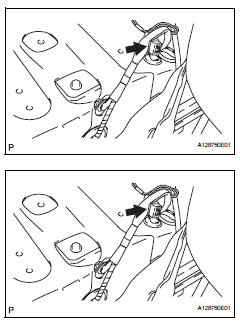
Remove the console box (see page ir-83).
Disconnect the connector.
Start the engine. After the engine has stopped, turn the ignition switch off.
Hint:
Dtc p0171 (system too lean) may be set.
Check that the engine does not start.
Remove the fuel tank cap, and let the air out of the fuel tank.
Connect the connector.
Install the console box (see page ir-90).
Disconnect fuel main tube
Notice:
Do not forcibly bend and twist the fuel main tube.
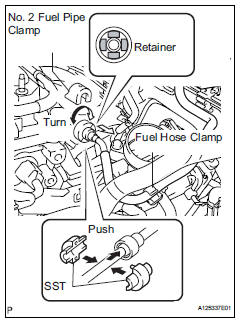
Remove the fuel tube from the fuel hose clamp.
Remove the fuel pipe clamp.
Wipe off dirt on the fuel tube connector.
Hold the fuel tube connector, and then install sst.
Sst 09268-21010
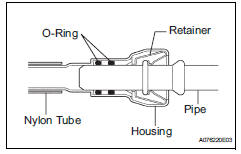
Turn sst to align the retainer inside the fuel tube connector with the chamfered part of sst.
Insert sst into the fuel tube and hold it. Then push the fuel tube connector toward sst side.
Mount the retainer of the fuel tube connector onto the chamfered part of sst.
Slide sst and fuel tube connector together towards the fuel tube until they make a click sound, and then disconnect the fuel tube.
Drain the fuel remaining inside the fuel tube.
Cover the fuel tube and fuel pipe with a plastic bag to protect the disconnected part.
Connect fuel main tube
Connect the fuel main tube.
Push the fuel tube connector until it makes a "click" sound.
Install the fuel pipe clamp.
Install the fuel tube to the fuel hose clamp.
Disconnect fuel tube connector
Wipe off any dirt on the fuel tube connector.
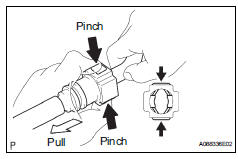
Pinch the fuel tube connector, and then disconnect the fuel tube. Do not use any tools.
Drain the fuel remaining inside the fuel tube.
Cover the fuel tube and fuel pipe with a plastic bag to protect the disconnected part.
Connect fuel tube connector
Connect the fuel tube connector to the fuel pipe.
Push the fuel connector until it makes a click sound.
Hint:
If it is difficult to connect the fuel tube connector, apply a small amount of new engine oil on the tip of the pipe.
Check for fuel leaks
Make sure that there are no fuel leaks after performing maintenance on the fuel system.
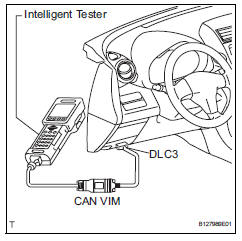
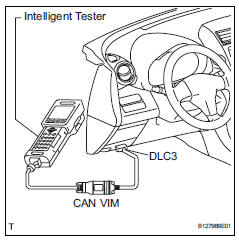
Connect the intelligent tester to the dlc3.
Turn the ignition switch on, and push the intelligent tester main switch on.
Notice:
Do not start the engine.
Select the active test mode on the intelligent tester.
Hint:
Refer to the intelligent tester operator's manual for further details.
Check that there are no leaks from the fuel system.
Turn the ignition switch off.
Disconnect the intelligent tester from the dlc3.
Parts location System diagram On-vehicle inspection
Check fuel pump operation
Connect the intelligent tester to the dlc3.
Turn the ignition switch on. Do not start the engine.
Select the following tester menus: diagnosis, enhanced obd ii, active test and fuel pump/spd. Operate the fuel pump.
Touch the fuel hose in the engine compartment to check the fuel flow, and you will be able to hear the sound of the fuel pump.
Stop the fuel pump.
Check fuel pressure
If there is no fuel flow, the fuel pump may not operate. Check the fuel pump circuit (see page fu- 33).
Check that the battery positive voltage is above 12 v.
Discharge the fuel system pressure (see page fu- 9).
Disconnect the cable from the negative (-) battery terminal.
Disconnect the fuel main tube (see page fu-10).
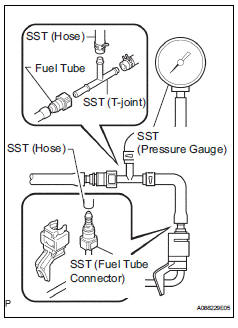
Install sst (pressure gauge) as shown in the illustration.
Reconnect the cable to the negative (-) battery terminal.
Start the engine.
Measure the fuel pressure at idle.
Fuel pressure: 304 to 343 kpa (3.1 To 3.5 Kgf/cm2, 44 to 50 psi)
If the pressure is not as specified, check the fuel pump and injectors.
After checking the fuel pressure, disconnect the cable from the negative (-) battery terminal and carefully remove sst and the fuel tube connector to prevent fuel from spilling.
Reconnect the fuel main tube (see page fu-14).
Check for fuel leaks (see page fu-14).
?
Test yourself
A quick Toyota RAV4 quiz: every answer comes with an explanation and a link to the manual page.