Inspection

- Inspect cylinder block for warpage
- Using a precision straightedge and feeler gauge, measure the warpage of the surface that is in contact with the cylinder head gasket.
If the warpage is greater than the maximum, replace the cylinder block.
- Inspect piston
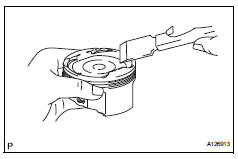
- Using a gasket scraper, remove the carbon from the piston top.

- Using a groove cleaning tool or a broken ring, clean the piston ring grooves.
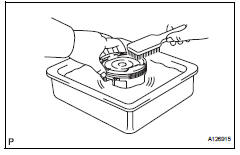
- Using a brush and solvent, thoroughly clean the piston.
Do not use a wire brush.
- Using a micrometer, measure the piston diameter at right angles to the piston pin hole, and at the piston 44.3 Mm (1.7587 In.) From the piston head.
If the diameter is not as specified, replace the piston.

- Inspect piston oil clearance
- Subtract the piston diameter measurement from the cylinder bore diameter measurement.
If the oil clearance is greater than the maximum, replace all the pistons. If necessary, replace the cylinder block.
- Inspect ring groove clearance
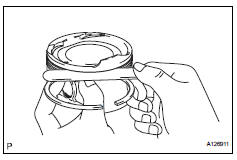
- Using a feeler gauge, measure the clearance between the new piston ring and wall of the ring groove.
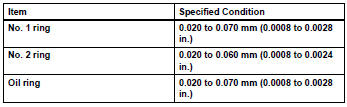
If the groove clearance is not as specified, replace the piston.
- Inspect piston ring end gap
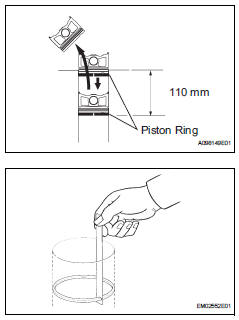
- Using a piston, push the piston ring a little beyond the bottom of the ring travel, 110 mm (4.33 In.) From the top of the cylinder block.
- Using a feeler gauge, measure the end gap.
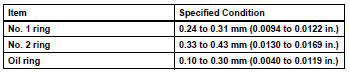
Maximum end gap


If the end gap is greater than the maximum, replace the piston ring. If the end gap is greater than the maximum, even with a new piston ring, replace the cylinder block.
- Inspect piston pin oil clearance
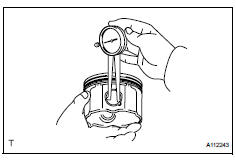
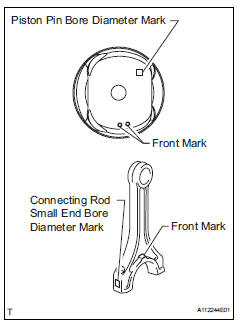
- Using a caliper gauge, measure the piston pin bore diameter.
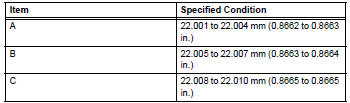 If the diameter is not as specified,
replace the piston.
- Using a micrometer, measure the piston pin diameter.
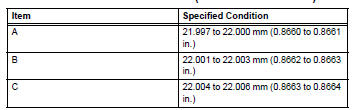
If the
diameter is not as specified, replace the piston pin.
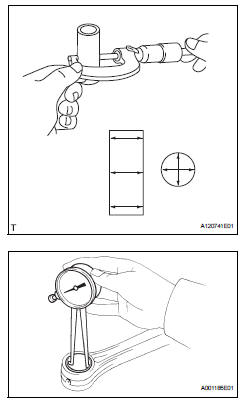
- Using a caliper gauge, measure the connecting rod small end bore diameter.
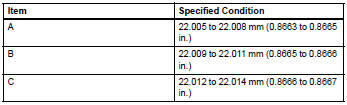
If the
diameter is not as specified, replace the connecting rod.
- Subtract the piston pin diameter measurement from the piston pin bore diameter measurement.
If the oil clearance is greater than the maximum, replace the connecting rod. If necessary, replace the piston and piston pin as a set.
- Subtract the piston pin diameter measurement from the connecting rod small end bore diameter measurement.
If the oil clearance is greater than the maximum, replace the connecting rod. If necessary, replace the connecting rod and piston pin as a set.
- Inspect connecting rod sub-assembly
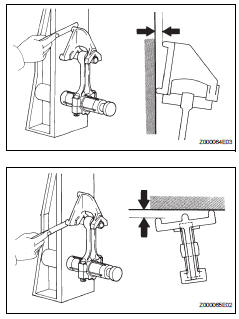
- Using a connecting rod aligner and feeler gauge, check the connecting rod alignment.
- Check for misalignment.
If the misalignment is greater than the maximum, replace the connecting rod.
- Check for twist.
If the twist is greater than the maximum, replace the connecting rod.
- Inspect connecting rod bolt
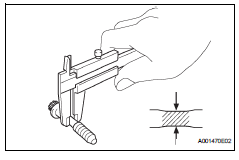
- Using a vernier caliper, measure the tension portion diameter of the bolt.
If the diameter is less than the minimum, replace the connecting rod bolt.
- Inspect crankshaft
- Using a dial indicator and v-blocks, measure the circle runout as shown in the illustration.
If the taper and distortion are greater than the maximum, replace the crankshaft.

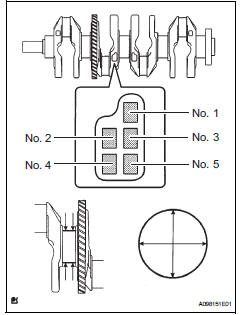
- Using a micrometer, measure the diameter of each main journal.
Standard diameter: 54.988 To 55.000 Mm (2.1830 To 2.1654 In.)
- Check each main journal for taper and distortion as shown in the illustration.
If the taper and distortion are greater than the maximum, replace the crankshaft.
Standard diameter (reference)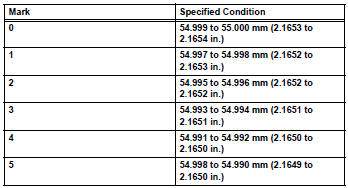
- Using a micrometer, measure the diameter of each crank pin.
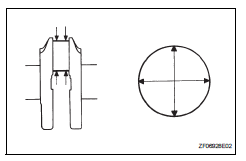
If the diameter is not as specified, check the connecting rod oil clearance.
- Inspect each crank pin for taper and distortion as shown in the illustration.
If the taper and distortion are greater than the maximum, replace the crankshaft.
- Inspect crankshaft bearing cap set bolt
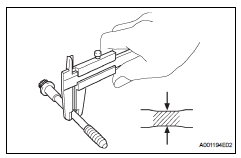
- Using a vernier caliper, measure the tension portion diameter of the bolts.
If the diameter is less than the minimum, replace the bolt.
Test yourself
A quick Toyota RAV4 quiz: every answer comes with an explanation and a link to the manual page.