Check mode procedure
HINT:
Intelligent tester only: Compared to normal mode, check mode is more sensitive to malfunctions. Therefore, check mode can detect the malfunctions that cannot be detected by normal mode.
NOTICE:All the stored DTCs and freeze frame data are erased if: 1) the ECM is changed from normal mode to check mode or vice versa; or 2) the ignition switch is turned off or turned to the ACC position from the ON position while in check mode.
Before changing modes, always check and make a note of any DTCs and freeze frame data.
1. CHECK MODE PROCEDURE (Using an intelligent tester)
(a) Check and ensure the following conditions:
(1) Battery voltage 12 V or more
(2) Throttle valve fully closed
(3) The shift lever in the P or N position
(4) A/C switched OFF
(b) Turn the ignition switch off.
(c) Connect an intelligent tester to the DLC3.
(d) Turn the ignition switch to the ON position.
(e) Turn the tester ON.
(f) Select the following menu items: DIAGNOSIS / ENHANCED OBD II / CHECK MODE.
(g) Switch the ECM from normal mode to check mode.
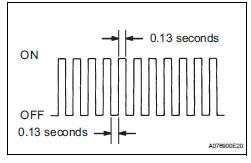
(h) Make sure that the MIL flashes as shown in the illustration.
(i) Start the engine.
(j) Make sure that the MIL goes off.
(k) Simulate the conditions of the malfunction described by the customer.
(l) Check for DTCs and freeze frame data using the tester.
FAIL-SAFE CHART
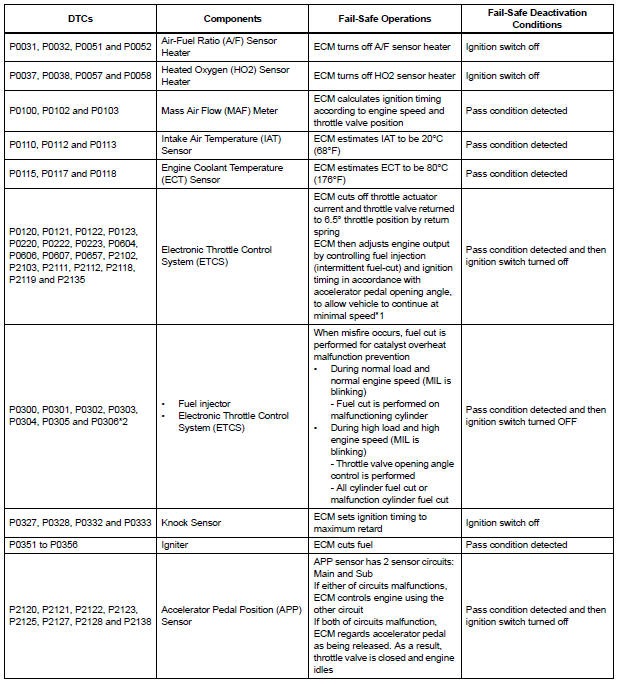
If any of the following DTCs are set, the ECM enters fail-safe mode to allow the vehicle to be driven temporarily.
HINT:
- *1: The vehicle can be driven slowly when the accelerator pedal is depressed firmly and slowly. If the accelerator pedal is depressed quickly, the vehicle may speed up and slow down erratically.
- *2: Misfire related fail-safe operations occur when catalyst overheat malfunctions occur.
Test yourself
A quick Toyota Sienna quiz: every answer comes with an explanation and a link to the manual page.