Battery

WARNING!
Risk of injury! Observe the warnings and safety regulations!

Caution!
To avoid damage to the battery or vehicle, observe the information on battery types.
General Information on Batteries
To ensure long service life, the battery must be tested, maintained and serviced in accordance with the specifications in this guide.
In addition to supplying energy for starting, the battery also acts as a buffer and supplies electrical energy to the entire vehicle electrical system.
Battery Types
General Information

Caution!
The batteries described below are maintenance-free batteries. Do not remove any labels and do not top up with distilled water. Carry out visual checks only. Observe the chapters on battery testing.
Battery with color indicator "Standard"
This is a maintenance-free battery with liquid electrolyte (flooded battery).

WARNING!
Batteries whose color indicator shows light yellow must not be tested or charged. No jump start may be given!
Risk of explosion when testing, charging or jump starting.
These batteries must be replaced.
This battery has a color indicator. The color indicator shows the state of charge and electrolyte level of the battery. Checking the color indicator.
Battery with color indicator "Enhanced"
This is a maintenance-free battery with liquid electrolyte (flooded battery).

Caution!
Do not remove any labels and do not top up with distilled water. Carry out visual checks only. Observe the chapters on battery testing.

WARNING!
Batteries whose color indicator shows light yellow must not be tested or charged. No jump start may be given!
Risk of explosion when testing, charging or jump starting.
These batteries must be replaced.
This battery is used for the special requirements of certain start-stop vehicles. This battery type can be identified by the "EFB" lettering on the battery cover. "EFB" is the English abbreviation for "enhanced flooded battery".
An "EFB" battery may only be replaced with an "EFB" battery.
The "EFB" battery has a color indicator for electrolyte level checking.
Checking the Color Indicator

Note
"EFB" batteries have been used since 05.2011 in smaller gasoline engines with start/stop systems and manual transmission.
AGM Battery
Maintenance-free battery with immobilized electrolyte and no color indicator.
Lead-acid battery in which the electrolyte is immobilized in an absorbent glass mat (AGM). The battery is sealed and fitted with valves.
AGM is the English abbreviation for Absorbent Glass Mat.
Due to the immobilized electrolyte, these batteries cannot have a color indicator. AGM batteries are identified by the abbreviation AGM on the battery.

Note
When replacing an AGM battery, always fit another AGM battery.
Warnings and safety precautions
Hazards When Handling Vehicle Batteries
Know and avoid hazards.
Batteries present hazards. These hazards can be avoided if the warnings on the battery, in the owner's manual and in ELSA are observed.

WARNING!
- Persons under supervision, such as trainees or interns, may only carry out work on vehicle batteries under the supervision of qualified personnel, such as an automotive mechanic/master mechanic or an automotive electrician/master electrician.
- Acid is highly corrosive. If batteries are handled improperly, personnel may be exposed to harmful electrolyte. Therefore, suitable agents against acid burns must be kept on hand. A suitable agent is, for example, soapy water.
- If electrolyte leaks from the battery, skin burns, acid damage and corrosion of the vehicle may occur. Safety-relevant vehicle components may be damaged as a result.
- The oxyhydrogen gas produced during charging, and partly at rest through outgassing after charging, is explosive. In extreme cases, improper handling can cause the battery to explode due to escaping gases.
- Batteries whose "magic eye" shows light yellow must be replaced. They must not be tested or charged, and no jump start may be given. Risk of explosion when testing, charging or jump starting.
- Sparks from grinding, welding, cutting work and open flames, e.g. smoking near the battery, are prohibited. Sparks from electrostatic discharge must also be avoided. Always touch the vehicle body before touching the battery.
- Carry out work on batteries only in well-ventilated rooms suitable for this purpose.
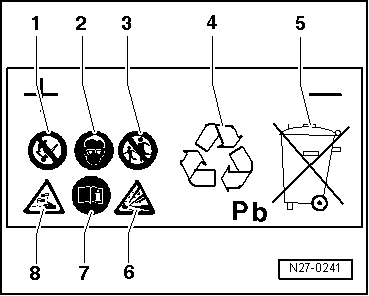
Safety Labeling on the Battery
Safety Labeling on the Battery
1. When handling batteries, fire, sparks, open flames and smoking are prohibited. Avoid creating sparks when handling cables and electrical equipment, and avoid electrostatic discharge. Avoid short circuits. For this reason, do not place tools on the battery.
2. Eye protection must be worn when working on the battery.
3. Keep children away from battery acid and batteries at all times.
4. Disposal: Old batteries are hazardous waste. They may only be disposed of at a suitable collection point and in accordance with the legal requirements.
5. Old batteries must not be disposed of with household waste.
6. Handling batteries involves a risk of explosion. Charging a battery produces a highly explosive oxyhydrogen gas mixture.
7. Always observe the notes on the battery, in ELSA "Electrical System General Information" and in the owner's manual.
8. Risk of chemical burns: Battery acid is highly corrosive, so wear protective gloves and eye protection when working on the battery. Do not tilt the battery, as acid can escape through the vent openings.
Working on the airbag system

WARNING!
When working on the airbag system (pyrotechnic components, airbag control module -J234-, wiring), disconnect the ground strap with the ignition switched on.
Exceptions: On vehicles with the battery in the passenger compartment, the ignition must be switched off.
- Then cover the negative terminal.
- After disconnecting the battery, a waiting time of 10 seconds is required.
- Connecting the battery must be carried out with the ignition switched on.
- When connecting, no person may be inside the vehicle.
In this case, make sure you are not within the working range of the airbags and belt tensioners.
If the ignition is not switched on after reconnecting the battery (warning lamps in the instrument cluster do not light up), the ignition (key/button) may only be switched on while sitting in the driver's seat, in the rearmost position.
Battery terminal bolt

WARNING!
Risk of injury! Observe the warnings and safety regulations!

Caution!
To avoid damaging the battery terminal clamps and battery posts, observe the following:
- Battery terminal clamps may only be fitted by hand, without force.
- Do not grease the battery posts.
- Fit the battery terminal clamps so that the battery post is flush with the clamp or protrudes from it.
- After tightening the battery terminal clamps to the specified tightening torque, do not retighten the fasteners.