Checking Pressures in the Refrigerant Circuit (with Air Conditioning Service Station)

Note
- Check cooling performance. The air conditioning system is working correctly if the air at the dashboard vents is at a temperature of 70 C or lower.
- Setting on the Climatronic: "LO".
- Setting on the air conditioning: "AC" on; "max"; "cold".
- Connections with valve and service connections for measuring and testing.
Test prerequisites
- Radiator and condenser are clean (clean if necessary).
- The thermal insulation on the expansion valve is in good condition and correctly installed. See vehicle-specific repair manual.
- The V-ribbed belt is in good condition and correctly tensioned. The V-ribbed belt for the A/C compressor and alternator is in good condition and correctly tensioned. See vehicle-specific repair manual.
- All air ducts, covers and seals are in good condition and correctly installed.
- Troubleshooting of the electrical system and vacuum system has not revealed any faults. See vehicle-specific repair manual.
- The air conditioning self-diagnosis with the Vehicle Diagnostic, Measurement and Information System -VAS 5051A- via "Guided Fault Finding" reveals no fault; no switch-off condition of the A/C compressor is shown in the measured value block (only on vehicles with "Air Conditioning" self-diagnosis).
- Airflow through the dust and pollen filter is not restricted by contamination. See vehicle-specific repair manual.
- The heating and A/C unit does not draw in unfiltered air at maximum fresh air blower speed. The evaporator and heater do not draw in unfiltered air at maximum fresh air blower speed. See vehicle-specific repair manual.
- The air distribution flaps in the heating and A/C unit reach their end positions. See vehicle-specific repair manual.
- The fresh air intake ducts under the hood and in the passenger compartment and the associated water drain valves are in good condition. See vehicle-specific repair manual.
- The engine is at operating temperature.
- The vehicle is not exposed to direct sunlight.
- The ambient temperature is above 15 ºC.
- All dashboard vents are open.
- With the engine running and the air conditioning set to maximum cooling output:
Setting Maximum Cooling Output
Setting on the Climatronic air conditioning operating and display unit -E87-:
- Select "Auto" operating mode (A/C compressor switched on).
- Set temperature preselection to "LO" for driver and passenger sides.
Setting on the heater controls:
- A/C button and Recirculation button pressed.
- Temperature rotary switch at the "cold" stop.
- Fresh air blower rotary switch in position "4".
- Does the coolant fan -V7- run (do the fans run) at least at stage 1?*

Note
On certain versions the fan only switches on after the pressure in the refrigerant circuit has exceeded a specified value.
- Does the fresh air blower -V2- run at maximum speed?
- Does the recirculation/fresh air flap move to the "Recirculation" position / does the ram pressure flap close and the recirculation flap open (within 1 min. after starting the vehicle)?*
- Is the coolant shut-off valve closed? *
- Are the valves of the pump-valve unit closed (and the coolant circulation pump not delivering)?*
Check pressures
- Switch the ignition off.
- Connect the air conditioning service station.
- Read the pressures from the pressure gauges; two readings may be displayed.
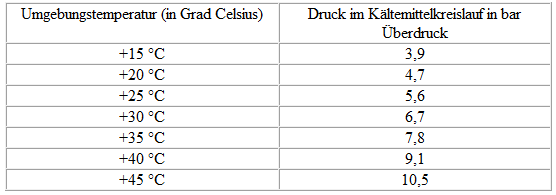

Note
- The temperature of the refrigerant circuit components should equal the ambient temperature.
- If individual refrigerant circuit components are warmer or colder, the pressure deviates from the values in the table.
- At absolute pressure, 0 bar corresponds to an absolute vacuum. Normal ambient pressure (gauge pressure) corresponds to 1 bar absolute pressure. On the scales of most pressure gauges, 0 bar corresponds to an absolute pressure of one bar (recognizable by the marking -1 bar below 0).
- On vehicles with high-pressure sensor -G65-, where the measured pressure is shown in the measured value block, the measured pressure should match the values in the table.
The pressure in the refrigerant circuit is lower than specified in the table.
Not enough refrigerant in the circuit.
- Locate leaks in the refrigerant circuit.
- Check the pressure relief valve.
Has the pressure relief valve vented:
- Check the control of the radiator fans.
- Check refrigerant pipes and refrigerant hoses for restrictions in cross-section or bend radii that are too small.
- Check refrigerant pipes and refrigerant hoses for external damage.
- If no fault is found, purge the refrigerant circuit with compressed air and nitrogen.
The pressure in the refrigerant circuit matches the table or is higher.
- Start the engine.
- On vehicles with an electrically driven A/C compressor, switch on the ignition.

WARNING!
High voltage in the hybrid vehicle's high-voltage system. Risk of electric shock! Before starting work, carry out a visual inspection of the high-voltage components in the work area. Observe general warnings → Electrical System Hybrid.
- Set the air conditioning to maximum cooling output.

Note
If the low-pressure switch was removed to connect the air conditioning service station, bridge the electrical contacts in the associated pressure measuring connector.
- The A/C compressor is driven by the engine via the A/C clutch -N25-.
- The A/C compressor control valve -N280- is controlled by the Climatronic control unit -J255-.
If the A/C compressor is not driven with the engine running, or the control valve is not activated:
- Determine and rectify the cause, e.g. by reading the air conditioning event memory.
- Observe test prerequisites.
- Check the voltage supply to the air conditioning compressor clutch -N25-. If it is OK, repair the compressor clutch.
- Check the control of the air conditioning compressor control valve -N280-.
Continue checking the pressures
- Check on vehicles with throttle and accumulator (with internally controlled A/C compressor).
- Check on vehicles with expansion valve and receiver/dryer (with internally controlled A/C compressor).
- Check on vehicles with expansion valve and receiver/dryer (without controlled A/C compressor).
- Check on vehicles with throttle, accumulator and air conditioning compressor control valve -N280- (with externally controlled A/C compressor).