Working with the Air Conditioning Service Unit

Caution!
- If there is a suspicion that chemical substances for sealing leaks have been added to the vehicle's refrigerant circuit, do not connect the air conditioning service unit and do not extract the refrigerant.
- Chemical leak sealants form deposits in the refrigerant circuit that impair the function of the air conditioning system and lead to failure of the air conditioning system (and your air conditioning service unit).
- Make the customer aware that their air conditioning system contains substances that have not been approved by VW. This air conditioning system cannot be drained or repaired by you.

Note
- Chemical substances for sealing leaks in the refrigerant circuit (leak-stop additives) sold on the open market are not approved by Volkswagen AG. No endurance, effectiveness or material compatibility tests have been carried out, so damage or malfunction of the air conditioning system or the air conditioning service unit cannot be ruled out.
- Leak-stop additives sold on the open market have different physical and chemical properties. They can permanently impair the function of the air conditioning system and the air conditioning service unit, and can even lead to total failure.
- VW does not permit the use of chemical substances to seal leaks in the refrigerant circuit.
- Chemical sealants for leaks in the refrigerant circuit usually react with the ambient air and the humidity it contains. They leave deposits in the refrigerant circuit (and in your air conditioning service station) that cause malfunctions in valves and other components they come into contact with. These deposits cannot be completely removed from the components.
- Chemical sealants for leaks in the refrigerant circuit usually cannot be identified from the outside. The required label that must be affixed to mark their use is usually not present. For this reason, be cautious with a vehicle whose history you do not know.
- The aftermarket offers containers that are supposed to separate these chemical substances (used to seal leaks) from the refrigerant. Since VW does not permit the use of these substances, no statement can be made here about the effectiveness or separation rate of these filters.
Important notes for working with the air conditioning service station
The following must be observed when operating the Air Conditioning Service Station -VAS 6007A- (this also applies to other or currently available air conditioning service stations)
- The installed filters and dryers must be replaced no later than when the operating time specified in the associated operating instructions is reached.
- Only refrigerant oils approved for the vehicle-specific refrigerant circuit may be filled.
Recovered refrigerant may not be reused, even after cleaning in the station, under the following conditions:
- In the event of air conditioning compressor damage in which the refrigerant has decomposed due to overheating.
- In the event of dark, sticky deposits in the refrigerant circuit (these can only be detected after the system has been opened).
- If the composition of the refrigerant recovered from the refrigerant circuit is unclear.
In all these cases, the air conditioning service station must be emptied, the system must be cleaned if necessary, and the filters and dryers as well as the filled refrigerant oil must be replaced.
Contaminated refrigerant can be returned to the refrigerant supplier in so-called recycling bottles for reprocessing or environmentally friendly disposal (for example, in the Federal Republic of Germany; other or additional regulations may apply in individual countries).
The air conditioning service stations available from specialist retailers can be divided into 2 groups:
- A. Air conditioning service stations that clean recovered refrigerant for reuse (so-called recovery and recycling stations), e.g. Air Conditioning Service Station -VAS 6007A-.
- B. Air conditioning service stations that fill recovered refrigerant into recycling bottles (so that it can then be reprocessed on an industrial scale); these units are known as recovery units.
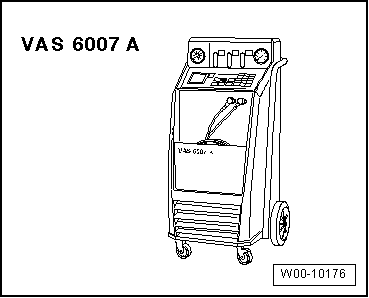
Connecting the air conditioning service station for measuring and testing
- Depending on the tools selected, the work sequence may vary. Therefore, observe the tool-specific operating instructions.

Note
The work sequence must generally be carried out as described in the operating instructions for your Air Conditioning Service Station -VAS 6007A- (or successor model).
To ensure that neither air nor moisture enters the refrigerant circuit through the charging hoses, connect them using the following procedure:
- Switch the ignition off.
- Connect the air conditioning service station to the power supply.
- Unscrew the caps from the service connections or connections with valves (see vehicle-specific refrigerant circuit).
- Evacuate the charging hose.

Note
Connect the charging hose with quick-release couplings to the service connections of the refrigerant circuit.

Caution!
With the engine running, do not open the valves on the low-pressure or high-pressure side. Otherwise, with the air conditioning switched on, the "short circuit" between the high-pressure and low-pressure sides of the refrigerant circuit can destroy the air conditioning compressor or the air conditioning service station.
- Turn the handwheel into the quick-release coupling adapter only far enough until the valve in the service connection is securely open (observe the pressure gauge, do not overpressurize the valve).
- Start the engine and carry out the intended testing and measuring work.
- Compare the determined values with the required measured values.
- Before removing the quick-release coupling, close it by turning out the handwheel.
Emptying the refrigerant circuit with the air conditioning service station

WARNING!
High voltage on the high-voltage system. Risk of electric shock at the air conditioning compressor!
On vehicles with a high-voltage system, the high-voltage system must now be de-energized → Electric drive.
- Depending on the tools selected, the work sequence may vary (observe the tool-specific operating instructions).
- The refrigerant circuit must be emptied if parts of the refrigerant circuit are to be removed, if there is uncertainty about the refrigerant quantity in the circuit, or if safety measures require it.
- All operating instructions important for working with the air conditioning service station and refrigerant can be found in the operating instructions supplied with the air conditioning service station.
Emptying:
- Switch the ignition off.
- Connect the air conditioning service station to the vehicle's service connections according to the associated operating instructions and put it into operation.

Note
- It cannot be ruled out that refrigerant oil is also extracted from the refrigerant circuit along with the refrigerant. To ensure lubrication of the air conditioning compressor, the refrigerant oil quantity in the circuit must be topped up with fresh oil.
- On vehicles with an air conditioning compressor without a magnetic clutch (with control valve for air conditioning compressor -N280-), the engine should run for < 10 minutes with the refrigerant circuit empty and closed (the air conditioning compressor runs continuously). The engine speed must not exceed 2000 revolutions per minute.
- On vehicles with a magnetic-clutch A/C compressor, the engine may be started. The A/C pressure switch -F129- or the high-pressure sensor -G65- (checks whether refrigerant is in the circuit) switches off the magnetic clutch as soon as there is no refrigerant in the refrigerant circuit.
Evacuating the refrigerant circuit with the A/C service station
- Carry out the procedure in principle as described in the operating instructions of your A/C service station.
- The procedure described here uses the A/C service station -VAS 6007A-.
Before the refrigerant circuit is charged with refrigerant, it must be evacuated (vacuum) for 45 minutes on 1 evaporator system and 60 minutes on 2 evaporator systems. This also removes moisture from the circuit.
Leaks can be detected while evacuating the refrigerant circuit.
Evacuating:

Caution!
- Do not start the engine during the evacuation process or as long as there is negative pressure in the refrigerant circuit.
- If the engine is started while there is negative pressure in the refrigerant circuit, the A/C compressor can be damaged.
- Start the engine only when the refrigerant circuit is filled.
- Switch the ignition off.
- If necessary, correct the refrigerant oil quantity in the refrigerant circuit; see the vehicle-specific repair manual.
- Connect the air conditioning service station to the power supply.
- Check the refrigerant quantity in the A/C service station.
- Connect the charging hose of the A/C service station with quick-release coupling adapter to the vehicle's refrigerant circuit (see vehicle-specific refrigerant circuit).
- Turn the handwheel of the quick-release coupling adapter in far enough to ensure the service port valves are fully open (do not overpressurize the valve).

Note
If, on vehicles that have a service port on only one side of the refrigerant circuit, the pressure needs to be measured after the system has been charged, use the valve adapter and charging hose with valve opener.
- Start the vacuum phase on the A/C service station. The refrigerant circuit is evacuated automatically (observe the preset evacuation time if applicable).
Once the vacuum phase is complete, the leak test of the refrigerant circuit starts. The negative pressure is displayed in bar and the time in seconds.
If the negative pressure does not hold, proceed as follows:
- Start the vacuum phase again on the A/C service station. The refrigerant circuit is evacuated automatically (observe the preset evacuation time if applicable). Monitor the vacuum display over a longer period. Only charge the system once the vacuum holds.
- If there is a leak of a size through which so much air enters during evacuation that the A/C service station cannot produce sufficient vacuum, or if the vacuum display shows immediately after the A/C service station is switched off that air is entering and the negative pressure is lost, the leak is too large to ignore.
- Locate the leak in the refrigerant circuit as follows:
Charging the refrigerant circuit with the A/C service station

WARNING!
High voltage on the high-voltage system. Risk of electric shock at the air conditioning compressor!
On vehicles with a high-voltage system, the high-voltage system must now be de-energized → Electric drive.
- Carry out the procedure in principle as described in the operating instructions of the A/C service station.
- Before charging refrigerant, correct the refrigerant oil quantity.
- The total refrigerant charge quantity can be filled either on the high-pressure side or on the low-pressure side.
Charging the refrigerant circuit
- Switch the ignition off.
- Evacuate the refrigerant circuit with the A/C service station.
- Turn out the handwheel on the quick-release coupling adapter (close the valve).
- Let refrigerant flow into the charging hose.
- Turn in the handwheel on the quick-release coupling adapter (do not overpressurize the valve) and charge the specified quantity of refrigerant.
- Switch off the A/C service station.

Note
If the A/C compressor has been removed, turn it over by hand approximately 10 revolutions at the V-ribbed belt pulley / clutch before first use. An electrically driven A/C compressor is not affected. This prevents damage from liquid hammer in the A/C compressor when the A/C is switched on for the first time. If oil is in the compressor cylinder, it is pushed out when the compressor is turned over.
- Start the engine with the A/C compressor switched off (version with magnetic clutch).
- Set the A/C compressor to the lowest possible output; operating mode "ECON" or A/C off (version without magnetic clutch, with control valve).
- Wait until the idle speed has stabilized.
- Switch on the A/C compressor and run the system at idle speed for at least 2 minutes.
- If necessary, check the pressures in the refrigerant circuit with the A/C service station.
- Switch off the engine.
- Turn out the handwheel on the quick-release coupling adapter.
- Remove the charging hose from the refrigerant circuit.
- Screw the protective caps back on.
Putting the A/C system into operation after charging

Note
If the A/C compressor has been removed, turn it over by hand approximately 10 revolutions at the V-ribbed belt pulley / clutch before first use. This prevents damage from liquid hammer in the A/C compressor when the A/C is switched on for the first time. If oil is in the compressor cylinder, it is pushed out when the compressor is turned over.
- Start the engine with the A/C compressor switched off (version with magnetic clutch).
- Set the A/C compressor to the lowest possible output; operating mode "ECON" or A/C off (version without magnetic clutch, with control valve).
- Wait until the idle speed has stabilized.
- Switch on the A/C compressor and run the system at idle speed for at least 2 minutes.
- If necessary, check the pressures in the refrigerant circuit with the A/C service station.
- Switch off the engine.
- Turn out the handwheel on the quick-release coupling adapter.
- Remove the charging hose from the refrigerant circuit.
- Screw the protective caps back on.
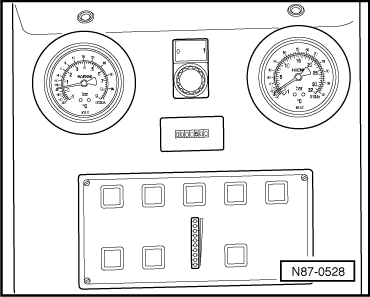
Filling refrigerant into the A/C service station tank
- Carry out the procedure in principle as described in the operating instructions of your A/C service station.
- A specific quantity of refrigerant is prescribed as the charge for each A/C system. To ensure that neither too much nor too little refrigerant is charged (either would impair cooling performance), the refrigerant tank sits on a scale.
Emptying the A/C service station

Note
- If it is necessary to empty the A/C service station (for example, because contaminated refrigerant was extracted), all filters and dryers must always be replaced. Only remove filters and dryers from their airtight transport packaging immediately before installation to keep moisture absorption as low as possible.
- Refrigerant cylinders that are filled with contaminated, used refrigerant are known as "recovery cylinders".
- Always evacuate recovery cylinders before filling them with refrigerant for the first time. Do not fill refrigerant cylinders that contain air with refrigerant.
- Different refrigerant types must not be mixed. Refrigerant mixtures cannot be reclaimed and must be disposed of. If there is uncertainty about the composition of the cylinder contents, inform the refrigerant reclaimer.

WARNING!
- When filling recovery cylinders (pressure gas containers), the applicable regulations, technical rules and laws must be observed.
- Overfilling of recovery cylinders must be prevented in all cases. Overfilled recovery cylinders have too little gas cushion to absorb the liquid expansion caused by heat. There is a risk of bursting.
- For your own safety, use only recovery cylinders with an integrated safety valve.
- Recovery cylinders must be weighed on a calibrated scale during filling. The maximum permissible fill quantity is 75 % (fill factor 0.75) of the filling weight stated on the recovery cylinder. It cannot be ruled out that refrigerant oil is also filled into the recovery cylinder along with the refrigerant.