General information on air conditioning
Introduction
This repair guide is intended to give workshop masters and technicians basic knowledge so that work can be carried out competently.

Note
- Competence is obtained by successfully completing training, e.g. AB160 or ST160 air conditioning systems including competence certification.
- This repair guide also serves as training material.
It must also be available for presentation to the responsible supervisory authority upon request.

Caution!
Tools or materials that are not approved (e.g. leak-stop additives) can cause damage or impairment to the system.
Only tools and materials approved by the manufacturer may be used.
If tools or materials that are not approved have been used, there is no warranty.
Further information sources
- Service Technology manual with measures for rectifying current faults.
- Repair guide for model-specific repair work → Heating, air conditioning.
- → Wiring diagrams, electrical fault finding and component locations
- Self-study programme No. 208 is partly no longer up to date, e.g. the statement "the fluid reservoir is replaced after every opening of the refrigerant circuit". The following conditions apply.
- Video programmes for operator training.
- Special tool catalogue / workshop test.
- Service Organisation Volume 1, Optional Equipment.
- Repair guide for air conditioning with R12 refrigerant (for vehicles built up to model year 1993). This repair guide is only available in paper form.
Fundamentals of climate control technology
Physical principles:
The four known states of matter of water also apply to the refrigerants in the air conditioning system.
- gaseous (not visible)
- vaporous
- liquid
- solid
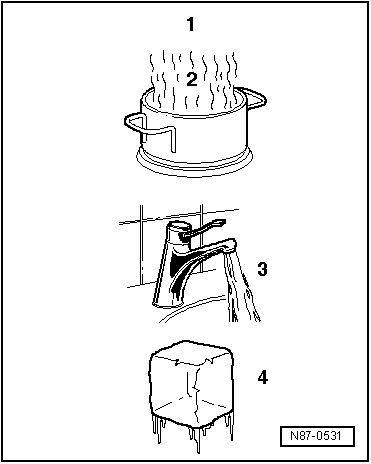
If water is heated in a container (heat absorption), rising water vapour is visible. If the vapour is heated further by absorbing heat, the visible vapour turns into invisible gas. The process is reversible. If heat content is removed from gaseous water, it first becomes vapour, then water, and then ice.
- Heat absorption
- Heat release
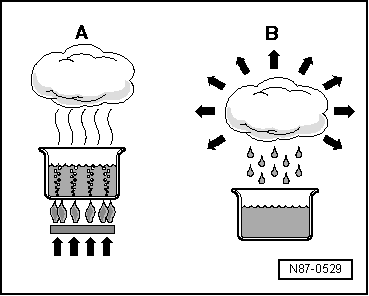
Heat always flows from the warmer substance to the colder substance
Every substance consists of a mass of moving molecules. The rapidly moving molecules of a warmer substance give off part of their energy to the molecules that have less heat and move more slowly. As a result, the molecular movement of the warmer substance slows down and that of the colder substance speeds up. This continues until the molecules of both substances move at the same speed. They then have the same temperature and no further heat exchange takes place.
Pressure and boiling point
The boiling point of a liquid given in tables always refers to atmospheric pressure of 1 bar. If the pressure above a liquid is changed, its boiling point also changes.
It is known that, for example, water boils at lower temperatures the lower the pressure is.
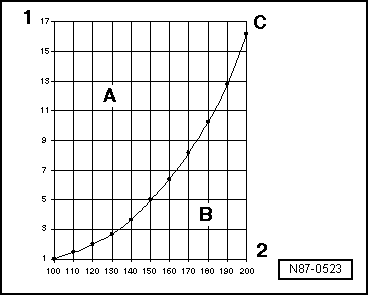
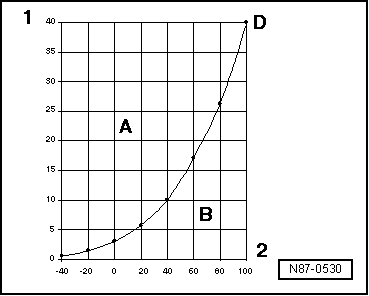
The vapor pressure curves for water and refrigerant R134a show that, for example, at constant pressure, lowering the temperature turns the vapor into liquid (in the condenser), or that, for example, reducing the pressure causes the refrigerant to change from the liquid to the vapor state (evaporator).
Vapor pressure curve, water
- liquid
- gaseous
- Vapor pressure curve, water
- Pressure above the liquid in bar (absolute)
- Temperature in °C
Vapor pressure curve, refrigerant R134a
- liquid
- gaseous
- Vapor pressure curve, refrigerant R134a
- Pressure above the liquid in bar (absolute)
- Temperature in °C
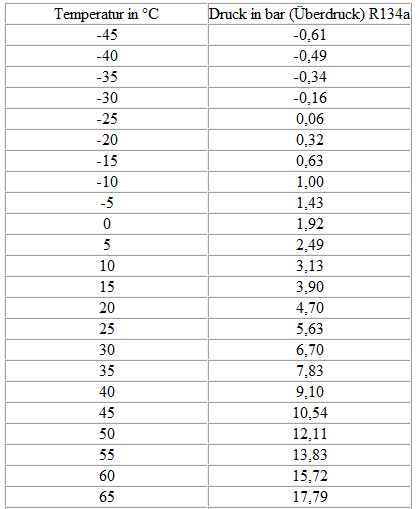
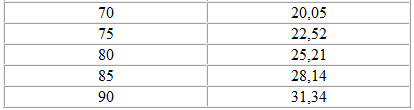
Vapor pressure table for refrigerant R134a
For every refrigerant, the vapor pressure table is published in the literature for refrigeration technicians. This table shows which vapor pressure acts on the liquid column in the container when the temperature of the container is known.
Since each refrigerant has its own characteristic vapor pressure table, the refrigerant type can be determined by measuring pressure and temperature.

Note
With absolute pressure, 0 bar corresponds to an absolute vacuum. Normal ambient pressure (gauge pressure) corresponds to 1 bar absolute pressure. On the scales of most pressure gauges, 0 bar corresponds to an absolute pressure of one bar (recognizable by the marking -1 bar below 0).
Refrigerant R134a
The evaporation and condensation process is the method used in vehicle air conditioning systems. It works with a low-boiling substance, which we call refrigerant.
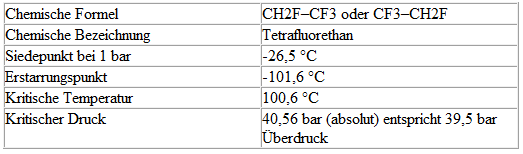
The refrigerant used is tetrafluoroethane R134a, which boils at -26.5 °C under a vapor pressure of 1 bar.
Physical data of refrigerant R134a
Critical point
The critical point (critical temperature and critical pressure) means that above it there is no longer a dividing surface between liquid and gas.
A substance is always gaseous above its critical point.
At temperatures below the critical point, all refrigerant types in pressure containers have a liquid phase and a gas phase, meaning there is a gas cushion above the liquid.
As long as gas is still present in the container alongside the liquid, the pressure depends on the ambient temperature.

Note
Refrigerants must not be mixed with one another. Only the refrigerant specified for the respective air conditioning system may be used.
Environmental aspects of refrigerant R134a
- R134a is a hydrofluorocarbon (HFC) and contains no chlorine.
- R134a has a shorter atmospheric lifetime than refrigerant R12.
- R134a does not attack the ozone layer; its ozone depletion potential (ODP) is zero.
- The global warming potential (GWP) of R134a is approx. 1430 (the GWP of carbon dioxide is 1).
- The contribution of R134a to the greenhouse effect is about 10 times smaller than that of refrigerant R12.
Properties of refrigerant R134a
Trade names and designations
Refrigerant R134a is currently available under the following trade names:
- H-FKW 134a
- SUVA 134a
- KLEA 134a

Note
- Other trade designations may be common in other countries.
- Of the wide range of refrigerants, only this refrigerant may be used in motor vehicles. The designations Frigen and Freon are trade names. They also apply to refrigerants that may not be used in motor vehicles.
Color
As vapor and liquid, refrigerant is colorless like water. Gas is invisible. Only the boundary layer between gas and liquid is visible (liquid level in the riser tube of the charging cylinder or bubbles in a sight glass). In a sight glass, the liquid refrigerant R134a may appear tinted (milky). This cloudiness comes from partially dissolved refrigerant oil and does not indicate a fault.
Vapor pressure
In a closed container that is not completely filled, refrigerant vapor evaporates from the surface at the same rate at which vapor particles recombine into liquid. This state of equilibrium arises under pressure and is often called vapor pressure. The vapor pressure depends on temperature.
Physical properties of R134a
The vapor pressure curves of R134a and other refrigerants are in some cases very similar, so a clear distinction based on pressure alone is not possible.
The air conditioning compressor is lubricated with R134a using special synthetic refrigeration oils, for example PAG oils (polyalkylene glycol oils).
Behavior toward metals
In its pure state, refrigerant R134a is chemically stable and does not attack iron or aluminum.
However, contamination of the refrigerant, for example with chlorine compounds, causes certain metals and plastics to be attacked. This can lead to blockages, leaks or deposits on the piston of the air conditioning compressor.
Critical temperature/critical pressure
Up to a gas pressure of 39.5 bar gauge (corresponding to a temperature of 101 °C), refrigerant R134a remains chemically stable; above this temperature the refrigerant decomposes (see flammability).
Water content
Water is soluble only in very small amounts in liquid refrigerant. In contrast, refrigerant vapor and water vapor mix in any ratio.
Any water present in the refrigerant circuit is carried along as droplets. The dryers, dryer bags or dryer cartridges in the liquid or accumulator reservoir can absorb approx. 7 grams of water. Once they are saturated, they can no longer absorb water. If water is still in the refrigerant circuit, it flows to the nozzle of the expansion valve or orifice tube and turns to ice.
The A/C system stops cooling.
Water destroys the A/C system because, under high pressures and temperatures, acids form in combination with other contaminants.
Flammability
Refrigerant is non-flammable. On the contrary, it has flame-retardant and fire-extinguishing properties. Refrigerant decomposes when exposed to flames and hot surfaces. UV light also splits refrigerant (this occurs during electric welding). This produces toxic decomposition products, which must not be inhaled. However, irritation of the mucous membranes provides sufficient and timely warning.
Fill Factor
A container must have a vapor space in addition to the liquid space. As the temperature rises, the liquid expands and the vapor-filled space becomes smaller. At a certain point, only liquid will remain in the container. From then on, only a slight increase in temperature is enough to generate very high pressures in the container, because the liquid still wants to expand but there is no space left for it. The forces generated are great enough to burst the container. To prevent a container from being overfilled, the Pressurized Gas Ordinance specifies how many kilograms of refrigerant per liter of internal container volume may be filled. This fill factor, multiplied by the internal volume, gives the permissible fill quantity. For the refrigerant used in motor vehicles, it is 1.15 kg/l.
Locating Leaks
The refrigerant circuit can develop leaks, for example due to external damage. Because only a small amount of refrigerant escapes, small leaks can be located with an electronic leak detector or with a leak detection additive added to the refrigerant circuit. Electronic leak detectors can detect leaks with a refrigerant loss of less than 5 grams per year. Leak detectors must be used that are designed for the composition of the specific refrigerant. For example, leak detectors for R12 are not suitable for R134a, because refrigerant R134a contains no chlorine atoms, so these leak detectors will not respond.
Refrigerant Oil
Refrigerant oil mixes with the refrigerant (approx. 20 - 40 %, depending on the A/C compressor type and refrigerant quantity), circulates constantly in the circuit and lubricates the moving parts.
Special synthetic refrigerant oils, e.g. polyalkylene glycol (PAG) oil, are used in R134a A/C systems. This is necessary because mineral oil, for example, does not mix with R134a. In addition, the materials of the R134a A/C system could be attacked if the mixture flows through the refrigerant circuit under pressure and high temperatures, or if the lubricating film in the A/C compressor breaks down. Using unapproved oils can cause the A/C system to fail, so only approved oils may be filled.
Oil type for R134a in motor vehicles: PAG

Note
- Do not store refrigerant oil open, as it is highly hygroscopic (absorbs water).
- Always keep the oil container closed.
- Do not use used refrigerant oil.
- Used oil disposal: Volkswagen InfoNet; General Operations; Manuals & Dealer Literature; Service Manual; 15. Environmental Protection; under General Information, follow the link "Environmental Protection in Dealer and Service Operations"; 4. Waste Disposal; 6. Disposal Routes; g. Used Oil Disposal; Refrigerant Oils
- Used refrigerant oils from systems containing halogenated hydrocarbons (at least one hydrogen atom replaced by a halogen such as fluorine, chlorine, bromine or iodine) must be disposed of as special monitored waste. Mixing with other oils or substances is not permitted. Proper storage and disposal must follow national regulations. In Germany, for example, observe the Chemicals Climate Protection Ordinance and the Circular Economy and Waste Act (other countries may have different regulations).
- Sources for the technical rules and the occupational safety and accident prevention regulations for Germany
- For other countries, obtain the sources from the responsible authorities.
- Ester oils are intended only for larger systems (not for motor vehicle A/C systems).
Properties of Refrigerant Oil
The most important properties are high solubility with refrigerant, good lubricating properties, acid-free condition and a very low water content. For this reason, only specific oils may be used. A list of approved refrigerant oils and filling quantities can be found in the vehicle-specific repair manual.
PAG oils suitable for refrigerant R134a are highly hygroscopic and not miscible with other oils. Therefore, to protect against moisture ingress, always reseal opened containers immediately. Refrigerant oil ages due to moisture and acids, becomes dark and viscous, and becomes aggressive toward metals.

Note
- Only the oil approved for the A/C compressor may be used in R134a refrigerant circuits. See the vehicle-specific repair manual.
- Used oil disposal: Volkswagen InfoNet; General Operations; Manuals & Dealer Literature; Service Manual; 15. Environmental Protection; under General Information, follow the link "Environmental Protection in Dealer and Service Operations"; 4. Waste Disposal; 6. Disposal Routes; g. Used Oil Disposal; Refrigerant Oils
Comfort
One of the basic requirements for focused and safe driving is a feeling of comfort in the vehicle interior. This comfort is only achieved with the use of air conditioning, especially in warm temperatures and high humidity. Open windows, an open sunroof or a higher air flow rate can also contribute to comfort, but they have disadvantages in the vehicle interior, e.g.: additional noise, draft, exhaust fumes, and unfiltered entry of pollen (unpleasant for allergy sufferers).
A controlled air conditioning system combined with a well-designed heating and ventilation system can create a feeling of well-being and comfort by regulating the interior temperature, the humidity and the air movement according to the outside conditions. This applies both when the vehicle is stationary and when it is driving.
Further important benefits of the air conditioning system are:
- Cleaning of the air supplied to the interior (dust and pollen, for example, are washed out by the moist evaporator fins and carried away with the condensation water).
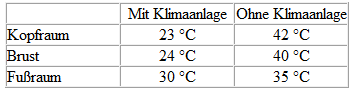
- Temperatures in a mid-size car (example: after a short drive time, outside temperature 30 °C in the shade and vehicle exposed to solar radiation).
Environmental aspects
Since approx. 1992, the air conditioning systems of newly produced vehicles have been gradually converted to the refrigerant R134a. This refrigerant contains no chlorine and is therefore ozone-friendly.
Until approx. 1992, the air conditioning systems were equipped with the refrigerant R12. Due to its chlorine atoms, this CFC has a high ozone depletion potential and, in addition, a potential to intensify the greenhouse effect.
Retrofit programs are offered for existing older systems filled with the ozone-depleting substance R12.
→ Repair guide for air conditioning systems with refrigerant R12. This repair guide is available in paper form only.
For environmental protection reasons, no refrigerants may be released into the atmosphere (legal texts and regulations).
Operating principle of the air conditioning system
The temperature in the passenger compartment is determined by radiant heat through the windows and by transfer heat through metal parts. However, to create comfortable temperatures for the occupants on very warm days, part of the existing heat must be pumped out.
Since heat flows towards colder temperatures, a unit that generates low temperatures is installed in the passenger compartment. In it, refrigerant is continuously evaporated. The heat required for this is extracted from the air flowing through the evaporator.
The refrigerant with the absorbed heat is pumped out by the air conditioning compressor. The compression work of the air conditioning compressor increases the heat content and the temperature of the refrigerant. It is now considerably higher than the temperature of the ambient air.
The highly heated refrigerant flows with its heat content to the condenser. There, due to the temperature difference between the refrigerant and the ambient air, the refrigerant releases its heat to the ambient air via the condenser.
The refrigerant is therefore a carrier of heat. Since it is needed again, it flows back to the evaporator.
For this reason, the basic principle of all air conditioning systems is a refrigerant circuit. Differences arise in the arrangement of the components.
General work safety
- According to VBG 20, Employers' Liability Insurance Association for Commercial Trades.
- Observe the workplace-specific operating instructions, see → Volkswagen ServiceNet, Manuals, Service Manual; Environmental protection. Refrigerant from air conditioning systems / refrigeration oils: these must be posted at the refrigerant workplace.
Product properties
The refrigerant used in motor vehicle air conditioning systems belongs to the new generation of refrigerants based on chlorine-free, partially fluorinated hydrocarbons (HFC, R134a).
In terms of their physical behavior, these are refrigerants liquefied under pressure. They are subject to the Pressure Vessel Ordinance and may only be filled into approved and labeled pressure gas containers.
Certain conditions must be observed for safe and proper use.
Handling refrigerant

WARNING!
There is a risk of frostbite.
The refrigerant may escape as liquid or vapor.
Do not open containers that contain refrigerant.
If refrigerant containers are opened, the contents may escape as liquid or vapor. This process is more violent the higher the pressure in the container.
The pressure depends on two conditions:
- The type of refrigerant in the container. "The rule is: the lower the boiling point, the higher the pressure."
- The temperature. "The rule is: the higher the temperature, the higher the pressure."
Wear safety goggles
Put on safety goggles. They prevent refrigerant from getting into the eyes, which could cause serious frostbite injuries.
Wear protective gloves and apron
Refrigerants dissolve fats and oils quite well. On contact with the skin, they therefore remove the protective fat film. However, degreased skin is sensitive to cold and disease germs.
Do not allow liquid refrigerant to contact the skin
The refrigerant draws the heat needed for evaporation from the surroundings, including the skin. Very low temperatures can be reached in the process. The result is local frostbite (boiling point of R134a -26.5 °C at ambient pressure).
Do not inhale refrigerant vapors

Note
At higher concentrations, escaping refrigerant vapors mix with the ambient air and displace the oxygen in the air that is necessary for breathing.
Welding and soldering on air conditioning systems
Before welding or soldering on vehicles (near air conditioning system components), extract the refrigerant and remove residues by blowing out with compressed air and nitrogen.
The decomposition products formed when the refrigerant is exposed to heat are not only toxic but also highly corrosive, so they can attack pipes and system components. They consist mainly of hydrogen fluoride.
Pungent odor
A pungent odor indicates that the decomposition products mentioned above have already formed. Under no circumstances may these substances be inhaled, as this could cause damage to the respiratory tract, lungs and other organs.
First aid
- In case of contact with eyes or mucous membranes, rinse immediately and thoroughly with running water and consult an eye doctor.
- In case of skin contact, remove contaminated clothing immediately and rinse the affected skin areas with plenty of water.
- If refrigerant vapors in higher concentration have been inhaled, move the affected person to fresh air immediately. Call a doctor. If breathing is impaired, give oxygen. If the affected person is breathing only weakly or not at all, tilt the head back and give artificial respiration.
Handling pressure vessels
- Secure containers against falling over!
Upright cylinders must be secured against tipping over, and horizontal cylinders must be secured against rolling away.
- Do not drop or throw containers!
If a container falls, it may be deformed so severely that it ruptures. The refrigerant then evaporates suddenly, releasing considerable forces. Flying cylinder fragments can cause serious injuries.
Improper transport can break off the cylinder valve. To protect the cylinder valves, cylinders may only be transported with the protective cap screwed on.
- Do not place near radiators!
Elevated temperatures can occur near radiators. Higher temperatures also mean higher pressures, which can exceed the permissible pressure of the container.
Do not heat above 50 °C
To rule out any hazard, the Pressure Vessel Ordinance specifies that containers must not be heated above 50 °C.
Do not heat uncontrolled
Never heat with an open flame. Local overheating can cause structural changes in the container material, which reduce its pressure resistance. There is also a risk of refrigerant decomposition due to local overheating.
Close empty containers
Empty refrigerant containers must always be closed to prevent moisture from entering. Moisture causes steel containers to rust, which weakens the container wall. In addition, rust particles that enter refrigeration systems from the containers can cause malfunctions there.
Safety regulations when working with recovery and filling units
- Before connecting the filling unit to the air conditioning system, make sure that the existing shut-off valves are closed.
- Before disconnecting the filling unit from the air conditioning system, make sure that the process has been completed so that no refrigerant can escape into the atmosphere.
- After the purified refrigerant has been filled from the filling unit into an external pressure gas cylinder, close the manual shut-off valves on the cylinder and on the filling unit.
- Do not expose the filling unit to moisture and do not use it in wet environments.
- Disconnect the power supply before carrying out maintenance work on the filling unit.
- To reduce the risk of fire, avoid using an extension cable. If this cannot be avoided, use an extension cable with a conductor cross-section of at least 2.5 mm2.
- In case of fire, remove the external cylinder.
- When oil carried over from the air conditioning system is drained from the suction accumulator into the supplied measuring cup, make sure it is later transferred into a container that can be sealed, as the oil contains a small amount of refrigerant. Refrigerant must not be released into the environment.
- When the air conditioning service station is parked, secure it against rolling away.
Safety precautions when working on vehicles with air conditioning and when handling R134a refrigerant
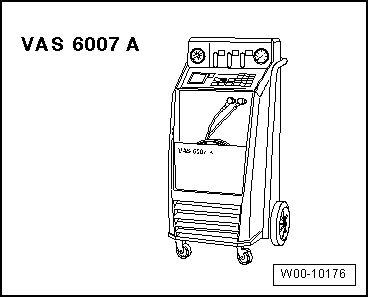
Air conditioning service station -VAS 6007A- (and other currently available air conditioning service stations)
→ Workshop equipment catalog

WARNING!
- It is recommended to keep an eye-rinsing bottle available.
- If liquid refrigerant gets into the eyes, rinse the eyes thoroughly with water for about 15 minutes. Then apply eye drops and see a doctor immediately, even if the eyes do not hurt.
- Inform the doctor that the frostbite was caused by R134a refrigerant. If refrigerant reaches other parts of the body despite the safety precautions, rinse these areas immediately with cold water for at least 15 minutes as well.
- Work on the refrigerant circuit of the air conditioning system only in well-ventilated rooms. Switch on the existing exhaust extraction system.
- Do not store refrigerant in lower-lying rooms (e.g. cellars) or in associated pits, stairwells or window wells.
- Do not weld, braze or solder any parts of a charged air conditioning system. This also applies to welding and soldering work on the vehicle if there is a risk that parts of the air conditioning system could heat up. During a repair paint job, object temperatures of no more than 80 °C may occur in the drying oven or in its preheating zone.
Reason:
Heating creates a strong overpressure in the system, which can open the system's pressure relief valve.
Remedy:
- Drain the refrigerant circuit using the air conditioning service station.

Note
Damaged or leaking air conditioning components must not be repaired by welding or soldering; they must always be replaced.
Containers holding refrigerant (e.g. filling cylinder of the air conditioning service station) must never be heated significantly or exposed to direct sunlight.
Remedy:
- Never fill the container completely with liquid refrigerant. Without a sufficiently large expansion space (gas cushion), the container can burst when the temperature rises, with disastrous consequences.
Under no circumstances may refrigerant be filled into systems and containers that contain air.
Remedy:
- Evacuate systems and containers before filling them with refrigerant.
General information on working on the refrigerant circuit
Observe the workplace-specific operating instructions, see → Volkswagen ServiceNet, Manuals, Service Manual; Environmental protection. Refrigerant from air conditioning systems / refrigeration oils: these must be posted at the refrigerant workplace.
- Work with extreme cleanliness.
- When handling refrigerant and nitrogen, wear work clothing, safety goggles and protective gloves.
- Switch on the existing exhaust gas extraction system.
- Drain the refrigerant circuit only with the air conditioning service station, then open the fittings and replace defective components.
- Close opened components and hoses with sealing caps to protect them from moisture and dirt.
- Only use tools and materials intended for refrigerant R134a.
- Protect refrigerant oil from moisture by keeping the can closed.
- Blow through the refrigerant circuit with compressed air and nitrogen:
- Flush the refrigerant circuit with refrigerant R134a.
For vehicles with an A/C compressor without magnetic clutch:

Note
- The engine should only be started after the refrigerant circuit has been reassembled.
- Start the engine only when the refrigerant circuit is filled, if possible.
- The A/C compressor is always driven by the poly-V pulley or torsionally elastic coupling (it has no magnetic clutch):
- If the A/C compressor is seized, the overload protection detaches from the A/C compressor shaft. Even if no dents are visible on the poly-V pulley or overload protection, the A/C compressor may be seized. Another sign is rubber abrasion in the area of the poly-V pulley or overload protection.
- To prevent damage to the A/C compressor when the refrigerant circuit is empty, it is equipped with a secured oil supply. This means that approx. 40 to 50 cm3 of refrigerant oil remains in the A/C compressor.
- The engine may only be started when the refrigerant circuit is properly assembled. If, for example, the refrigerant lines are not connected to the A/C compressor, the A/C compressor can overheat with the engine running (due to internal heating) to the point of being destroyed.
- The regulating valve for A/C compressor -N280- is not activated when the refrigerant circuit is empty, and the A/C compressor runs at idle with the engine.
- If it is necessary to start the engine with an empty refrigerant circuit:
- The refrigerant circuit must be fully assembled.
- At least a quarter of the refrigerant oil quantity specified for this refrigerant circuit must be in the A/C compressor.
- Engine speed must not exceed 2000 rpm.
- The engine should run for < 10 minutes.
O-ring
- Only use O-rings that are resistant to refrigerant R134a and the associated refrigerant oils. The color coding of the O-rings no longer applies. Black and colored O-rings are used.
- When using O-rings, make sure the inner diameter is correct.
- Use O-rings only once.
- Before installing, lightly coat O-rings with refrigerant oil (PAG oil).

Note
- When blowing through components with compressed air and nitrogen, always extract the gas mixture escaping from the components via a suitable exhaust gas extraction system.
- After completing repair work, screw sealing caps (with seals) onto all connections with valves and onto the service connections.
Before commissioning the air conditioning system. Observe vehicle-specific fill quantities.
Do not top up refrigerant. Extract the existing refrigerant and refill the system.
Before commissioning the air conditioning system after refilling
- After installing a new A/C compressor or filling with fresh refrigerant oil (e.g. after blowing through the refrigerant circuit), turn the poly-V pulley of the A/C compressor 10 revolutions by hand before starting the engine. This prevents damage to the A/C compressor.
- On 5-cyl. and 10-cyl. diesel engines, turn the A/C compressor 10 revolutions by hand at the overload protection. Then install the A/C compressor. This prevents damage to the A/C compressor.
- Start the engine with the air conditioning switched off (magnetic clutch for air conditioning -N25- and regulating valve for A/C compressor -N280- are not activated).
- Once the engine idle speed has stabilized, switch on the A/C compressor and operate it for at least 10 minutes at idle speed and maximum cooling output.