Handling Defects
Rolling Noises
General information on rolling noises
Rolling noises perceived by the human ear are vibrations that reach our ear through the air from the sound source.
Of interest here are the noises caused by certain properties and effects when the tyres roll (sound source).
The cause of noise generation depends essentially on the road surface/tyre combination.
The surface structure and material of the road also have a strong influence on rolling noise. For example, the noise level on a wet road is considerably higher than on a dry road.
The tread pattern has a major influence on noise generation. Tires with transverse grooves at a 90º angle are louder than tires with angled grooves.
Small tread blocks are unstable. Their strong deformation excites the air as the tire rolls. This creates air vibrations that lead to noise.
Wider tires are louder. They need more tread grooves to displace water. As the tire rolls, these grooves displace air, which also creates air vibrations.
Other effects that also influence noise generation:
- "Tire vibration" is the main cause of rolling noise. It is caused by excitation of the air column in the tread grooves.
- "Air pumping" is the compression and expansion of air as the tire contact patch meets the road, caused by deformation of the tread blocks.
Rolling noise: reference information
Noise generation is mainly determined by the tire and the road surface.
The road surface factors are roughness, texture and material.
Tire factors include tire and rim width, among others. A wider tire causes louder noise because its wider contact patch displaces more air and sets more mass into vibration than a narrower tire.
A wider rim also results in a wider contact patch for the tire. Its effect on noise generation is therefore basically similar to that of a wider tire. In addition, the wider rim may negatively affect the damping properties of the tire.
Tire rolling noise is more noticeable in the rear seats of front-engine vehicles, because wind and engine noise are less audible at the rear.
Flat spots
Flat spots result from an emergency braking maneuver with locked wheels, which abrades rubber material at the tire/road contact surface.
When the tires slide over the road surface, frictional heat is generated, which reduces the abrasion resistance of the tread compound.
Even a highly abrasion-resistant tread compound does not rule out flat spots, such as those that can occur during extreme braking maneuvers.
Even ABS-controlled braking systems cannot rule out brief wheel lock-up and the resulting smaller flat spots.
The extent of this abrasion depends mainly on vehicle speed, road surface and wheel load. The following numerical examples illustrate this.
If a vehicle with locked front wheels is braked to a standstill on a dry road surface, the rubber abrasion in the postcard-sized contact patch amounts to approximately
- from 57 km/h = 23.8 m braking distance up to 2.0 mm,
- from 75 km/h = 41.8 m braking distance up to 3.3 mm,
- from 92 km/h = 71.6 m braking distance up to 4.8 mm.
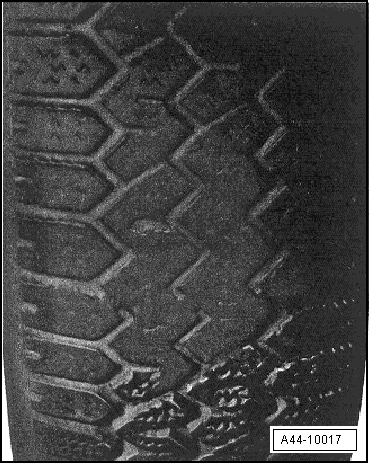
Flat spots in the tread
Tires with such damage are unusable and must be replaced.
Vehicle pulls to one side
General
Perform a test drive to determine whether the vehicle pulls and, if so, to which side. If the vehicle pulls to one side.
If a wheel alignment has been performed, attach the wheel alignment report with the complaint notice to the tires.
Due to manufacturing tolerances, the tire may have conicity in its construction. As the tire rolls, this creates a lateral force that acts directly on the suspension and can lead to self-steering behavior of the vehicle. By deliberately swapping the wheels, you can compensate for this self-steering behavior.
Conicity
Conicity is caused by a slight offset of the tread and/or belt, by a few tenths of a millimeter, relative to the geometric center of the tire. Conicity is not visible and cannot be measured with workshop equipment.
Tire components
- Bead
- Shoulder
- Tread
- Steel cord belt
- Geometric center of the tire
- Actual position of the belt. It may be offset inward or outward.
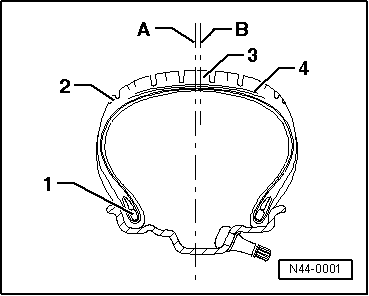
Exaggerated for better illustration.
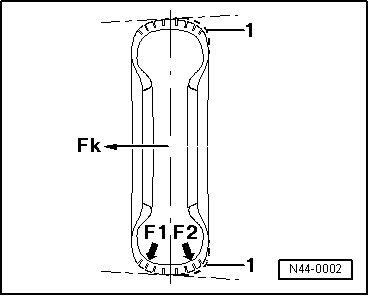
- Belt/tread offset
- Unequal wheel contact forces
- Unequal wheel contact forces
- Fk – Conicity force
The offset causes different stiffness at the inner and outer shoulders of the tire, which leads to unequal wheel contact forces. As a result, the belt and tread are not pressed onto the road with equal force (F1, F2). A conical shape develops. The resulting force (conicity force Fk) can become large enough, depending on speed, to make the vehicle pull to one side.
If the force (Fk) at one wheel of an axle is, for example, 50 newtons, and at the other wheel also 50 newtons, and these forces act in the same direction, they add up. Turning the tire on the rim can compensate for the pulling, because the forces then act in opposite directions.
Because the direction in which the conicity force acts is not visible on the tire, only test drives and targeted wheel or tire swaps can determine which tire causes the pulling.
The tire consists of several components and materials that are vulcanized into one part at the end of a complex manufacturing process. This results in different construction tolerances, which can be noticeable as more or less strong lateral forces (conicity lateral forces). These forces can also occur on new tires.
Pulling to one side at the front axle
Causes of pulling to one side can lie in the chassis. Experience shows, however, that tires cause the pulling to one side in more than 90 % of complaints.
Pulling to one side during normal driving
On a straight, level road, at constant speed or moderate acceleration, the vehicle tends to pull to one side. A force is felt at the steering wheel.
Pulling to one side during hard acceleration
Pulling to one side during hard acceleration is partly due to the design of front-wheel-drive vehicles. Differing friction between the left and right wheels, as well as road unevenness (potholes) and resulting variations in traction, have a considerable effect on handling. This does not constitute a warranty defect.
Remedy for vehicle pulling to one side
Test conditions before and during the test drive
- Check all front and rear suspension components for damage.
- Check the tire inflation pressure and correct it if necessary.
- Check the tires for external damage. Punctures, cuts, bulges in the sidewall, flat spots and/or damage to the tread.
- Ask the customer whether the tire was damaged by a nail or similar object and whether it was repaired by a tire dealer. Replace such tires if necessary.
- Check the tires for even wear and tread depth.
- Are all tires of the same construction, brand and tread pattern?
- For non-directional tires, make sure all DOT markings on the tire face outward. A tire or wheel change may have been carried out on the vehicle at an earlier time.
- Are the tire brands ones recommended by the factory as original equipment?
- For the test drive, use a level, straight road that does not slope to one side and has no ruts.
- Carry out the test drive with the customer under the conditions stated above. The customer should demonstrate the complaint.

Note
No crosswind may be present during the test drive.
If the complaint is justified, we recommend exchanging the wheels/tires as described on the following pages.
Before you begin, please observe the following notes, otherwise your efforts may be useless!

Note
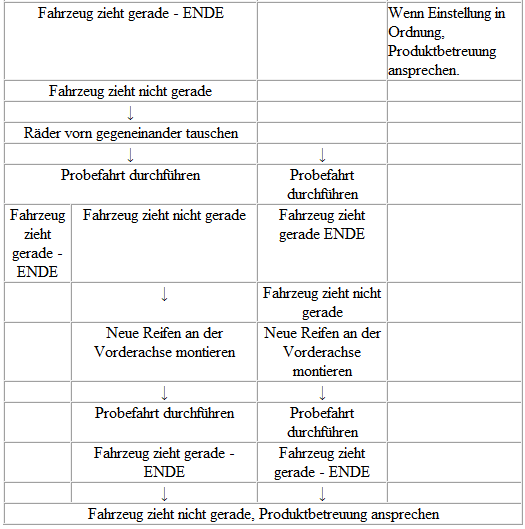
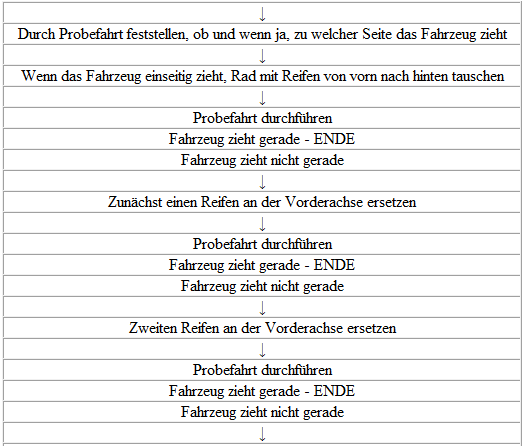
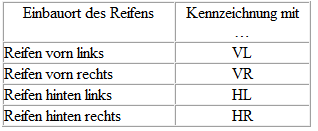
- Mark the tires/wheels before the first exchange, e.g. LF, RF, LR, RR.
- After exchanging the wheels or rotating the tire on the rim, pay close attention to how the vehicle behaves during the test drive. Record how and what was exchanged.
- Assess the intensity and any change in the pulling to one side.
- For this, it is essential that test drives are always carried out by the same person and on the same road. It is best to drive your "test route" in both directions.
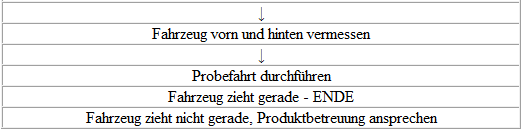
- Replacing one tire with a new tire does not ensure that the pulling to one side will be eliminated. It is therefore advisable to first carry out a targeted exchange of the wheels, as described on the following pages.
- If there is a large difference in tread depth between the front and rear tires, the tires with the greater tread depth should always be fitted to the front axle.
Targeted wheel exchange for non-directional tires
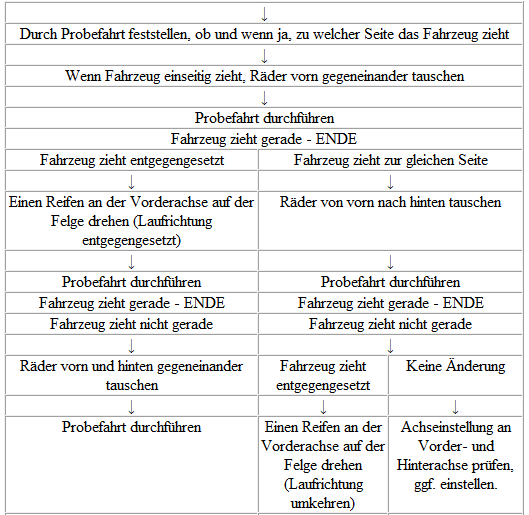
Targeted wheel exchange for directional tires
Vibration
Vibration, causes of vibration
The causes of vibration are varied. Vibration can also be caused by tire wear, among other things. Wear from driving does not always occur evenly across the entire tread of the tire. This produces even slight imbalances that disturb the smooth running of the wheel, which was originally balanced exactly.
These slight imbalances cannot yet be felt at the steering wheel, but they are present. They increase tire wear and reduce tire service life.
Recommendation
To ensure
- optimal safety,
- optimal smooth running and
- even wear
throughout the tire's service life, it is recommended to balance the wheels/tires at least twice during the tire's service life.
Vibration, carry out test drive before balancing
If the vehicle comes to the workshop with the complaint "vibration", a test drive is essential before balancing.
- This gives you information about the type of vibration.
- Note the speed range in which the vibration occurs.
- Lift the vehicle on the lift immediately after the test drive.
- Mark the mounting position on the tire
- Remove the wheels from the vehicle.
- Balance the wheels.
Vibration, vibration check
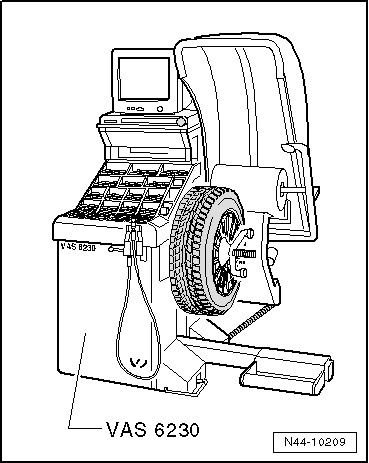
With the Vibration Control System -VAS 6230 A-, you can perform further functions in addition to the previously known static balancing.
A special feature of this system is the testing of the radial force of the wheel/tire while rolling.
A roller presses against the wheel with a force of approx. 635 kg. This simulates the tire contact force against the road surface while driving.
Radial and lateral runout in the wheel/tire and differing stiffness in the tire cause the tire contact forces to fluctuate.
The -VAS 6230 A- detects and stores the position of the maximum measured radial force in the tire. Then the position of the smallest dimension between the rim flange and the wheel center is measured.
Remove standing flat spot
Eliminating flat spots
- Flat spots cannot be removed from the tyre with workshop equipment.
- Flat spots can only be driven out by warming up the tyres.
- It is recommended not to use the method described below in cold and wintry weather.
Requirements/conditions
- If necessary, check and correct the tire pressure.
- If possible, drive the vehicle onto a motorway.
- If traffic and road conditions permit, drive a distance of 20 to 30 kilometres at a speed of 120 to 150 km/h.

WARNING!
- Do not endanger yourself or other road users during this test drive.
- During the test drive observe the applicable road traffic regulations and speed limits!
- After driving, lift the vehicle immediately.
- Unscrew the wheels from the vehicle.
- Balance the wheels on the stationary wheel balancing machine.