Tire wear
Influences on tire service life
The following factors affect the service life of a tire to varying degrees.
Driving style:
- Speed
- Braking
- Acceleration
- Cornering
Maintenance:
- Air pressure
Environment:
- Road surface
- Outside temperature/climate
Vehicle:
- Weight
- Dynamic toe and camber values
Tire application:
- Speed range
- wet or dry
Tire construction:
Winter/Summer
Chassis modifications:
If aftermarket "lowering kits" and/or alloy wheels that are not approved by the vehicle manufacturer are used, wheel positions may occur that deviate from the wheel position specified by the design while driving.
Even if the axle geometry setting is correct during a wheel alignment with the vehicle stationary, the altered ride height and wheel position during driving can change the movement of the suspension.
Uneven tire wear is therefore inevitable.
Saw-tooth wear
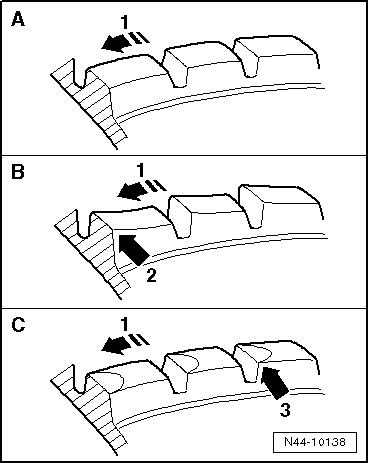
Saw-tooth wear is a stepped wear of the individual tread blocks, which can cause increased rolling noise. Saw-tooth wear results from uneven deformation of the tread blocks in the tire contact patch. Saw-tooth wear is more pronounced on non-driven wheels than on driven wheels.
New tires are more prone to saw-tooth wear because the tall tread blocks have greater elasticity. As tread depth decreases, the tread blocks become stiffer and the tendency to form saw-tooth wear decreases.
Appearance of saw-tooth wear
- Tread blocks of a new tire; viewed in the direction of rotation -arrow 1-, the blocks are the same height at the front and rear.
- Saw-tooth wear; viewed in the direction of rotation -arrow 1-, the blocks are higher at the front -arrow 2- than at the rear.
- Viewed in the direction of rotation -arrow 1-, the tread blocks show greater wear in the front area of the "saw tooth" -arrow 3-.
Pronounced saw-tooth wear can cause noise complaints.
Increased saw-tooth wear occurs with:
- excessive toe values
- incorrect tire pressure
- coarse-block, open tread patterns
- tires fitted to the non-driven axle
- extreme cornering.
Non-directional tires
If saw-tooth wear occurs, the tire rotation direction must be reversed. If saw-tooth wear increases and rolling noise increases, perform a cross-rotation of the wheels. This reduces the saw-tooth wear.
On vehicles with front-wheel drive, this effect is increased by higher wear on the front axle.
Tire rolling noise is still somewhat louder immediately after a wheel change; after approx. 500...1000 km of driving, the normal noise level is reached again.
Directional tires
If saw-tooth wear on the rear axle tires is increased, mainly on front-wheel drive vehicles, move the tires from rear to front. If saw-tooth wear on the outer edges of one axle is increased, turn both tires around on their rims. Then fit the left wheel on the right side and the right wheel on the left side.
Wear behavior of high-speed tires
These tires are designed for the highest speeds. Their development therefore emphasizes good grip on wet roads. These tread compounds do not have the wear resistance of T- and H-rated tires for lower speeds.
The service life of high-speed tires is therefore considerably shorter under comparable operating conditions.
Measuring tread depth

Note
- Measure tread depth in the main tread grooves.
- Do not measure at the TWI (Tread Wear Indicator).
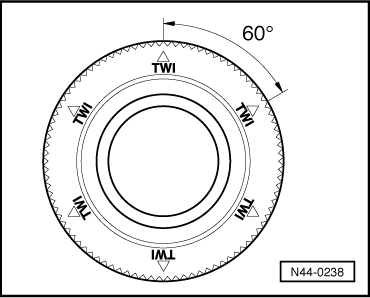
Measure the tread depth in the main grooves at the most worn points of the tire. The positions of the TWI indicators are visible on the tire shoulder.
Instead of "TWI", a "Δ" or the manufacturer's logo may be marked.
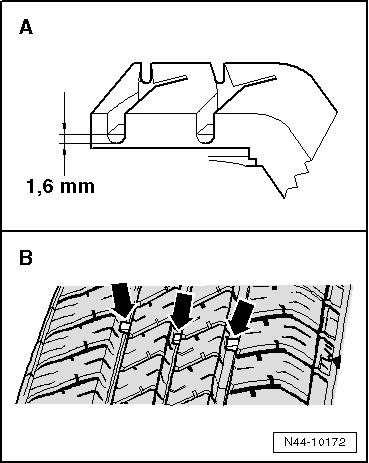
The TWI bars are 1.6 mm high. This is the legally required minimum tread depth in the Federal Republic of Germany.
Other values may apply in other countries.
The TWI indicators must not be included in the measurement. The measured value is determined by the dimension at the deepest point of the tread groove.
- TWI indicators in the main tread grooves
- Main tread grooves with TWI indicators -arrows-
One-sided wear
In many cases the causes are the driving style, but sometimes also incorrect wheel alignment.
Increased one-sided wear
One-sided wear, usually combined with scuffing marks on tread ribs and sipes, always occurs when tires roll at an extreme slip angle and therefore "scrub" on the road surface.
Fast driving on winding roads causes increased wear, especially on the outer shoulder.
A rounded outer tire shoulder combined with particularly high wear of the outer tread blocks indicates fast cornering. This wear pattern is influenced by driving style.
To optimize handling, the suspension is set to specific toe and camber values. If the tires roll under conditions other than those specified, one-sided and increased wear must be expected.
Particularly with incorrect toe and camber values, one-sided and heavier wear can occur; the risk of diagonal feathering also increases.
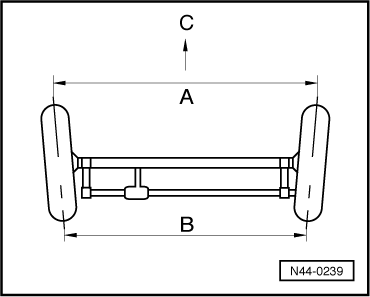
Toe-out or negative toe
The distance between the wheels is greater at the front -A- than at the rear -B- (-C- direction of travel).
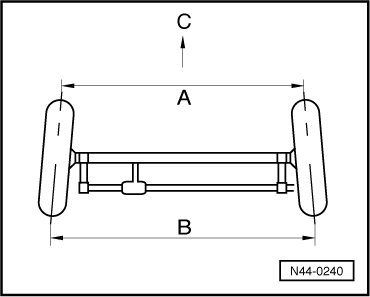
Toe-in or positive toe
The distance between the wheels is smaller at the front -A- than at the rear -B- (-C- direction of travel).
To avoid one-sided tire wear, make sure the wheel position is within the tolerance specified by the vehicle manufacturer. The most common deviation in wheel alignment is caused by external influences, e.g. hard contact with a curb when parking.
A wheel alignment measurement shows whether the wheel setting is within the specified tolerances or whether a correction of the wheel position is required.
Chassis modifications
If lowering kits and/or alloy wheels that are not recommended by the vehicle manufacturer are used as accessories, the wheel alignment may deviate from the alignment specified by the design.
Even if the axle geometry is correctly set during the wheel alignment check with the vehicle stationary, the changed ride height and wheel position while driving can alter the movement of the wheel suspension.
Uneven tire wear is therefore inevitable.
Improper use of the air suspension level settings
The off-road level is recommended only for driving off-road. Permanent use of the off-road level on normal roads can lead to increased tire wear, because the changed ride height alters the wheel alignment compared with the on-road level.
To prevent one-sided tire wear, make sure that the axle geometry is correctly set and that the vehicle is used as intended:
Proper maintenance of the vehicle and tires helps prevent tire wear. In particular, observe the following notes:
- The prescribed minimum tire inflation pressures must be observed.
- Uneven wear between the front and rear axles cannot be avoided, depending on driving style. This can be counteracted by regularly swapping the wheels from one axle to the other. For example, changing regularly from summer to winter tires and back is suitable. This change also has the positive side effect that all tires wear out at the same time and a completely new set of tires can be fitted. This avoids using different tread patterns on the two axles, which can have a negative effect on handling.
- Saw-tooth wear is a normal wear pattern, especially when driving very calmly. It can lead to increased rolling noise, which generally decreases again as tread depth decreases. If saw-tooth wear is slight or is still forming, swapping the wheels from one axle to the other is generally sufficient. If saw-tooth wear is more pronounced, swap the wheels so that their direction of rotation is reversed. This does not apply to directional tires!
- With some tire tread patterns, premature wear may visually appear to occur: once the winter tire sipes or tread grooves are worn, only compact tread blocks without negative void remain, which give the impression of a worn-out tire. In this case, the remaining tread depth must be measured in each tread groove. If this is greater than the legally required minimum tread depth (Germany 1.6 mm; it is recommended to use winter tires only in summer operation once the remaining tread depth reaches 4 mm [regulation in Austria]), the tire may continue to be used without restriction.
Outer shoulder wear
Improper use of the air suspension level settings
The off-road level is recommended only for driving off-road. Permanent use of the off-road level on normal roads can lead to increased tire wear, because the changed ride height alters the wheel alignment compared with the on-road level.
To prevent one-sided tire wear, make sure that the axle geometry is correctly set and that the vehicle is used as intended:
Proper maintenance of the vehicle and tires helps prevent tire wear. In particular, observe the following notes:
- The prescribed minimum tire inflation pressures must be observed.
- Uneven wear between the front and rear axles cannot be avoided, depending on driving style. This can be counteracted by regularly swapping the wheels from one axle to the other. For example, changing regularly from summer to winter tires and back is suitable. This change also has the positive side effect that all tires wear out at the same time and a completely new set of tires can be fitted. This avoids using different tread patterns on the two axles, which can have a negative effect on handling.
- Saw-tooth wear is a normal wear pattern, especially when driving very calmly. It can lead to increased rolling noise, which generally decreases again as tread depth decreases. If saw-tooth wear is slight or is still forming, swapping the wheels from one axle to the other is generally sufficient. If saw-tooth wear is more pronounced, swap the wheels so that their direction of rotation is reversed. This does not apply to directional tires!
- With some tire tread patterns, premature wear may visually appear to occur: once the winter tire sipes or tread grooves are worn, only compact tread blocks without negative void remain, which give the impression of a worn-out tire. In this case, the remaining tread depth must be measured in each tread groove. If this is greater than the legally required minimum tread depth (Germany 1.6 mm; it is recommended to use winter tires only in summer operation once the remaining tread depth reaches 4 mm [regulation in Austria]), the tire may continue to be used without restriction.
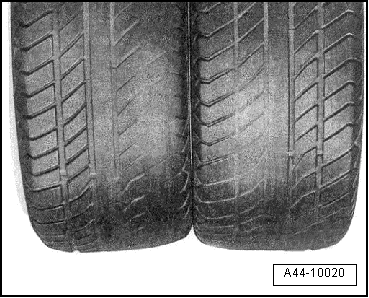
Diagonal scuffing
Diagonal scuffing on the tire
Diagonal scuffing runs at an angle of approx. 45° to the circumferential direction.
It usually occurs once, but may also occur several times around the tire circumference.
The scuffing occurs almost exclusively on the non-driven tires, especially the rear left. Some vehicle models show frequent scuffing, while others are completely trouble-free. The effect is intensified by high toe-in values. Toe-in values at the lower tolerance limit of the specified settings improve the wear pattern.
The area of the strongest diagonal scuffing often shows where the tire components join.
Wheels with toe-in roll at a slip angle even when driving straight ahead. This causes diagonal tension in the tire/road contact zone.
Driving with underinflated tires promotes this wear pattern. To avoid such wear patterns, the toe-in values of both rear wheels should be the same and the specified tire pressure must be maintained.
If you notice scuffing, mount the tires on the driven axle, provided the scuffing is still in its early stage. Deeper scuffing cannot be repaired.
Alignment error
If "diagonal scuffing" is reported, check the toe-in setting. If it is correct, the cause of the diagonal scuffing most likely lies in the tire.
Tires with diagonal scuffing caused by incorrectly set axle geometry on the wheels are excluded from warranty.
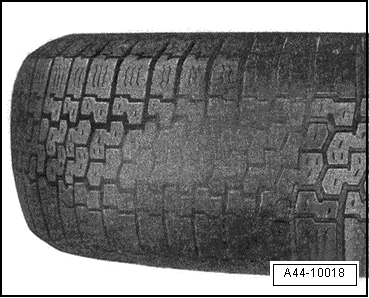
Center wear
This wear pattern is found on driven wheels of high-performance vehicles that often cover long distances at high speeds.
At high speeds, centrifugal force causes the tire diameter in the center of the tread to grow more than at the shoulders. As a result, the drive forces are transmitted to the road from the central area of the tread. This is reflected in the wear pattern.
Such effects can be particularly pronounced with wide tires.
Reducing the tire inflation pressure does not counteract this wear pattern.

WARNING!
For safety reasons, the tire inflation pressure must under no circumstances be reduced below the prescribed tire inflation pressure.
A largely even wear pattern is achieved if the wheels are swapped in time from the driven axle to the non-driven axle.
Increased tread wear
Typical wear pattern of tires on the driven axle of a high-performance vehicle.
The increased center tread wear results from the stresses associated with the centrifugal force of the tire and the transmission of drive forces.
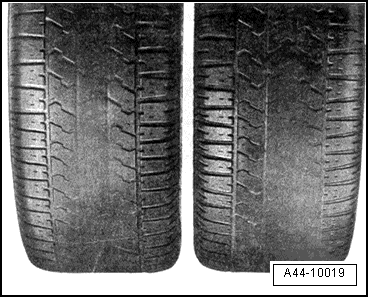
Permissible tread depth differences
- Use only tires of the same construction and tread design on all four wheels.
- Always fit the tyres with the greatest tread depth on the front axle.
- Replacing individual tyres is generally possible. However, the vehicle manufacturer recommends replacing tyres at least axle-wise (in pairs).
- With a sport differential on the rear axle, the vehicle manufacturer generally recommends replacing the wheels on the rear axle axle-wise (in pairs).

Note
The technical reason for these restrictions is thermal stress on the transmission oil caused by excessive differences in the rolling circumference of the tyres.
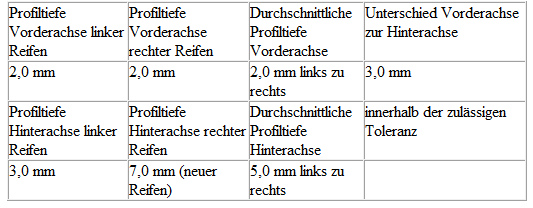
The difference between front and rear axle must not be greater than 3 mm.
Example: