Tire assessment
Standing flat spot
What is a flat spot?
The terms flattening and flat section are also used for flat spot.
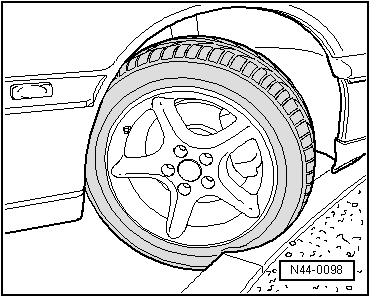
Flat spots also cause running unevenness, like an incorrectly balanced wheel. It is important that you recognise a flat spot on the tread as such!
Standing flat spots cannot be balanced out, and they can reappear at any time under various circumstances. Standing flat spots can be removed without complex special tools, provided it is not a brake flat spot caused by an emergency stop.

Note
Brake flat spots are irreparable damage to the tyre! Tyres with such damage must be replaced.
Causes of flat spots
- The vehicle stands in one place for several weeks without being moved.
- The tire pressure is too low.
- The vehicle was parked in a drying booth of a paint shop after painting.
- The vehicle was parked for a long time with warm tyres in a cool garage or similar. In this case a flat spot can develop overnight.
- Remove the standing flat spot.
Constrictions
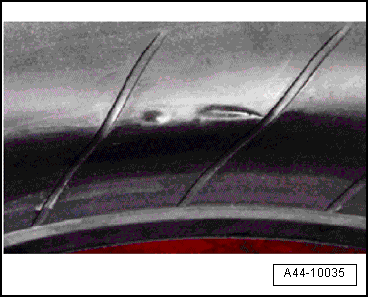
Constrictions are slight depressions in the tire sidewall.
They run from the bead toward the tire shoulder. The illustration shows the components mentioned.
They are caused by material build-up where the tire components are joined.
Constrictions have no effect on
- safety,
- service life,
- handling or
- other tire characteristics.
Constrictions can be more or less visible. Dismounting the tire from the rim or further inspection is not required.
What causes constrictions?
For weight reasons, modern steel-belted tires are usually manufactured with a single-ply sidewall.
The sidewall components consist of elongated strips before they are assembled into a tire. They must overlap at the material joints. This creates slight unevenness/waves in the area of the overlapping components. Due to the single-ply construction, these overlaps are more easily visible from the outside.
Brake flat spot
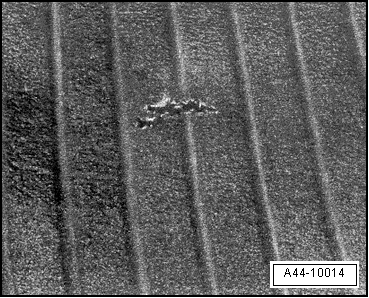
- A brake flat spot is a flat area on the tire tread that can occur during extreme braking on a firm surface such as asphalt.
- During braking, a localized area of the tire is abraded, causing a tire imbalance.
- The consequences of a brake flat spot are strong vibrations in the vehicle, which can lead to poorer handling and increased noise.
- In most cases, because of the larger contact area at this point, the tire tends to lock up again even with slightly less braking force, which further intensifies the vibrations.
- If the brake flat spot is only slight, the vibrations may disappear after a short time as the tire wears further.

Caution!
"Larger" brake flat spots are irreparable tire damage! Tires with such damage must be replaced.
Bulges in the tire sidewall
A bulge in the tire sidewall indicates that the carcass in the tire structure has been damaged.
Typical causes of this kind of damage include driving over curbs at a sharp angle.
The carcass of tires pinched in this way can be damaged.
The tire structure is stretched so far that individual fibers in the carcass break.
The extent of the damage depends on the impact speed, the impact angle, the air pressure, the axle load and the type of obstacle.
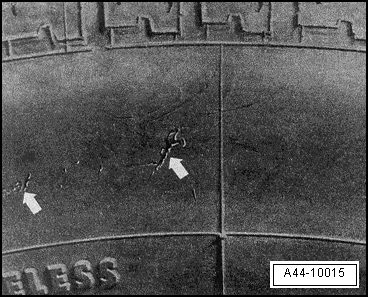
Pinch marks on the sidewall of a tire -arrows-

Note
- Driving over curbs should be avoided!
- If it is unavoidable, drive over the curb at as blunt an angle as possible and very slowly.
Inside view of a tire with a broken carcass
A heavy impact has pinched the carcass at the rim flange, and it has broken open in the contact zone.
Internal tire damage from impact fracture (double break)
Double break -arrows-, caused by pinching when driving over a curb. Often not visible from the outside.
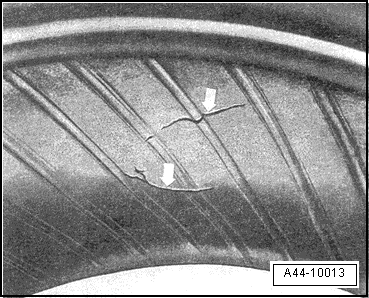
Cut damage
Cut damage caused by a sharp-edged obstacle -arrow-
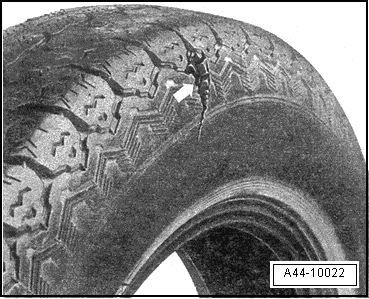
Damage from foreign objects
Driving over sharp, hard objects such as nails, screws or similar can puncture the tire.
This inevitably leads to tire damage.
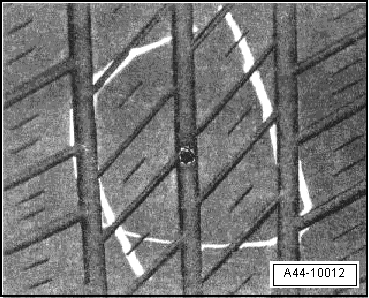
Damage from an embedded foreign object
Often the embedded foreign object -marked- is lodged so firmly in the tire that it does not come out on its own, even at higher speeds. It can then act like a plug and seal the tire relatively well. The result is a slow loss of air that the driver does not notice immediately, but which can lead to sudden total failure of the tire.

Note
Tires with steel belts whose structure has been punctured by a foreign object should not be repaired.
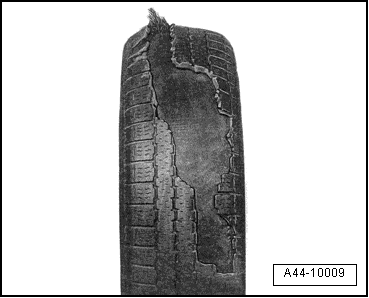
Tread torn off
Tire with tread torn off
Damage of this kind usually develops over a longer period. If an already damaged tire is then subjected to high loads, centrifugal forces at higher speeds can cause tire components to separate.
The illustration shows a tire whose tread was torn off by driving with too low an air pressure.
Tire damage from insufficient air pressure
The most common causes of failure are small external injuries, a defective valve, or a rim that is leaking due to corrosion or damage.
Carcass separating from the rubber
Severe heating from driving with considerably low pressure caused overheating and subsequent separation of the carcass from the rubber material -arrows-.
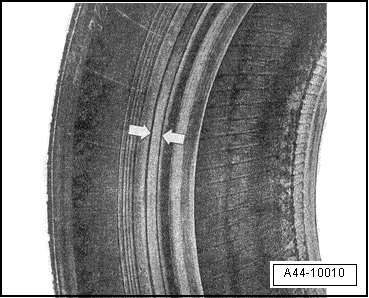
The tire shown was at times driven with an inflation pressure too low for the load. Typical signs of this are the circumferential chafing marks in the bead area caused by the rim flange, and discoloration. Small, wrinkled creases are visible in the area of the inner sidewall.
When the tire rolls, high shear forces arise between the steel cord plies, particularly at the belt ends.
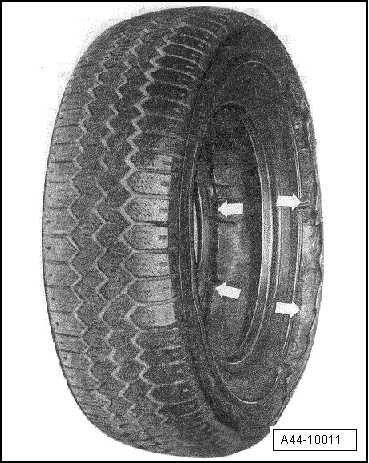
Tire with wide circumferential indentations in the bead area
Wide circumferential indentations in the bead area -arrows- indicate driving with too low an air pressure.
Driving with too low an air pressure, or failing to recognize or ignoring tire damage, can have serious consequences.
The tire can no longer absorb the forces that occur during driving.
Due to the defects mentioned, the function of the tire is severely impaired. The rubber compounds separate from one another, and the tire components partly detach, up to complete destruction.
Inspecting tires
Tire damage can have serious consequences, so regular inspection by the driver and by you is the best way to detect it early.
Previously damaged tires cannot withstand driving situations such as high speeds, long distances, sporty driving and the like.
Damage can be caused by various factors:
- Driving with too low an air pressure
- Mounting errors during tire installation
- Break-in damage
- Aging
- Improper storage

WARNING!
As soon as a safety risk cannot be ruled out, the tire must be replaced.
When checking the tire, pay particular attention to the following criteria:
- Surface erosion or marbling of the inner side (air pressure was too low or insufficient for the load)
- detached rubber or loose cord threads
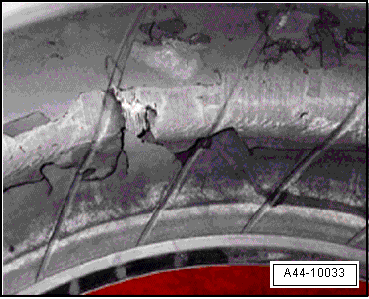
- exposed or deformed bead core
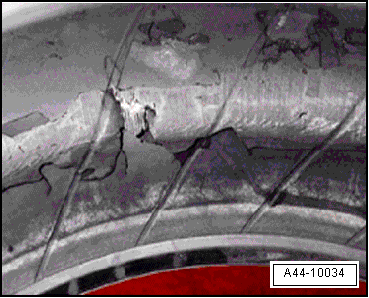
- Damage to the tire bead with visible cords
Damage caused during mounting
Bead core broken when inflating the tire.
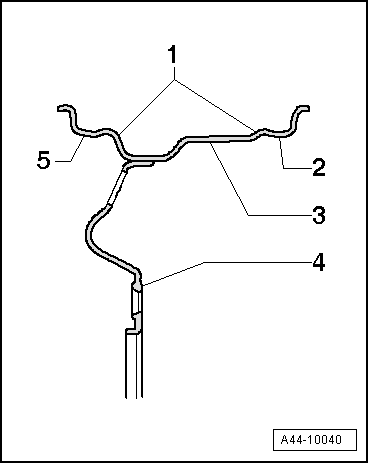
Modern passenger car radial tires are mounted exclusively on safety rims. These have a circumferential raised area on their shoulders -1-.
- Hump (H2)
- Inner rim shoulder
- Rim
- Wheel disc
- Outer rim shoulder
The hump prevents the tire from being pressed off the rim shoulder when driving with too low an inflation pressure.
When inflating the tire, it can happen that the bead of the tire does not slide completely over the outer rim hump.
In this case there is a risk that the bead core will be overstretched at excessive inflation pressure and its steel wires will break completely or partly. Broken bead cores cannot be seen from the outside.

DANGER!
- Tires with a damaged bead core do not sit securely on the rim. Such tires are a safety risk!
- There is also a risk that a cracked core will break during further driving and the tire will burst suddenly. If the bead core breaks during inflation, the carcass is also destroyed.