Cooling system/coolant
Connection diagram - coolant hoses
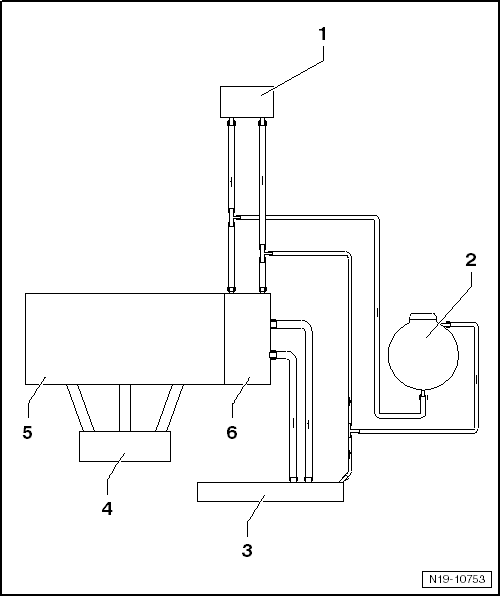
- Heater core
- Coolant expansion tank
- Checking for leaks "Checking cooling system for leaks"
- Radiator
- Removing and installing "Removing and installing radiator"
- Intake manifold
- Removing and installing "Removing and installing intake manifold"
- Cylinder head and cylinder block
- Coolant regulator housing with coolant pump
- remove and install "Removing and installing coolant pump"
Checking cooling system for leaks
Required Special Tools, Test and Measuring Equipment and Auxiliary Items
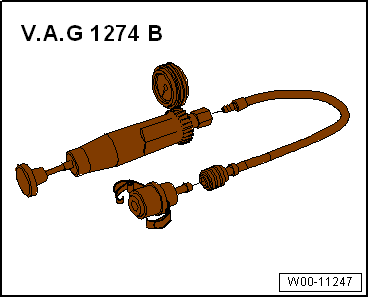
- Cooling system tester -V.A.G 1274 B-
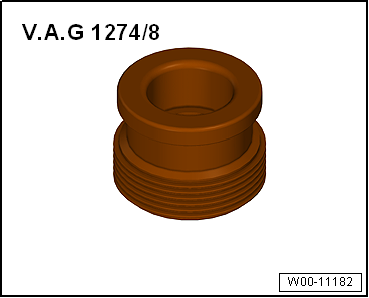
- Adapter for cooling system tester -V.A.G 1274/8-
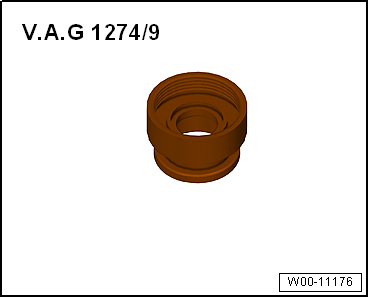
- Adapter for cooling system tester -V.A.G 1274/9-
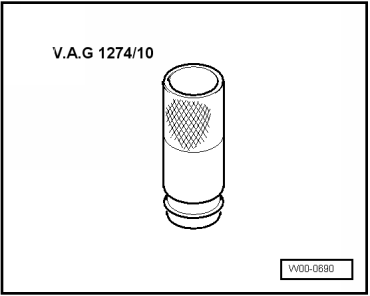
- Adapter for cooling system tester -V.A.G 1274/10-
Test conditions
- Engine at operating temperature
Test procedure:
Risk of scalding from hot steam and hot coolant. With a warm engine, the cooling system is under excess pressure. To release the excess pressure, cover the coolant expansion tank cap with a rag and open it carefully.
- Open the coolant expansion tank cap.
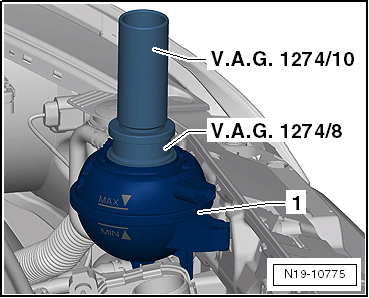
- Screw the adapter for cooling system tester -V.A.G 1274/8- into the coolant expansion tank -1-.
- Screw the adapter for cooling system tester -V.A.G 1274/10- into the adapter for cooling system tester -V.A.G 1274/8-.
- Clamp connector -V.A.G 1274 B/1- into the adapter for cooling system tester -V.A.G 1274/10-.
- Connect connector -V.A.G 1274 B/1- to the cooling system tester -V.A.G 1274 B- using the supplied connecting hose.
- Use the hand pump of the tester to build up an excess pressure of approx. 1.5 bar.
Risk of scalding from hot steam and hot coolant. Risk of scalding! Before disconnecting the cooling system tester -V.A.G 1274 B- from the connecting hose or connector -V.A.G 1274 B/1-, be sure to release the existing pressure. To do this, press the pressure relief valve on the cooling system tester -V.A.G 1274 B- until the pressure gauge shows "0".
If the pressure drops:
- Locate and repair the leak in the engine compartment and underbody.
Checking pressure relief valve in filler cap
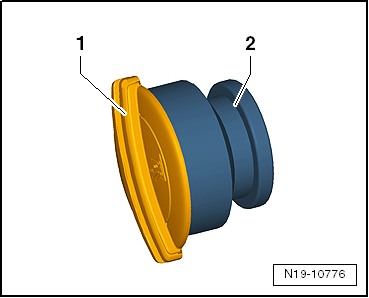
- Screw cap -1- into the adapter for cooling system tester -V.A.G 1274/9--2-.
- Clamp connector -V.A.G 1274 B/1- into the adapter for cooling system tester -V.A.G 1274/9-.
- Connect connector -V.A.G 1274 B/1- to the cooling system tester -V.A.G 1274 B- using the supplied connecting hose.
- Use the hand pump of the cooling system tester to build up excess pressure.
Blue filler cap
- The pressure relief valve must open at an excess pressure of 1.4 bar.
Black filler cap
- The pressure relief valve must open at an excess pressure of 1.6 ... 1.8 bar.
Opens pressure relief valve prematurely:
- - Replace filler cap.
Draining and topping up coolant
Draining coolant

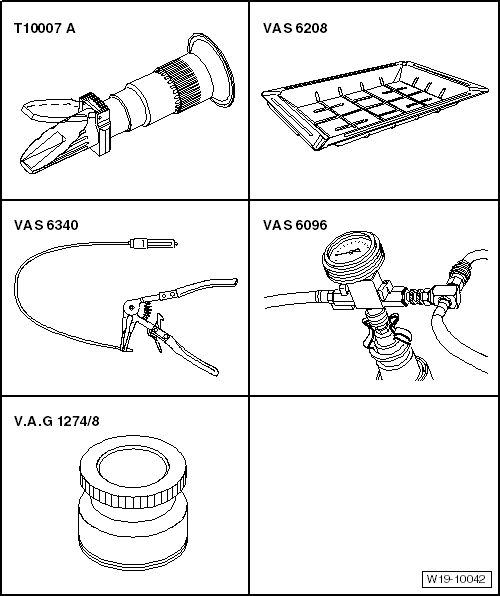
Required Special Tools, Test and Measuring Equipment and Auxiliary Items
- Refractometer -T10007 A-
- Drip pan for workshop crane -VAS 6208-
- Hose clamp pliers -VAS 6340-
- Cooling system filling unit -VAS 6096-
- Adapter for cooling system tester -V.A.G 1274/8-
Risk of scalding from hot steam and hot coolant. With a warm engine, the cooling system is under excess pressure. To release the excess pressure, cover the coolant expansion tank cap with a rag and open it carefully.
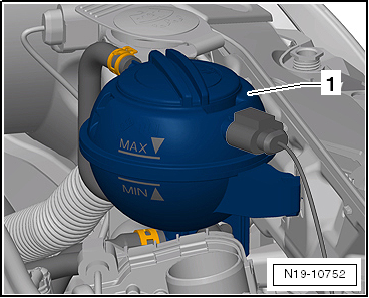
- Open the filler cap of the coolant expansion tank -1-.
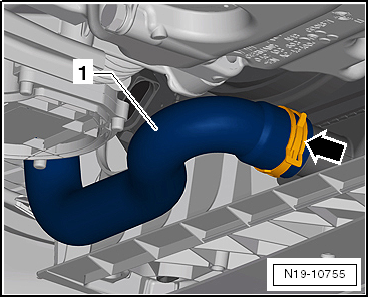
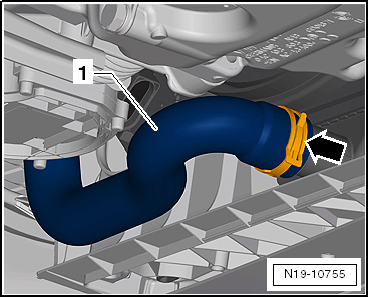
- Loosen hose clamp -arrow- and disconnect coolant hose -1- from radiator "Wiring diagram - coolant hoses".
- Let the coolant drain.

Note
Observe disposal regulations!
Topping up coolant
Required Special Tools, Test and Measuring Equipment and Auxiliary Items
- Refractometer -T10007 A-
- Drip pan for workshop crane -VAS 6208-
- Hose clamp pliers -VAS 6340-
- Cooling system filling unit -VAS 6096-
- Adapter for cooling system tester -V.A.G 1274/8-

Note
- The water used for the mixture is a major factor in the effectiveness of a coolant. Due to its ingredients, which can vary by country or even by region, the required water quality has been defined. Distilled water meets all requirements. For this reason, when topping up or refilling, mix the coolant with distilled water.
- Only coolant additives listed in → Electronic Parts Catalog (ETKA) may be used. Other coolant additives can considerably impair the corrosion protection. The resulting damage can lead to coolant loss and subsequently to severe engine damage.
- Coolant in the correct mixing ratio prevents frost and corrosion damage as well as limescale deposits. It also raises the boiling point. For this reason, the cooling system must always be filled with coolant additive, all year round.
- Especially in countries with tropical climates, the coolant contributes to operating reliability under high engine loads due to its higher boiling point.
- To determine the current antifreeze value, the refractometer -T10007A- MUST be used.
- Antifreeze protection must be set to at least -25 ºC, in countries with arctic climates to approx. -36 ºC. Only if stronger antifreeze protection is required for climatic reasons may the antifreeze protection be increased, but only up to -48 ºC, otherwise the cooling effect of the coolant deteriorates.
- The coolant concentration must not be reduced by topping up with water, even in the warm season or in warm countries. Antifreeze protection must be at least -25 ºC.
- Read the antifreeze value on the scale for the respective coolant additive that was topped up.
- The temperature read on the refractometer -T10007A- corresponds to the "ice flake point". From this temperature onward, the first ice flakes can form in the coolant.
- Do not reuse used coolant.
- Use only water/coolant additive as lubricant for coolant hoses.
Recommended mixing ratios (use only distilled water for mixing):

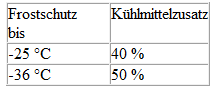
1) The coolant quantity may vary depending on vehicle equipment.
- Push on coolant hose -1- and secure it with hose clamp -arrow-.
- Screw adapter for expansion tank -V.A.G 1274/8- onto the expansion tank.
- Fill the coolant circuit with the cooling system filling unit -VAS 6096- → Operating instructions for cooling system filling unit VAS 6096.
- Top up coolant to the MAX mark on the expansion tank.
- Place cooling system tester -V.A.G 1274 B- on the expansion tank and pressure-test the cooling system at 1.5 bar.
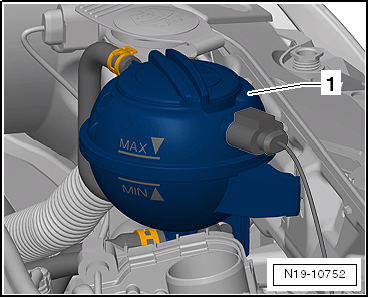
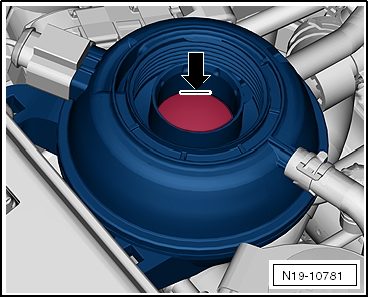
- Top up coolant to the edge -arrow- on the expansion tank.
- Close the expansion tank.
- If equipped, switch off the air conditioning.
- Switch off heater controls.
- Start engine and let it warm up first.
- Hold engine speed at approx. 3800 rpm until the fan starts.
- After the fan starts, hold engine speed at approx. 3800 rpm for a further 5 minutes.
- Switch off engine.
Risk of scalding from hot steam and hot coolant. With a warm engine, the cooling system is under excess pressure. To release the excess pressure, cover the coolant expansion tank cap with a rag and open it carefully.
- Check coolant level and top up if necessary.
- With the engine at operating temperature, the coolant level may be at or above the "MAX mark".
- With a cold engine, the coolant level must be between the "MIN mark" and the "MAX mark".