Safety Precautions When Working on the Ignition System
In the electronic ignition system, the voltage reaches 40 kV. Under unfavorable conditions, such as humidity in the engine compartment, voltage surges can break down insulation, which in turn may result in an electric shock.
To prevent personal injury and/or damage to the electronic ignition system, observe the following precautions:
• Wash the engine only after it has been switched off.
• Before performing welding work, disconnect all battery cables.
• Do not disconnect the alternator or starter while the engine is running.
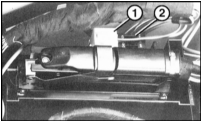
When performing a compression test, be sure to disconnect the DME main relay (1) to prevent the ignition coil from operating. (2 - DME fuses). Refer to the accompanying illustration. Check the compression; refer to the Compression Test section.
• Ignition system wires must only be disconnected with the ignition switched off.
• Connect and disconnect the test instrument leads (tachometer/ignition tester) only with the ignition switched off.
• The primary side (high-voltage side, spark plug side) of the ignition system must be loaded with a resistance of at least 4 kOhm. Spark plug connectors must be connected.
• Never start the engine with the cable disconnected from the ignition coil (terminal 4).
• Do not connect a suppression capacitor or a test lamp to terminal 1 (-) of the ignition coil.
• Do not connect terminal 1 of the ignition coil to ground or to the battery. When installing an anti-theft alarm later, do not use the wire to terminal 1 for starter lockout.
• Do not start the engine immediately after it has been heated to a temperature above +80°C (for example, during painting or steam cleaning).
• Persons with a cardiac pacemaker must not perform work on the electronic ignition system.
Test yourself
A quick BMW 1 quiz: every answer comes with an explanation and a link to the manual page.