Spark Plugs
General Description and Specifications
Spark plugs have a 16 mm hex size. The manufacturer recommends a specific type of spark plug; however, suitable spark plugs with the appropriate heat range from other manufacturers may be used. Spark plugs should be replaced every 20,000 km or 2 years. Before removing the spark plugs, make sure there are no foreign objects in the spark plug wells. Washers, bolts or stones that fall into the spark plug holes will damage the valves, valve seats or cylinder head when the engine is first started.
A spark plug consists of a center electrode, an insulator with a shell, and a side electrode. The center electrode is hermetically sealed to the insulator, and the insulator is firmly bonded to the shell. The spark is formed between the center and side electrodes. Starting readiness, idle characteristics, acceleration and maximum vehicle speed depend on the spark plug. For this reason, do not use spark plugs other than those recommended by the vehicle manufacturer. The main parameter of a spark plug is its heat range. It characterizes the spark plug's heat load capacity under specific operating conditions. Spark plugs are selected so that they reach the self-cleaning temperature under all possible operating conditions. The lower the heat range number of a spark plug, the higher its resistance to pre-ignition and the higher its resistance to fouling.
The heat range number is indicated in the spark plug code. The code has the following structure:

1 — W - thread M14 x 1.25 with flat seat gasket, wrench size 21; F - thread M14 x 1.25 with flat seat gasket, wrench size 16; H - thread M14 x 1.25 with taper seat, wrench size 16.
2 — Heat range. Can be from 06 ("cold" spark plug) to 13 ("hot" spark plug). The number 8 corresponds to heat range 150 (former designation), 7 - 175, 6 - 200, etc.
3 — B - thread length 12.7 mm, insulator heat cone protrudes beyond shell end; C - thread length 19 mm, normal heat cone position; D - thread length 19 mm, insulator heat cone protrudes; L - thread length 19 mm, increased heat cone protrusion.
Thread length data refers to spark plugs with flat gasket seat. Additionally "T" (e.g., "DT") - 3 ground electrodes.
4 — Electrode design
5 — Center electrode material: no designation - nickel-chromium alloy, C - copper-nickel alloy, S - silver, P - platinum.
6 — With interference suppression resistor.
Spark plugs used for BMW 5 Series are listed in the Specifications.
* Due to technical development, new spark plug types may appear. Information on spark plug characteristics can be obtained from specialist workshops.
Spark plug condition as an indicator of engine performance
Spark plug appearance can be used to evaluate ignition, fuel injection adjustment, mixture quality and engine wear (pistons, piston rings, etc.). Refer to the photo inserts.
When installing spark plugs, make sure they are not overtightened, as the sealing washer may be damaged. Do not exceed the tightening torque of 25 N·m.
SPARK PLUG APPEARANCE
Carbon deposits
Symptoms: Soot indicates an over-rich air-fuel mixture or weak spark intensity. Causes misfires, hard starting and unstable engine operation.
Recommendations: Check whether the air filter is clogged, whether the fuel level in the float chamber is too high, whether the choke valve is stuck, and whether the contacts are excessively worn. Try using spark plugs with a longer insulator, which increases resistance
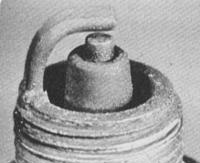
Carbon deposits
Symptoms: Soot indicates an over-rich air-fuel mixture or weak spark intensity. Causes misfires, hard starting and unstable engine operation.
Recommendations: Check whether the air filter is clogged, whether the fuel level in the float chamber is too high, whether the choke valve is stuck, and whether the contacts are excessively worn. Try using spark plugs with a longer insulator, which increases resistance
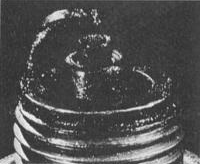
Oil fouling
Symptoms: Oil fouling is caused by wear of valve stem seals. Oil enters the combustion chamber through worn valve guides or piston rings. Causes misfires, hard starting and unstable engine operation.
Recommendations: Perform mechanical repair work and replace the spark plugs.

Overheating
Symptoms: Porous, white insulator, electrode erosion and no deposits. Shortens spark plug service life.
Recommendations: Check whether the heat range of the installed spark plugs meets the Specifications, whether ignition timing is set correctly, whether the mixture is too lean, whether there are vacuum leaks in the intake manifold, and whether the valves are sticking. Also check the coolant level and whether the radiator is clogged.

Pre-ignition
Symptoms: Electrodes are melted. Insulator is white but may be contaminated due to misfires or foreign particles entering the combustion chambers. May lead to engine failure.
Recommendations: Check the heat range of the installed spark plugs, ignition timing, mixture quality (whether it is too lean), whether the cooling system is clogged, and whether the lubrication system operates normally.
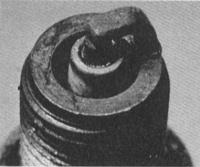
Electrically conductive glaze
Symptoms: Insulator has a yellowish color and a polished appearance. Indicates a sudden temperature increase in the combustion chambers during rapid acceleration. Normal deposits melt and form a varnish-like coating. Causes misfires at high speeds.
Recommendations: Replace the spark plugs with colder ones, while maintaining the driving style.
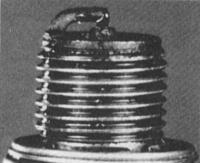
Electrode bridging
Symptoms: Combustion residues get into the gap between the electrodes. Solid deposits accumulate, forming a bridge between the electrodes. Causes ignition failure in the cylinder.
Recommendations: Remove deposits from the electrode gap.
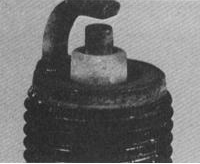
Normal spark plug condition
Symptoms: Gray-brown color and slight electrode wear. The heat range of the spark plugs corresponds to the engine type and its general condition.
Recommendations: When replacing spark plugs, install spark plugs of the same type.
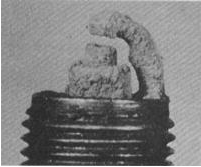
Ash deposits
Symptoms: Soft brownish deposits on one or both electrodes of the spark plug. The source is oil and/or fuel additives. Excessive buildup may insulate the electrodes and cause misfires and unstable engine operation during acceleration.
Recommendations: If deposits build up quickly, replace the valve stem seals to prevent oil from entering the combustion chambers. Try changing the fuel brand.
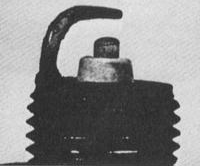
Wear
Symptoms: Rounded electrodes with slight deposit buildup at the working end. Normal color. Causes hard starting in cold, humid weather and increased fuel consumption.
Recommendations: Replace the spark plugs with new ones of the same type.
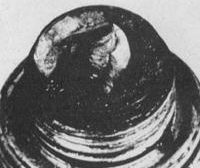
Detonation
Symptoms: Insulators may be chipped or cracked. Improper spark plug gap adjustment may also damage the insulator. May cause damage to the pistons.
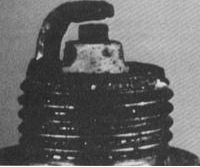
Splashing
Symptoms: After misfiring for a long period, deposits may loosen while the combustion chamber remains at operating temperature. At high deposit rates, flakes break off the piston and stick to the hot insulator, causing misfiring.
Recommendations: Replace the spark plugs, or clean and reinstall the old ones.

Mechanical damage
Symptoms: May be caused by foreign material entering the combustion chamber, or by the piston striking a plug that is too long. Results in cylinder failure and piston damage.
Recommendations: Remove foreign particles from the engine and/or replace the spark plugs.
Since spark plug service life is normally about 15,000 km, it is sufficient to clean them every 8,000 km.
Test yourself
A quick BMW 1 quiz: every answer comes with an explanation and a link to the manual page.