Driving Stability Control Systems
The driving stability control systems of the BMW 5 Series, 7th generation, provide comprehensive support for greater safety in every driving maneuver. These include ABS, DSC, DTC and xDrive, which specifically regulate braking and drive forces. The vehicle remains easy to control even in difficult situations such as cornering, snow-covered roads or sudden evasive maneuvers. Dynamic Traction Control ensures the best possible traction on slippery surfaces. Integral Active Steering further improves maneuverability in city traffic and stability at high speeds. These systems work in the background to make driving safer and more dynamic, ideal for everyday use and demanding routes.
Vehicle equipment
This chapter describes all standard, country-specific and optional equipment offered in the model series. It therefore also describes equipment that is not available in a given vehicle, for example due to the selected optional equipment or country variant. This also applies to safety-related functions and systems. When using the corresponding functions and systems, observe the applicable laws and regulations.
Anti-lock Braking System ABS
ABS prevents the wheels from locking when braking.
Steering control is maintained even during full braking, which increases active driving safety.
ABS is on standby after every engine start.
Brake Assist
When the brake pedal is pressed quickly, the system automatically provides as much brake boost as possible. This keeps the braking distance as short as possible during full braking.
The advantages of ABS are also utilized in this process.
If full braking is to continue, do not reduce the pressure on the brake pedal.
Adaptive Brake Assist
In conjunction with Active Cruise Control, the system ensures that the brakes respond even faster in critical situations when braking.
Hill Start Assistant
Principle
The system supports starting off on inclines.
Pulling away
- Hold the vehicle with the foot brake.
- Release the foot brake and drive off promptly.
After the foot brake is released, the vehicle is held for approx. 2 seconds.
After the accelerator pedal is pressed, the vehicle is held until it starts moving.
Depending on the load or when towing a trailer, the vehicle may roll back slightly.Dynamic Stability Control DSC
Principle
Within the limits of physics, the system helps keep the vehicle on a safe course by reducing engine output and by applying the brakes to individual wheels.
General
Dynamic Stability Control detects unstable driving states such as the following:
- The rear of the vehicle breaking away, which can lead to oversteer.
- Loss of grip at the front wheels, which can lead to understeer.
Safety notes
WARNING The system does not relieve the driver of responsibility for correctly assessing the traffic situation. Due to system limits, the system cannot always react appropriately on its own in all traffic situations.
There is a risk of accident. Adapt your driving style to traffic conditions. Observe traffic and intervene actively in the relevant situations. WARNING When driving with a roof load, e.g. with a roof rack, the higher center of gravity can compromise driving safety in critical driving situations. There is a risk of accident or property damage. Do not deactivate Dynamic Stability Control DSC when driving with a roof load.
Overview
Button in vehicle
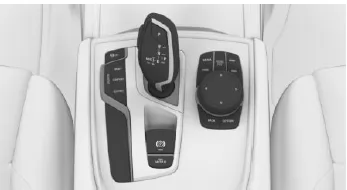
 DSC OFF
Deactivating/activating DSC
General
Deactivating DSC reduces driving stability during acceleration and when cornering.
Stabilizing interventions by Integral Active Steering are only performed by the rear-wheel steering.
To support driving stability, reactivate DSC as soon as possible.
Deactivating DSC
Press and hold the button until DSC OFF appears in the instrument cluster and the DSC OFF indicator lamp lights up.
Activating DSC
 Press the button.
DSC OFF and the DSC OFF indicator lamp go out.
Display
In the instrument cluster
When DSC is deactivated, DSC OFF is shown in the instrument cluster.
Indicator and warning lamps
 Indicator lamp lights up: DSC is deactivated.
 Indicator lamp flashes: DSC is regulating drive and braking forces.
Warning lamp lights up: DSC has failed.
Dynamic Traction Control DTC
Principle
DTC is a variant of DSC optimized for forward traction.
In special road conditions, e.g. unplowed snow-covered roads or loose surfaces, the system ensures maximum forward traction with limited driving stability.
General
When DTC is activated, maximum traction is available.
Driving stability is limited when accelerating and when cornering.
In the following situations, it may be advisable to activate DTC briefly:
- Driving in slush or on unplowed, snow-covered roads.
- Rocking free or pulling away from deep snow or loose surfaces.
- Driving with snow chains.
Overview
Button in vehicle
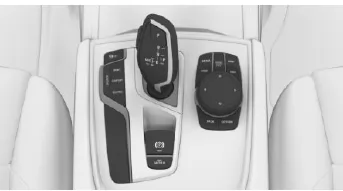
 DSC OFF
Activate/deactivate DTC
Activate DTC
 Press the button.
The instrument cluster shows TRACTION and the DSC OFF indicator lamp illuminates.
Deactivate DTC
 Press the button again.
The TRACTION indicator and the DSC OFF indicator lamp go out.
Display
Display in the instrument cluster
When DTC is activated, TRACTION is displayed in the instrument cluster.
Indicator and warning lights
 Indicator lamp lit: DTC is activated.
xDrive
xDrive is the all-wheel-drive system of the vehicle.
The interaction of xDrive and Dynamic Stability Control DSC further optimizes traction and driving dynamics.
Depending on the driving situation and road conditions, xDrive variably distributes the drive forces between the front and rear axles.
Integral Active Steering
Principle
Integral Active Steering is a combination of variable steering ratio and rear-wheel steering.
The system varies the steering angle of the wheels in relation to the steering wheel movements.
At large steering wheel angles and low speeds, e.g. when maneuvering, the wheel angle is increased, i.e. the steering becomes more direct.
Rear-wheel steering increases maneuverability by turning the rear wheels slightly opposite to the front wheels.
At higher speeds, the rear wheels are turned in the same direction as the front wheels.
In critical driving situations, Integral Active Steering can stabilize the vehicle through targeted steering at the rear wheels before the driver intervenes, e.g. when oversteering.
General
The system offers different calibrations.
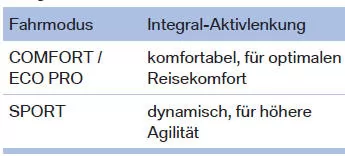
The different calibrations are assigned to the various driving modes of the Driving Experience Control switch.
Snow chain operation
In snow chain operation, rear-wheel steering is deactivated.
Malfunction
In the event of a malfunction, larger steering wheel movements are required, while the vehicle reacts more sensitively to steering wheel movements at higher speeds.
The stability-enhancing intervention may be deactivated.
Drive on carefully and anticipate traffic.
Have the system checked by a manufacturer service partner, another qualified service partner, or a specialist workshop.
The driving stability control systems of the BMW 5 Series G30/G31 combine state-of-the-art technologies for maximum safety and dynamics. From the Anti-lock Braking System ABS through Dynamic Stability Control DSC to Integral Active Steering, each system contributes to safe and precise handling, even under difficult conditions.
Flexibility is a particular highlight: depending on the driving situation, systems such as DTC or DSC can be adjusted or deactivated to achieve the best possible progress on snow or loose surfaces, for example. The intuitive control via vehicle buttons and the clear display in the instrument cluster make operation considerably easier.
FAQQuestion 1: When should DTC be activated?
Answer: When driving on loose surfaces, in snow, or when using snow chains, to improve forward traction.
Question 2: Is DSC always active during normal driving?
Answer: Yes, to support driving stability, DSC remains switched on by default and should only be deactivated in exceptional cases.
Test yourself
A quick BMW 5 quiz: every answer comes with an explanation and a link to the manual page.