Operating principle: cruise control
Cruise control function
Performance
Cruise control is a function that allows the user to regulate the speed of the vehicle.
Cruise control uses the speed setpoint programmed by the user and the vehicle speed to control the engine torque.
In regulation mode, the engine ECU continuously compares the programmed speed with the instantaneous vehicle speed.
Cruise control is active only if the vehicle speed is between 40 and 200 km/h.
Block diagram of the cruise control function
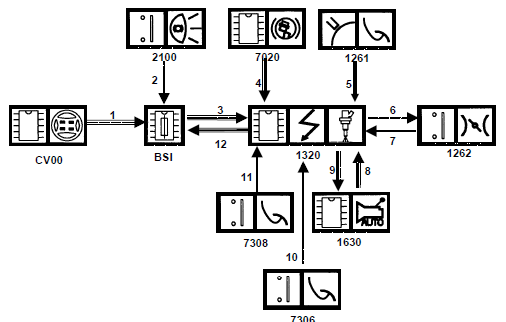
Block diagram of the cruise control function
Key:
- Single arrow = wired link
- Triple arrow = multiplexed link
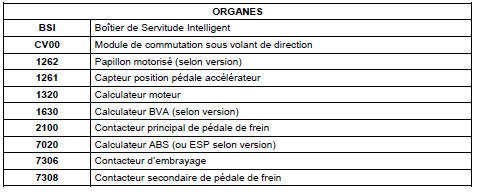
LINKS |
||
| LINK NO. | SIGNAL |
SIGNAL TYPE |
| 1 | Cruise control switch status | VAN CAR 1 |
| 2 | Main brake switch status | ON / OFF |
| 3 | Cruise control switch status. Driver request to activate / deactivate cruise control. Main brake switch status. Main brake switch information fault |
CAN |
| 4 | Vehicle speed information | CAN |
| 5 | Accelerator pedal position | ANALOGUE |
| 6 | Electronic throttle control | ANALOGUE |
| 7 | Electronic throttle position | ANALOGUE |
| 8 | Gearbox ratio information. Selector lever position information |
CAN |
| 9 | Cruise control status information | CAN |
| 10 | Clutch switch status | ON / OFF |
| 11 | Secondary brake switch status | ON / OFF |
| 12 | Cruise control status information. Cruise control fault information |
CAN |
Functional description
In regulation mode, the engine ECU continuously compares the programmed speed with the instantaneous vehicle speed.
The instantaneous speed information is transmitted by the ABS ECU.
| STEP | DETAILS |
| 1 | Reading of the cruise control command status by the steering column switch module |
| Transmission of the cruise control command status to the BSI via the VAN CAR 1 network. | |
| 2 | Reading of the main brake pedal contact by the BSI. |
Consistency check with the main brake contact 3 information broadcast by the BSI via the CAN network.
Note: The driver can exceed the programmed speed by using the accelerator pedal. As soon as the driver releases the accelerator pedal, speed control at the programmed speed is active again.
IMPACT OF THE AUTOMATIC GEARBOX
The automatic gearbox ECU broadcasts the following information on the network:
- the engaged gear ratio,
- the selector lever position.
This information is used by the engine ECU to enable or disable cruise control.
The automatic gearbox ECU receives the cruise control status (active or disabled) in order to disable its driver intent self-detection strategies.
CRUISE CONTROL EXIT MODES
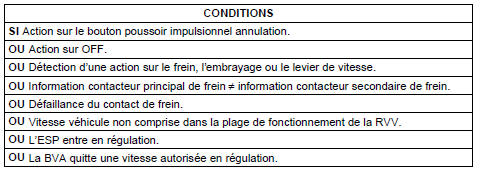
The cruise control function is faulty in the following cases:
- main brake contact information ¹ secondary brake contact information,
- brake contact failure,
- cruise control switch fault.
DEGRADED MODES
If one of the networks (CAN or VAN CAR 1) or the brake contact fails, cruise control is disabled.
Test yourself
A quick Citroen C5 Aircross quiz: every answer comes with an explanation and a link to the manual page.