Air conditioning
Manual heater / air conditioner
(depending on version/market, where fitted)
Controls
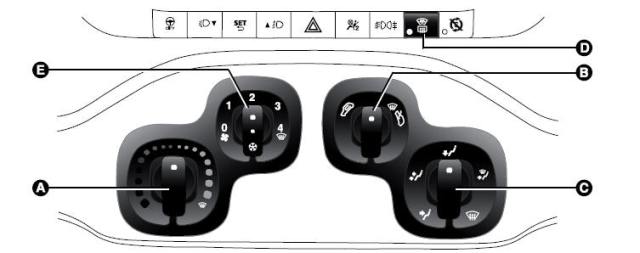
A - Air temperature adjustment knob (red-hot/blue-cold).
B - Air recirculation knob:
 interior air recirculation.
 outside air intake.
WARNING It is advisable to select interior air recirculation when stopped in traffic or in tunnels, or when driving on dusty roads, to prevent polluted outside air from entering. Avoid using this function for prolonged periods, especially with several people on board, to prevent the windows from fogging up.
C - Air distribution knob:
 towards the central and side dashboard vents for ventilation of the torso and face in warm seasons.
 split between the footwell outlets (warmer air) and the dashboard vents (cooler air).
 towards the footwell outlets. The natural tendency of heat to rise allows the passenger compartment to warm up quickly, giving a prompt feeling of warmth.
 split between the footwell outlets and the windscreen and front side window outlets. This distribution provides good heating of the passenger compartment while also helping to prevent the windows from fogging up.
 towards the windscreen and front side window outlets to defog or defrost the windows.
D - Rear window heater / heated mirrors / heated windscreen button (where provided for versions/markets). When activated, the LED on the button itself lights up. To preserve battery efficiency, the function is timed and switches off automatically after approximately 20 minutes.
E - Fan speed knob and air conditioner on/off (where provided for versions/markets).
WARNING In hot and humid weather conditions, using cold air towards the windscreen may cause condensation on the outside, with possible reduced visibility.
NOTE To cut off the airflow from the vents, set the knob to 0 and turn knob B to interior air recirculation.
Auxiliary heater
(depending on version/market, where fitted)
Allows the passenger compartment to warm up more quickly in cold weather conditions. The heater always activates automatically based on ambient conditions, with the engine running and when the engine coolant temperature is low. The heater switches off automatically when comfort conditions are reached.
The heater only operates when the outside temperature and engine coolant temperature are low. The heater does not activate if the battery voltage is insufficient.
Automatic air conditioner
(depending on version/market, where fitted)
Controls
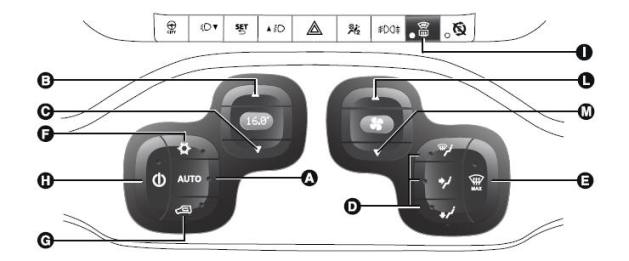
A - AUTO function on (automatic air conditioner operation).
B - Air temperature increase.
C - Air temperature decrease.
D - Manual air distribution selection.
Press the buttons to set one of the five possible airflow distributions:
 towards the windscreen and front side window outlets to defog or defrost the windows.
 towards the central and side dashboard vents for ventilation of the torso and face in warm seasons.
 towards the footwell outlets. The natural tendency of heat to rise allows the passenger compartment to warm up quickly, giving a prompt feeling of warmth.
 split between the footwell outlets (warmer air) and the dashboard vents (cooler air).
 split between the footwell outlets and the windscreen and front side window outlets. This distribution provides good heating of the passenger compartment while also helping to prevent the windows from fogging up.
WARNING In hot and humid weather conditions, using cold air towards the windscreen may cause condensation on the outside, with possible reduced visibility.
E - MAX-DEF function on/off (rapid defrosting/defogging of the front windows).
F - Air conditioner compressor on/off.
G - Interior air recirculation on/off.
H - Air conditioner on/off.
I - Rear window heater and, where provided for versions/markets, heated outside rear view mirrors and heated windscreen on/off.
L/M - Fan speed adjustment.
The automatic air conditioner manages the Start&Stop function (engine off when vehicle speed is zero) so as to guarantee adequate comfort inside the passenger compartment.
NOTE In extreme weather conditions, it is advisable to limit use of the Start&Stop function to avoid continuous switching on and off of the compressor, which may cause the windows to fog up quickly and moisture to build up, allowing bad odours into the passenger compartment.
WARNING 18) In low outside temperatures, it is advisable not to use the recirculation function, as the windows may fog up quickly. WARNING 2) The system uses refrigerant compliant with the regulations in force in the countries where the vehicle is sold: R134a or R1234yf.When recharging, use only the gas indicated on the specific label located in the engine compartment. The use of other refrigerants compromises the efficiency and integrity of the system. The lubricant used for the compressor is also strictly tied to the type of refrigerant gas; refer to the Fiat Service Network.
Test yourself
A quick Fiat Panda quiz: every answer comes with an explanation and a link to the manual page.