Tyre Pressure Monitoring System
WARNING
The Tyre Pressure Monitoring System does not replace manual tyre pressure checks. You must check the tyre pressures regularly with a pressure gauge. If the tyre pressures are not correctly maintained, the risk of tyre failure, loss of control, rollover and personal injury increases.
 You must check
the tyre pressures (including the spare tyre, if fitted) every two weeks when the tyres are cold.
You must inflate the tyres to the correct pressure.
See Wheels and Tyres (page 257). The tyre pressures are also shown on the tyre pressure label (located on the driver's door edge or on the B-pillar).
Your vehicle is fitted with a Tyre Pressure Monitoring System, which is part of the driver assistance features. A warning light illuminates when one or more tyres are significantly underinflated. If the low tyre pressure warning light comes on, stop the vehicle as soon as it is safe to do so, check the tyres and inflate them to the correct pressure.
Driving on underinflated tyres can:
- cause them to overheat;
- lead to tyre failure;
- increase fuel consumption;
- reduce tyre life;
- affect the vehicle's handling or its ability to stop.
The system does not replace proper tyre maintenance.
You must maintain the correct tyre pressures even if underinflation does not trigger the warning light.
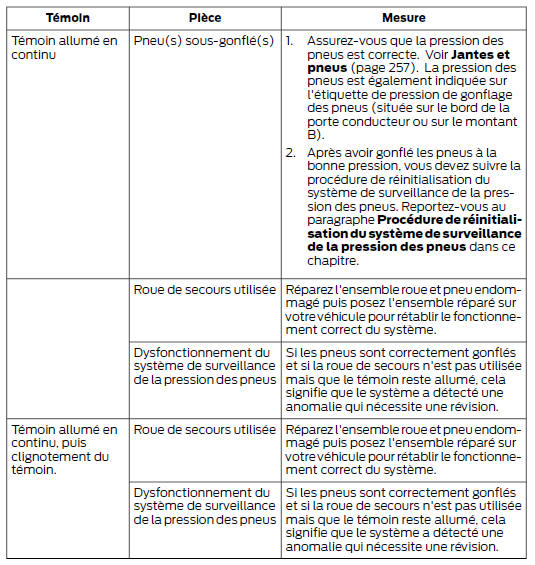
The Tyre Pressure Monitoring System has a malfunction indicator that warns you when the system is not working correctly. The malfunction indicator and the low tyre pressure warning light are combined. When the system detects a malfunction, the light flashes for approximately one minute, then stays on. This sequence repeats each time you switch on the ignition for as long as the malfunction persists. The system has detected a fault that requires servicing.
When the malfunction indicator is on, the system may not be able to detect or signal low tyre pressures. A malfunction can occur for various reasons, including the fitting of a replacement tyre or a spare wheel that prevents the system from working correctly. Always check the Tyre Pressure Monitoring System malfunction indicator after replacing one or more tyres or wheels on your vehicle. Make sure the system continues to work correctly with the replacement tyres or wheels. Refer to the paragraph When Fitting the Temporary Spare Tyre in this section.
Changing tyres with a Tyre Pressure Monitoring System

Always have your tyre service carried out by an authorised dealer.
Note: Each wheel and tyre assembly is fitted with a pressure sensor located inside the wheel and tyre cavity. The pressure sensor is located on the valve stem. The tyre covers the pressure sensor, so it is only visible when the tyre is removed.
Take care not to damage the sensor when changing the tyre.
Understanding the Tyre Pressure Monitoring System
The system measures the pressure of all four tyres and sends the tyre pressure readings to the vehicle.
The system detects this lower pressure as being significantly below the correct inflation pressure and the light comes on. You must inflate the tyres to the correct pressure.
When Fitting the Temporary Spare Tyre
If you have to replace a road wheel and tyre assembly with a temporary spare wheel, the system continues to detect a malfunction. The purpose is to remind you that the damaged wheel and tyre assembly must be repaired and the repaired wheel and tyre assembly refitted to the vehicle. To restore correct system operation, you must have the wheel and tyre assembly repaired and refitted to your vehicle.
If you think the system is not working correctly
The main function of the system is to warn you when the tyre pressure is low. It can also warn you if the system is no longer able to operate correctly. Refer to the table below for more information about the system:
Tyre Pressure Monitoring System Reset Procedure
Overview
You must follow the system reset procedure after each tyre change or tyre pressure adjustment.
To maintain the load capacity of the vehicle, the front tyre pressure must be different from the rear tyre pressure.
The system illuminates the warning light when the front and rear tyre pressures are different.
Tyres must be rotated regularly to ensure consistent performance and maximum tyre life. The system must therefore know when the tyres have been rotated in order to determine which pairs of tyres are fitted to the front and rear axles. With this information, the system can correctly detect any loss of tyre pressure and warn the driver.
Performing the System Reset Procedure
Switch the ignition on. Using the controls on the information display, select:
| Message | Description and action |
| Settings | Press the OK button. |
| Driver Assist | Press the OK button. |
| Tyre Pressure Monitoring | Press and hold the OK button until a confirmation message is displayed. Alternatively, if the vehicle is equipped with a tyre pressure monitoring system reset button, press and hold this button until a confirmation is displayed. |
Effect of Temperature on Tyre Pressure
Under normal driving conditions, the tyre pressure may increase by a maximum of 0.3 bar compared with a cold start condition.
If the vehicle remains stationary overnight and the temperature drops considerably compared with the daytime temperature, the tyre pressure may decrease by a maximum of 0.2 bar for a drop of 17 °C or more in the ambient temperature. The system detects this pressure drop as being considerably lower than the correct inflation pressure and the warning light illuminates.
When Inflating the Tyres
When inflating the tyres, the system may not respond immediately to the air added to the tyres.
If the warning light is illuminated:
- Check each of the tyres to make sure none is flat.
- If one or more tyres are flat, carry out repairs as required.
- Check the tyre pressure and inflate all tyres to the correct pressure.
- Carry out the tyre pressure monitoring system reset procedure.
Test yourself
A quick Ford Mondeo quiz: every answer comes with an explanation and a link to the manual page.