Emission Control System
Repair Procedures
In this manual: Emission Control System
10steps
~60min
3/5difficulty
Done 0 of 10
Inspection
[System Inspection]- Disconnect the vapor hose from the throttle body and connect a vacuum pump to the nipple on the throttle body.
- Using the vacuum pump, check the following items by applying vacuum. • With cold engine [engine coolant temperature < 60 °C]
Engine Status Applied vacuum Result Idle 0.5 kgf/cm² (50 kPa, 7.3 psi) Vacuum is applied 3000 rpm
• With warm engine [engine coolant temperature > 80 °C]Engine Status Applied vacuum Result Idle 0.5 kgf/cm² (50 kPa, 7.3 psi) Vacuum is applied Within 3 minutes after starting the engine at 3000 rpm Try to apply vacuum Vacuum is released 3 minutes after starting the engine at 3000 rpm 0.5 kgf/cm² (50 kPa, 7.3 psi) Vacuum will be held momentarily, then released - Turn the ignition switch OFF and disconnect the negative (-) battery cable.
- Disconnect the PCSV connector (A).
- Disconnect the vacuum hose (B), which is connected to the intake manifold, from the PCSV.
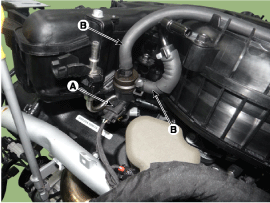
- Connect a vacuum pump to the nipple and apply vacuum.
- With the PCSV control line grounded, check whether the valve operates when battery voltage is applied to the PCSV.
Battery Voltage Valve Vacuum Connected Open Released Disconnected Close Supplied - Measure the resistance of the PCSV coil.
Specification: 22.0 ~ 26.0 ? [20 °C]
- Select "Leak Test".
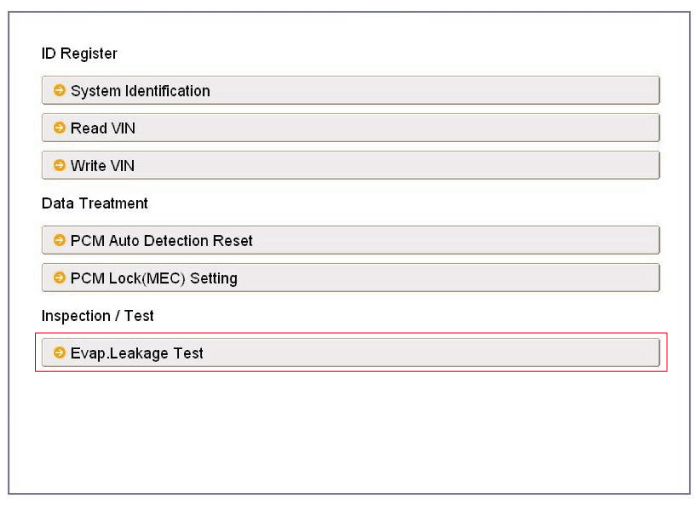
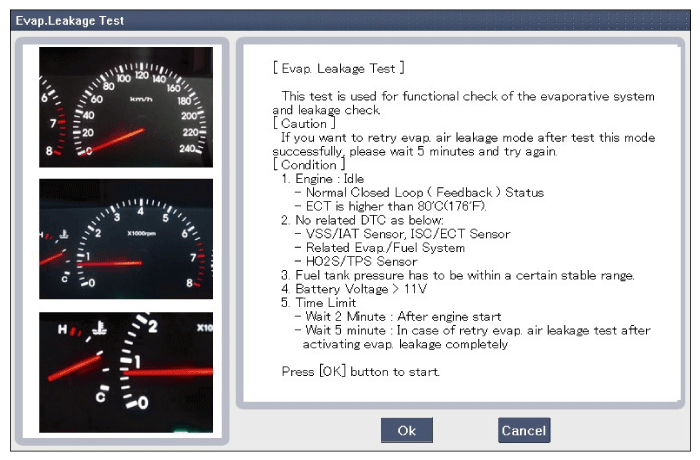
- Continue the test in accordance with the instructions on the screen.
[Leak Test Required Conditions]
- Ignition switch ON, engine idling
- No DTC present
- Fuel level: 15 ~ 85 %
- Shift lever position: P or N
- ECT: Below 105 °C
Test yourself
A quick Hyundai Genesis DH quiz: every answer comes with an explanation and a link to the manual page.
Was this page helpful?