Fuses
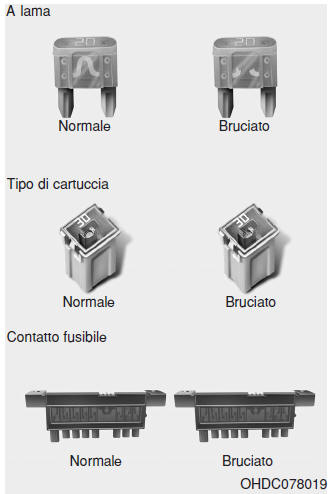
The vehicle's electrical system is protected by fuses from damage caused by electrical overloads.
This vehicle has 2 or 3 fuse panels: one in the instrument panel bracket on the driver's side, and the others in the engine compartment.
If a headlight, accessory or control does not work, check the appropriate fuse.
If a fuse is blown, its internal element has melted.
If the electrical system does not work, check the fuse panel on the driver's side first.
Before replacing a blown fuse, disconnect the negative battery cable.
Always replace a blown fuse with one of the same rating.
If the replacement fuse blows, this indicates an electrical problem. Avoid using the affected system and consult an authorized HYUNDAI dealer.
Three types of fuse are used: blade type for low amperage, cartridge type and fuse link for high amperage.
WARNING - Replacing fuses - Never replace a fuse with anything other than another fuse with the same rating. - A fuse with a higher rating can cause damage and the risk of fire. - Never insert a wire or aluminium foil in place of the correct fuse, even as a temporary repair. It can cause serious damage to the wiring and a possible fire. NOTICE Do not use a screwdriver or other metal objects to remove fuses, as they may cause a short circuit and damage the system.NOTE
The current fuse/relay panel label may differ from the supplied components.
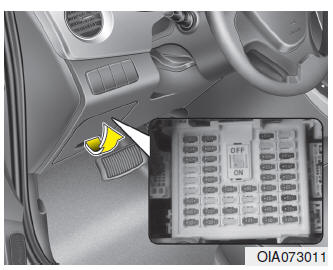
Replacing instrument panel fuses
1. Turn off the ignition switch and all other switches.
2. Open the fuse panel cover.
WARNING - When replacing a blown fuse or relay with a new one, make sure the new fuse or relay fits securely into the retainers. Incomplete seating of the fuse or relay may damage the vehicle wiring and electrical systems and may cause a fire. - Do not remove fuses, relays and terminals secured with bolts and nuts. Fuses, relays and terminals may be installed incompletely, which may cause a fire. If fuses, relays and terminals secured with bolts or nuts are blown, it is recommended that you consult an authorized HYUNDAI dealer. - Do not insert other objects such as a pin or wire, except fuses or relays, into their terminals. This may cause a contact failure or system malfunction.3. Remove the affected fuse. Use the puller tool provided in the engine compartment fuse panel.

4. Check the removed fuse and replace it if blown.
5. Install a new fuse with the same rating and make sure it fits securely into the terminals.
If it is a slow-blow fuse, it is recommended that you consult an authorized HYUNDAI dealer.
If no spare fuse is available, use a fuse with the same rating from a circuit that is not needed while driving the vehicle, such as the cigarette lighter.
If the headlights or other electrical components do not work and the fuses are intact, check the fuse panel in the engine compartment. If a fuse is blown, it must be replaced.

Fuse switch
Always set the fuse switch to ON.
If the switch is moved to OFF, some items must be reset and the transmitter (or smart key) may not operate correctly.
WARNING Always keep the fuse switch in the ON position while driving the vehicle.
Replacing engine compartment fuses
1. Turn off the ignition switch and all other switches.
2. Remove the fuse panel cover by pressing the tab and pulling upward.
3. Check the removed fuse and replace it if blown. To remove or install a fuse, use the tool provided in the engine compartment fuse panel.
4. Install a new fuse with the same rating and make sure it fits securely into the terminals.
If it is a slow-blow fuse, it is recommended that you consult an authorized HYUNDAI dealer.
WARNING After checking the fuses in the engine compartment fuse box, make sure to reinstall the fuse box cover. Otherwise, electrical problems may occur due to water entering.
Test yourself
A quick Hyundai i10 quiz: every answer comes with an explanation and a link to the manual page.