How the Car Radio Works
AM (MW, LW) and FM radio signals are broadcast from radio transmitters located throughout the city. The signals are received by the vehicle's radio antenna. The radio receives these signals and sends them to the speakers of the audio system.
If the incoming radio signal is strong enough, the modern audio system design provides the highest possible sound quality. However, in some cases the incoming signal may be weak and may be accompanied by interference. Causes may include distance from the receiving station, a high-power station nearby, or buildings, bridges, or other large structures.

AM (MW, LW) signals can be received at greater distances from the station than FM signals. This is possible because AM (MW, LW) radio waves have a lower frequency. These long-wavelength, low-frequency signals do not travel in a straight line through the atmosphere; they can follow the curvature of the earth. In addition, they bend around obstacles that block their path, which provides better reception.
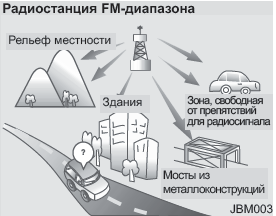
The high frequency of FM radio signals prevents them from following the curvature of the earth. Therefore, the strength of these signals normally decreases over short distances from the transmitting station. In addition, buildings, terrain, or other obstacles affect their propagation. As a result, under certain reception conditions, the radio may appear to be malfunctioning. The following reception conditions are common and do not indicate a technical malfunction.
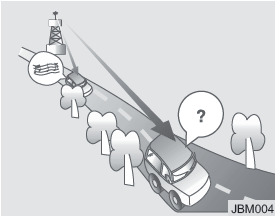
• Gradual volume reduction: as the vehicle moves away from the radio station, the strength of the received signal decreases and the volume drops. If this occurs, tune the radio to another station.
• Signal fading / radio noise:
A low FM signal strength or large obstacles between the transmitter and the car radio may cause interference, resulting in signal fading or radio noise. This effect can be reduced by lowering the high frequency level in the tone settings until the source of interference disappears.
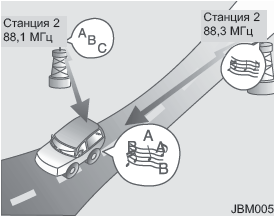
• Interference from another station: as the FM signal weakens, it may be replaced by a stronger signal from another station operating on a nearby frequency.
This happens because the radio is designed to receive the signal with the highest strength. If this occurs, tune the radio to a station with a stronger signal.
• Radio signal interference:
Receiving radio signals from several directions at the same time may cause signal distortion or fading. This is caused by simultaneous reception of the direct and reflected signal from one station, or signals from two stations operating on nearby frequencies.
If this occurs, tune the radio to another station until the reception conditions change.
Use of Mobile Phones or Two-Way Radios
Using a mobile phone inside the vehicle may cause noise in the audio system. This does not indicate a malfunction. In this case, use the mobile phone as far as possible from the audio system.
Using a mobile phone or two-way radio only with their built-in antennas may disrupt the normal operation of the vehicle's electrical system and adversely affect driving safety.
CAUTION
Do not use a mobile phone while driving. To use a mobile phone, stop the vehicle in a safe location.
Test yourself
A quick Hyundai Solaris quiz: every answer comes with an explanation and a link to the manual page.